


University of North Carolina Athletics
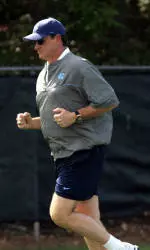
Lucas: Tempo A Teaching Tool
April 13, 2007 | Football
April 13, 2007
By Adam Lucas
The best measure of how things have changed during Butch Davis's first month on the Carolina football practice field came following Thursday afternoon's spring practice session at Kenan Stadium.
Bobby Rome was asked a question about Davis's preference for speed. This seems like a reasonable question. To most people, speed on a football field means 40 times and shuttle runs.
Not to Tar Heel football players. They've undergone such an indoctrination that when the coaching staff showed them film on Monday of a practice session from several weeks earlier, there was a substantial amount of giggling among the players as they watched their previous performance. It looked like a different team; maybe, in some ways, it was a different team.
"Coach Davis wants a lot more speed," Rome said. "You can see it in the way he's moved players around. He's taken guys who might have been average speed at a bigger position and moved them to a smaller position, so now they can use their speed better."
Those are the changes that will be obvious when Carolina takes the field for the spring game Saturday at noon. It's deluxe athlete Shaun Draughn getting more repetitions with the first team at safety or Rome himself being moved from fullback to H-back, where the Tar Heels will try to take advantage of his athletic ability by putting him in motion and lining him up at various places on the field. Lee Pace's excellent piece in the upcoming issue of Tar Heel Monthly details the way the new staff has implemented their emphasis on speed from the conditioning program to the practice field.
But in Davis's system, speed also means tempo. This is something that is in the handbook of every newly hired football coach in America. It is a required part of every introductory press conference and it's one of the first things they all say: "Things are going to move faster on the practice field."
Usually, though, they say it and then it disappears around the first month of workouts. Davis, in contrast said it--and now he's doing it.
"It moves so much faster," Rome said. "When we go from drill to drill, everything is full speed. Meetings are faster. Even water breaks are a lot faster."
"Everything is done to the second," safety Trimane Goddard said. "Even in the weight room. You get your set in, you take the proper rest, then you get your next set in. Coach Davis wants everything on a certain schedule, and that makes sure everyone is always alert."
With very few exceptions, practices now last approximately two hours, a significant trimming of on-field time. Last week, the Tar Heels ran nearly 50 scrimmage plays in less than 40 minutes, which qualifies as Autobahn-like speed given that they're still trying to install new offenses and defenses.
Every second is tracked by a new addition to the practice field--a digital clock that counts down the time remaining in each period of practice.
"That clock helps a lot," Rome said. "When we didn't have a clock, there were times you wondered how much time was left and whether you needed to save some energy in case it got long. Now, you look up there and see there are three minutes left and you think, `Hey, I can bust my tail for three minutes.' You don't mind giving everything you've got because you know exactly how long you're going to be out here. You do it right, you get it done, and you're out of here."
Rome might not know it, but he's hit on one of Davis's central teaching points. Football is supposed to be fun. So he wants his players to leave the Kenan Football Center eager to return, and he wants them to walk in the door the next day eager to get back on the field. Long practices lead to long faces, which leads to wasted time, which is right up there with needless personal foul penalties in the Davis handbook of forbidden follies.
Davis has a hard time suppressing a smile as he explains the way the breakneck tempo on the practice field translates to Kenan Stadium on game day.
"When the game is played we will change personnel groupings potentially every play, so we need everyone to be focused and alert," the head coach said. "We have to be able to get to the line of scrimmage and in and out of the huddle. It's a fast pace, and it puts a lot of pressure on the defense from an offensive perspective.
"It also helps because even though it's not a two-minute situation, it's at such a high tempo that you have to be prepared for the ball to be snapped every 25 seconds instead of every 45 seconds. It forces communication. Guys have to communicate a great deal either through hand signals or verbally."
Defensive coordinator Chuck Pagano has worked with Davis for a dozen years, so he's already familiar with the required tempo...and with the potential benefits.
"We're going to push them in practice and use a pace that will make game day seem slow," he said. "During games, we want them to be like, `Where's the offense? Why aren't they running another play?'"
Of course, speed without organization only leads to wasting time more quickly. Basketball coach Roy Williams bristles when his style is described as simply "play fast." That's not the full and correct description--he demands playing fast and under control.
That philosophy dovetails nicely with Davis's preferred methods. He demands efficiency, but he also gives his players the tools to succeed at a faster tempo. Traditionally, the spring game has marked the end of spring practice. Not this year. Teams are allowed 15 spring practices, and the Tar Heels will be on the field for the 14th time tomorrow. Their 15th practice will be saved for Monday as the squad prepares for a long offseason with no on-field coaching allowed.
"We intentionally saved a practice because we want to come out and show them what we expect from them over the next three months," Davis said. "We'll go through one-on-ones, individual routes, and what we want from them when we're not here."
He's been on the job for 20 weeks and Butch Davis has already planned to knock out walls in his office, totally redesign the locker room and weight room, and tweak the uniforms. He walks the building at least once a week to identify potential problem areas that could be as small as a photograph hanging askew.
Change is coming to Carolina football, and it's coming the only way he knows how to make it:
Quickly and efficiently.
Adam Lucas's third book on Carolina basketball, The Best Game Ever, chronicles the 1957 national championship season and is available now. His previous books include Going Home Again, focusing on Roy Williams's return to Carolina, and Led By Their Dreams, a collaboration with Steve Kirschner and Matt Bowers on the 2005 championship team.

Players Mentioned


