University of North Carolina Athletics
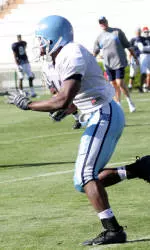
Lucas: Williams More Than Just Good Story
August 23, 2007 | Football
Aug. 23, 2007
By Adam Lucas
It's easy to get swept up in the Kendric Williams story.
Consider: he's a walk-on who has gone from deep on the depth chart to scholarship starter. He's a military brat who lived all over the country--and the world--while growing up, and still can speak a bit of Japanese as evidence of his two years living in Okinawa. He's a psychology major who picked that course of study because he intends to go to law school. He's got a catchy nickname, T-37, that adorns the shirts of his family at every Tar Heel game.
That's the Kendric Williams story. But there is also this piece, and this is a piece that's too often forgotten, that seems to slip unnoticed beneath all the other storybook trappings:
Kendric Williams is a good football player.
Barring something unexpected, he will start at cornerback in the season opener against James Madison on Sept. 1. He has never played a single down on defense in his Carolina career, yet he's held the starting position throughout camp virtually without challenge.
"He has great explosiveness and he's an excellent athlete," Butch Davis says. "At corner, you're looking for a guy with great feet and great transition speed. He can get in and out of his cuts."
"He's been on everybody like glue," says fellow defensive back and roommate Jabir Jones. "You can't throw anything on him. He has an uncanny sense for finding the ball."
For the previous two seasons, Williams has used that speed--Jones calls him the fastest player on the team in pads--exclusively on special teams. He was a kick-blocking phenom in spring practice of 2006 and made 3 tackles last season.
But after playing tailback in high school, he could never crack the depth chart at corner--until Davis's arrival.
This is nothing new for Davis. After Williams's vagabond childhood, with his family following his Marine father around the nation and beyond, he had flown under the recruiting radar even after settling in Charlotte in 2002. That forced him to walk on at Carolina, which he picked largely because of the academics. A gifted arguer who is known to engage in half-hour disputes with his roommates over the merits of the PlayStation3 against the Xbox 360, he spent much of his freshman season contemplating ditching football to focus on his studies.
Davis didn't know any of that background. He made a point of watching as little film as possible of his new team prior to spring 2007, preferring instead to form his own first-hand impressions.
"When walk-ons come here, once they are on the football team I could care less whether they're here on a Pell grant, the GI Bill, Uncle Sam, or their Mom and Dad paying the way," Davis says. "Once they get here, the best players will play. They always have the chance to earn a scholarship here."
His history proves it. Necessity originally forced him down the walk-on path--faced with scholarship restrictions at Miami, he had to be creative in pursuing talent. That led him to an untapped pipeline, and he turned a handful of former walk-ons into NFL players.
There's a similar tradition at Carolina, where the patron saint of walk-ons is probably David Thornton, who went from oversized defensive back to making 15 tackles at Oklahoma in his first start to a fourth-round draft pick to a $22.5 million contract with the Tennessee Titans. It's not an easy path; Jones, one of Williams's fellow walk-ons, describes it as "inner warfare every day, because you just have to trust your abilities since you're doing a lot of hard work every day without the same privileges other people are getting."
Those privileges are mandated by the NCAA. Once classes begin, walk-ons can no longer eat at the training table beside their scholarship brethren. And, of course, there's the financial aspect of paying for the privilege of spending significant hours each week on the practice field.
"At Miami, we had a lot of players who were looking at their options," Davis says. "Joaquin Gonzalez turned down the Ivy League. We had guys looking at mid-level Division I offers. They knew if they came to the University of Miami and demonstrated they could contribute to the program, they would have a chance to earn a scholarship and play for a top-10 or top-15 program. We would love to develop that same reputation here. We will give walk-ons a great opportunity."
That first opportunity went to Williams, who was awarded a scholarship at the first meeting of training camp.
"The first person I called was my mom," Williams says. "She was screaming and crying. She was probably more excited than me--of course, that's probably because she'd had to put up the money. I talked to my dad at the same time, and then I called my uncle. Before the night was over my mom had called my whole family, because I started getting calls from aunts, cousins, and everybody."
The next time they call, it'll likely be with the intention of congratulating him on his defensive debut in the opener. Mention trotting onto the field as a starter against the Dukes, though, and Williams just shakes his head.
"I'm living a dream right now," he says, "and I haven't even played a down."
Adam Lucas most recently collaborated on a behind-the-scenes look at Carolina Basketball with Wes Miller. The Road To Blue Heaven will be released on September 1. Lucas's other books on Carolina basketball include The Best Game Ever, which chronicles the 1957 national championship season, Going Home Again, which focuses on Roy Williams's return to Carolina, and Led By Their Dreams, a collaboration with Steve Kirschner and Matt Bowers on the 2005 championship team.