University of North Carolina Athletics
THM: Davis Oversees Extreme Makeover
August 28, 2007 | Football
Aug. 28, 2007
Tar Heel Monthly is the premier magazine devoted to the stories and personalities behind UNC athletics and is one of the only full-color, all-glossy college sports publications in the country. It is delivered free to all Rams Club members or click here for subscription details.
The following story originally ran in the September 2007 issue of the magazine.
By Adam Lucas
In the summer of 1979, his first offseason as an Oklahoma State assistant coach, Butch Davis was given an assignment that would turn out to be the perfect preparation for his future stint as North Carolina's head coach. Davis had spent six seasons at the high school level, moving from a volunteer assistant to a prep head coach, and was excited to move up to big-time college football.
And how did he discover coaches spent their offseason in the big-time?
"I helped paint the locker room," Davis remembers. "We painted some stripes and painted the lockers. When I was a high school coach, I quickly learned I had to be my own fundraiser. Doing that job, you learn to paint rooms, build things, and drive the school bus. Over the years, through a combination of experience, you start to learn what makes a difference in winning and losing."
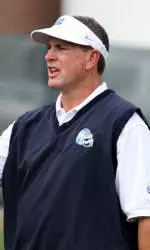
In Chapel Hill, he won't have to drive the team bus or paint the walls in the locker room himself. But since Davis was introduced as Carolina's 33rd head coach on November 27, 2006, he's overseen a significant overhaul of the football program. Sure, he and his coaching staff have installed a new offense and new defense. That's a part of every new coach's job description.
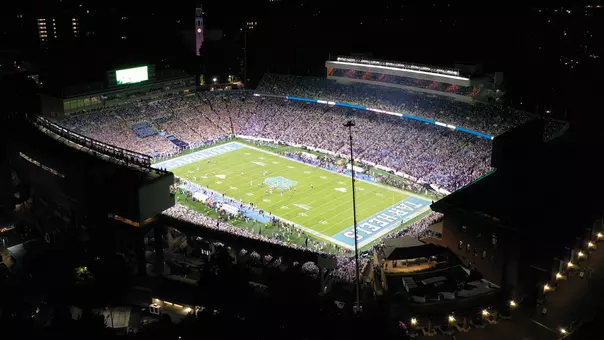
Davis's contributions have gone beyond the tactical. And when nearly 60,000 Carolina football fans make the pilgrimage to Chapel Hill on September 1 for what amounts to Davis's inauguration as head coach, they'll see several visual examples of the changes he's made in his ten months on the job. Other modifications will be more subtle, lurking just below the surface of a Carolina football game day.
Put them together, though, and the result is an extreme makeover, Carolina football style.
Dick Baddour walked into a senior staff meeting in late October 2006 with some jarring news.
Carolina football was at a nadir. The Tar Heels had just been thumped, 23-0, on national television by a struggling Virginia team. Their last appearance at ostensibly friendly Kenan Stadium had been a 37-20 defeat to South Florida; more sobering than the score was the fact that attendance was announced at just 44,000 on a sunny, 60-degree day made for football.
A few days earlier, Baddour had announced the end of John Bunting's Carolina coaching career, a painful severing of a family tie.
And now the athletic director had a message for his senior staff, the associate athletic directors charged with helping pilot all facets of the athletic department.
"There will be a major hire for football," Baddour said. "I want everyone, within your department, preparing to do everything possible to support a major hire for football. And I want everyone preparing to do everything possible to take advantage of a major hire for football."
They were bold words. At the time, there was little evidence to suggest Carolina could pull off a hire that would be termed major. Bunting had been a calculated risk candidate. His predecessor, Carl Torbush, was elevated from within. His predecessor, Mack Brown, was plucked from Tulane and at the time didn't meet the description of "major."
Now Baddour was promising a first-choice candidate that would send a clear signal about Carolina's football intentions. The group immediately acted on the charge they had been given.
An informal football planning task force was formed. It included representatives from marketing, communications, tickets, the Rams Club, gameday operations, and the football office. The group reported directly to Baddour, who also occasionally participated in meetings.
 The team entrance will be trimmed down--with a focus on football--in 2007.  |
|
The task was simple: take everything you know about Carolina football. Update it, modernize it, and prepare to bring the entire program to the level of the coach that would soon be hired. A month later, when Davis was hired, the group gained another resource. Davis has coached at Miami and the NFL and has definite ideas about the way to run a first-class program. His reach stretches from his Kenan Football Center office over every aspect of the football program, from logos (he likes the one that includes the Tar Heel helmet rather than the generic "NC") to the structure of the locker room (the old format was ripped out; a new, more inclusive setup was installed for the start of training camp).
"Our goal is not to change the culture here," says Michael Beale, Carolina's assistant director of athletics for marketing. "We are not going to change Carolina to fit big-time football. We are going to push the envelope, try to create new traditions, and change big-time football to fit Carolina."
Some of those changes will be evident before fans ever set foot inside Kenan Stadium for the season opener. A series of meetings with the town of Chapel Hill produced a somewhat surprising result: everyone was in agreement that football could thrive in a small town trying desperately to preserve its quaint status while also seeking to capitalize on the benefits of major college football.
A thriving football program benefits Franklin Street merchants who see increased sales. It benefits the athletic department through increased ticket sales. And it benefits the University by providing six or seven weekends per year for alums to return to campus and fall in love again with UNC.
In the past, those groups had occasionally been in conflict about the best way to help fans enjoy the experience. The task force has smoothed some of those relationships and laid the foundation for a change in the way football is presented in Chapel Hill.
"We want to do everything we can for 2007," says Rick Steinbacher, the associate athletic director for marketing and promotions. "But we also want to have great relationships with all the groups involved so we can keep working on this for long-term solutions. We're not trying to push through a one-year agenda. We're looking for win-win ways to make gameday a better experience for everyone involved over a long period of time."
Steinbacher made a trip to the University of Georgia during the 2006 football season to see how a similar institution with some similar challenges presented football game day. Some of the Bulldogs' ideas wouldn't work in Chapel Hill; others were tweaked to make them Carolina-appropriate.
One Georgia feature that made it an appealing case study was the fact that Sanford Stadium is an on-campus facility, which creates the same parking issues in Athens faced in Chapel Hill. As Steinbacher puts it, "The greatest thing about our stadium is that it's smack in the middle of campus. And one of our biggest challenges is that our stadium is smack in the middle of campus."
Kenan isn't going anywhere, and neither is the rest of campus. So after careful consultation with the University, over 1,000 new parking spaces were added to game day parking availability for 2007. They're not part of a secret new parking deck. Instead, they're pre-existing spaces that were previously not made available to the athletic department.
Athletics also combined forces with the town to create the Fifth Quarter bus service. The round-trip bus service will pick up at two locations and give patrons three options: Franklin Street, Tar Heel Town, and Kenan Stadium. The hope is that whether a family wants to play games at Tar Heel Town, a group of young alums want to revisit Franklin Street haunts, or football die-hards want to get to Kenan when the gates open, the Fifth Quarter service will have something for everyone.
Getting fans to Chapel Hill is the first part of the equation. The next--physically getting them inside the stadium--has been a Carolina bugaboo for several years. In the down years, it hasn't been uncommon for kickoff to take place with several thousand empty shiny metal bleachers as fans are slow to file into Kenan.
 Rams Club members have already received their copy, and the THM football preview issue is available to new subscribers for four more days. |
|
The ticket office asked student groups if they'd be interested in moving to the west end zone. Students jumped at the idea, which will centralize most of the student population. The band--which has a completely new set of instruments courtesy of a sizable purchase by the athletic department--has been repositioned from the sideline to the end zone directly above the home tunnel, where the hope is their sound will spread more evenly through the stadium.
Kellan White, the chairman of student spirit group Carolina Fever, looked at the new seating plan and saw potential. He's predisposed to that outlook, of course. His positive outlook is the type that looks at Carolina's 2007 schedule and says, "I don't see why we can't be this year's Wake Forest. Where were they picked in the preseason last year? Last? We can do exactly what they did."
What they did, of course, was win the ACC championship and participate in the Orange Bowl. That's a steep challenge, but White's goals are even loftier: he wants to make Carolina football cool again among the student body.
Working off the new seating arrangement, White and a band of students labeled the west end zone "The Tar Pit" in the hopes of giving personality and caché to the west end zone.
"We want to give students something they can call their own," White says. "We want students to say, `The Tar Pit belongs to us.' It will be run by the students and we want to turn it into a section of the stadium that gives our team a competitive edge. I want students to take pride in it."
In another example of University synergy, the student-led initiative has received the full backing of the athletic department. Students will be in control of The Tar Pit, and as long as it's handled in good taste, athletics will support it.
Students seated in The Tar Pit will be the beneficiaries of one of the most obvious changes to Kenan Stadium: a significant investment in rock concert-quality speakers for that area of the stadium.
"Coach Davis was very big on a good sound system," Steinbacher says. "With stadium expansion on the horizon, we can't make long-term changes to our speakers right now. Eighty-five percent of our sound is provided by the video board sound system. It's very unbalanced, because if you sit close to the video board you're being blown away and if you sit in the end zone you're not hearing enough.
"So as a temporary fix we are basically putting rock concert speakers in the enclosed end zone. It should make that end zone a lot louder, and it also enables us to turn down the video board so we're not blowing people away in that end zone."
Exactly what those speakers will play has been the topic of frequent debate. Davis leans toward a playlist heavy on rock. Expect to hear Phil Collins's "In the Air Tonight" during team flex and AC/DC's "Thunderstruck" at the same time during every pregame warmup session. He used the same idea at Miami; the intention is to give fans--especially fans outside the gates--an audible cue that reminds them how long remains until kickoff. If the Pavlovian theory works, by November 2007 you won't be able to hear those familiar opening strains of "In the Air Tonight" without feeling the impulse to look around for a group of players going through pregame drills.
The team entrance will take on similar trappings. After several years of a lengthy entrance video, this year's video will be pared down. The volume on the speakers will be turned up, a hard-hitting song will rock Kenan, and the team will race onto the field. No elaborate cartoons. No lasers. No gimmicks.
It's a decidedly big-time football approach. But everyone involved has also made a conscious effort to make sure the key element remains football, not a razzle-dazzle spectacle.
"The focus is the Carolina football team," Steinbacher says. "Everything else we do should supplement the team. Our team entrance won't be a show. It will be a football team. We don't want people fired up about a show. We want them fired up about the fact that Carolina is getting ready to play football."
Left unspoken is the fact that all the task forces in the world won't impact the one biggest feature of a successful gameday environment: winning. It all comes back to that fourth-floor office in the Kenan Football Center, where Davis is sitting in front of you outlining his plan for a winning program. He has a meeting with Nike in two weeks to discuss potential uniform changes. Plans are on the drawing board for a dramatic Kenan Stadium expansion. With the luxury of a full recruiting year, his staff plans an even more impressive haul than last February's star-studded class. He gives the distinct impression that he's more than a football coach--he's also a CEO.
But he's a CEO with a clear understanding of what determines his job status.
"The reason you choose to be a coach is to be a coach and spend time with your players," he says. "In any transition, the first year is the most important because you're juggling a lot of things. Eighty percent of the outside stuff gets done in the first year. After that, we can focus more on the football part of it. Right now, we have a lot of things to do to make Carolina the aggressive, full-out football team and classy program we want it to be.
"If there's a way we can make this program better in any way, it's my obligation to do it."
Adam Lucas most recently collaborated on a behind-the-scenes look at Carolina Basketball with Wes Miller. The Road To Blue Heaven will be released on September 1. Lucas's other books on Carolina basketball include The Best Game Ever, which chronicles the 1957 national championship season, Going Home Again, which focuses on Roy Williams's return to Carolina, and Led By Their Dreams, a collaboration with Steve Kirschner and Matt Bowers on the 2005 championship team.