University of North Carolina Athletics
Extra Points: Another Twist & Turn To Heated Rivalry
September 10, 2007 | Football
Sept. 9, 2007
by Lee Pace, Extra Points
The 11 football encounters between Carolina and East Carolina have been marked by any number of milepost moments and heroic performances, beginning perhaps with Pirate Eddie Hicks scoring three touchdowns as coach Pat Dye's "skinny legged kids" hammered the Tar Heels 38-17 in 1975.
There was Kelvin Bryant's six-touchdown rushing output in Carolina's 56-0 win in 1981, just days after the spying caper in which an East Carolina assistant coach was nabbed watching Tar Heel practices and making notes from the UNC Law School library. The North Carolina State Legislature ran a good power game in the mid-1990s, suggesting that Carolina should put the Pirates back on their schedule and avoid any ugly haranguing over funding for the Chapel Hill campus. And who in Kenan Stadium in 2001 will forget Tar Heel Derrick Johnson racing from behind to strip the ball from Pirate Art Brown near the goal-line, turning a sure touchdown into Carolina's ball and helping secure a 24-21 Tar Heel win?
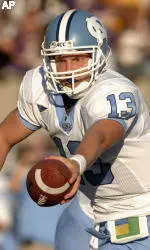
Saturday night before a rowdy and full house at Dowdy-Ficklen Stadium, Pirate Ben Hartman stood up to the specter of having missed three field goals already, stared down his demons and calmly nailed a 39-yarder at the gun to lift the Pirates to a 34-31 win over the Tar Heels. The field goal ended a lively evening that included stouthearted performances by quarterbacks T.J. Yates of the Tar Heels and Patrick Pinkney of the Pirates, wicked hits by both defenses, interesting slight-of-hand moves by both offensive coordinators, and stirring scoring plays of 78, 37, 39, 24, 51 and 58 yards.
"What a game ... what a game," Pirate coach Skip Holtz marveled afterward.
"There's a good possibility all the games this year have a chance to be very much like this," Carolina coach Butch Davis said. "They're all going to be knock-down, drag-outs."
The Tar Heels and Pirates played eight times from 1972-81, then took a two-decade hiatus when Carolina's administration decided to play no in-state schools in football or basketball outside of its ACC rivals N.C. State, Duke and Wake Forest. East Carolina chafed as it attempted to build its program on regional and national levels and watched as the Tar Heels scheduled colorless home games in the 1990s against the likes of TCU, Texas-El Paso and Ohio University. The schools announced in 1995 they would again play football in 2001 and '03, with John Swofford, the Tar Heel athletic director at the time, saying the decision was for the good of the institution and outside the realm of any athletic department issues. Four more games were added several years ago for the 2007, '09, '10 and '11 football seasons.
Whether these games are good for the Tar Heels as Davis works toward his goal getting Carolina into contention for a national title is a discussion for another day. Davis contended for a national title at Miami, and the Tar Heels under Mack Brown fielded back-to-back Top 10 squads a decade ago, so the coaching wherewithal and institutional capability are secure. It's a matter of time before they coalesce into something special around Kenan Stadium.
But these games with East Carolina are certainly fun for the fans. Anyone with an appreciation for the spectacle of college football wandering the Greenville campus Saturday, breathing the aroma of Down East barbecue and hearing the strains of beach music was certainly fortified. East Carolina plays to the hilt its regional heritage of Blackbeard and Major Stede Bonnet plundering along the coast; a Johnny Depp look-alike Pirate leads the team onto the field amidst a cloud of purple smoke to the music of Jimi Hendrix's "Purple Haze."
"This game is their Super Bowl," noted Tar Heel Kentwan Balmer, who grew up in Eastern North Carolina in the town of Weldon and witnessed the 2003 UNC at ECU game as a Pirate recruit. "The atmosphere will be hostile. Everyone will be up for North Carolina. It'll be us against the world. I love that kind of environment. We'll feed off their crowd. We won't back down."
In this space last week I gladly joined in the chortling over the successes of the 37-14 win over James Madison but also cautioned over too much cart-wheeling. There are many elements of this team that need to mature and evolve, and Saturday night's game was Exhibit A.
The Tar Heels had too many blown assignments among the linebacker and secondary corps, where they have five neophyte starters among seven total. Quarterback T.J. Yates and the center misconnected on a damaging exchange in the fourth quarter. A Tar Heel was called for offside on a successful on-side kick attempt. Connor Barth had an extra point partially blocked when holder Ryan Baucom was slow to get the ball placed, and later Baucom fumbled the snap on a late-game field goal try. Carolina's kick-off cover team, which played well in the opener, allowed returns of 44 and 63 yards. Punter Terrence Brown was impressive against JMU but managed only 38.3 yards in six kicks; a 34-yard punt from his own end zone early in the second half set up the Pirates with great field position en route to a touchdown. The Tar Heels lost one fumble and one interception and were dominated in time of possession--36 minutes to 24 for the game and 10 to five in the second quarter.
"You can't win football games turning the ball over, giving up big plays in special teams, giving up big plays defensively," Davis said Saturday night after the game.
Sunday, having reviewed the tape and after meeting with his coaching staff, Davis pointed out the Pirates' excellent average starting field position on their 41 yard line and more than a hundred yards of offense ECU gained after initial contact by a Tar Heel. The former issue was due to poor kick-off coverage, the latter to sloppy tackling. In the second half, the Pirates started drives at the Tar Heel 38, 31 and 17 yard lines.
"We did a poor job containing the football with our kick-off cover unit," Davis said. "We can't have that inconsistency.

"Defensively, I was disappointed in the number of missed tackles. We missed contact, we missed the tackle, they ran after contact. Instead of second-and-eight, they had second-and-three."
One positive for the Tar Heels was the overall performance of the offense, which had 423 yards total production and 6.6 yards per snap. They connected on big plays--Hakeem Nicks scored on a 37-yard pass, and Brandon Tate scored on 51 and 39-yard passes. And they connected on a variety of screen passes designed to attack the Pirates' aggressive front seven. Tailback Johnny White had four catches for 58 yards, and fullback Bobby Rome had two for 59 yards. White had 101 all-purpose yards with 43 more on the ground.
"They were bringing a lot of blitzes, twisting along the line, rushing up field, and that gave us a chance to utilize the screen and hit them in their weak spots," center Scott Lenahan said.
"They came with big guys and linebackers," Yates added. "The screens were the best way to take advantage of it."
Most impressive from the quarterback's perspective was Yates' improving ability to fend off the rush, maintain his composure and find a receiver open downfield. And, in only his second college game, he showed a fiery and combative side on the sideline as he attempted to pump up his offensive mates prior to a late-game possession.
"Every game, every practice I get a little more comfortable in the pocket," Yates said. "I'm learning to not worry about the defense, just look downfield."
The Tar Heels had a good experience in their opener a week ago, tested some newcomers and had their first taste of combat together as a team and staff. But Saturday the stakes and the degree of competition were ratcheted up a few notches. The offense played against a strong, athletic and deep front seven, a unit that included former Tar Heel defensive tackle Khalif Mitchell. The defense and special teams faced players with more speed than those on JMU's roster. The trip to Greenville was the first road game for 27 players competing in only their second college game, and it was a rowdy and intensely anti-Tar Heel environment at that.
"You can't have turnovers, you can't have penalties, you can't have missed opportunities," Davis said. "You can't have dropped passes. They were a major factor in the ball game. We saw some good, positive things. Unfortunately, there were enough negative things that we weren't able to get the win."
The victory for the Pirates was their first over the Tar Heels since that 1975 upset engineered by coach Pat Dye. What is important and interesting to note about the series is that during seasons in which the Tar Heels challenged for the ACC title and also played the Pirates, they have had little or no trouble with East Carolina. The 1972 Carolina team finished 11-1 overall and won the ACC title; the Tar Heels that year pounded ECU 42-19. The 1980 team won the ACC title with an 11-1 overall mark and hammered the Pirates 31-3. And the 1981 team was 10-2, finished second to Clemson for the ACC title and romped over the Pirates behind Bryant, 56-0.
Chapel Hill writer Lee Pace is in his 18th season writing "Extra Points," a colorful and in-depth look at Tar Heel football. He'll answer your questions about the Tar Heels regularly during the season in his "Extra Points Mailbag" column and on the Tar Heel Sports Network's pregame show. Email him your questions (please, no recruiting questions) about the Tar Heels at leepace@nc.rr.com and he'll answer the most interesting ones.