University of North Carolina Athletics
Lucas: Euwell Completes Amazing Comeback
October 29, 2008 | Football, Featured Writers, Adam Lucas
Oct. 29, 2008
By Adam Lucas
Just days before Linwan Euwell's college football career was supposed to begin, he was afraid his football career might be over.
In the fall of 2007, Euwell had ascended to the second-string SAM linebacker and was being groomed to receive immediate playing time.
"I was really excited," Euwell remembers. "I was starting to show what I can do."
What the Pinetops, N.C., native can do is play with the combination of size and speed that Butch Davis loves. At 6-foot-2, 220 pounds, he's also the perfect special teams candidate, which is where the Tar Heels were going to use him in the fall of 2007, along with spot duty at linebacker.
Until one day in practice that Euwell tried to back up on a pass play and felt his knee lock. And then he felt his knee twist. And then he felt...nothing.
"I couldn't feel my knee," he remembers. "My whole leg was numb."
Euwell had dislocated his left knee, which is much more serious than dislocating a kneecap. The knee contains four major ligaments. He had completely torn three of them and partially tore the fourth.
His hopes of playing as a true freshman were gone. Now his best hope was simply to retain the hope of maybe--maybe--being able to get on the football field again.
"We've probably only had four to six of those injuries since I've been here," says Dr. Tim Taft, Carolina's director of sports medicine, who started working at Carolina in 1973. "According to data from two years ago, roughly ten percent of the Americans with this injury end up with leg amputations. It is potentially a catastrophic injury."
Euwell was lucky, because Taft had previously treated that exact type of injury successfully before. Former lineman Darrell Hamilton suffered the same injury and eventually became an NFL Draft pick.
"The injury was as bad an injury as you can have to your knee," says Tar Heel football trainer Scott Trulock. "This was not your run of the mill injury. We're very fortunate to have a surgeon like Dr. Taft who has done these before, because you don't run across them every day."
"This is a very serious injury," Taft told Euwell. "But I've seen people come back from it before."
That was all Euwell needed to hear.
"Once he told me he'd seen people come back, that was when I set my mind that I was coming back," says Euwell.
That meant long hours in the training room. For a Division I caliber football player, the rehab isn't particularly physically taxing. They're accustomed to doing extraordinary things with their bodies.
But the mental part breaks many athletes. It's one thing to go into the training room and do one-legged squats--the exercise Euwell cites as the toughest of his rehab--for 10 minutes on one day. It's much more difficult to go back and keep doing them repeatedly, day after day, with no prospect of returning to the field anytime soon.
"There were plenty of days when I'd wake up in the morning and think, `Is this worth it?'" says Euwell. "I felt like every time I took a step forward I would take two steps back. I could have taken a medical hardship and called it quits. But every time that happened, my grandma would call me and tell me to keep the faith. And I knew that if it hurt, I had to push through the pain."
Every day, he recited Philippians 4:13. And every day, he drew a little closer to becoming a college football player again.
"I don't know if I've seen anyone embrace rehab with a more positive attitude than Linwan," says Butch Davis. "He was such a diligent worker that he put himself two to three months ahead of schedule. There was a time when they told him he probably wouldn't play again until 2009."
Slowly, Euwell began to realize he'd be ready well before 2009. In the locker room, he felt comfortable horseplaying with his teammates, jumping around without considering what it might do to his knee. On the field during this summer's training camp, he ran down a ballcarrier and realized only on his way back to the huddle that his knee brace had fallen down to his ankle, leaving his knee unprotected.
Just like the fall of 2007, he began to climb back up the depth chart. He started to appear on the Tar Heel injury report as "doubtful," which qualified as a major success. He spent time with the scout team in practice, earning praise from Davis for his enthusiastic attitude and willingness to contribute to the team in any way possible.
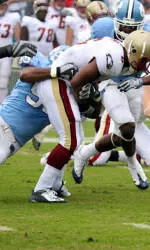
Then, before the Boston College game, he found himself on the first-string kickoff coverage unit. The Tar Heels kicked off to open the game, putting Euwell on the field for the afternoon's first play. He lined up in one of the inside slots, meaning he had to navigate through the most traffic.
With the ball in the air, he threw aside one blocker and then hurled Jeff Smith to the ground.
Less than a year later, against even the most optimistic prognostications, he was back. One play, one tackle.
It's become fashionable for special teams members to celebrate wildly when they make a play. Sometimes, it's a little much.
This time, it was just right.
Euwell bounced up and pumped his arms. He received a smack on the helmet from Johnny White, and then another from Kendric Burney. When he reached the sideline, he was greeted as if he'd just scored the winning touchdown.
"What was it like?" Euwell says with a wide grin. "It was like Christmas when you're five years old, and you see that toy you've always wanted under the tree."
"On the sideline, we were zeroed in on him," Trulock says. "We deal with injured players every day, and this is someone who was absolutely unwavering in his commitment to the process, without any guarantees of what the outcome might be. It was an emotional moment for me and my staff. This is someone who has defied the odds of what would normally be expected. It's a good lesson for all of us in courage and faith and what is possible."
Adam Lucas is the publisher of Tar Heel Monthly. He is also the author or co-author of four books on Carolina basketball.