University of North Carolina Athletics
Lucas: This Is The Dream
December 11, 2008 | Football, Featured Writers, Adam Lucas
Dec. 11, 2008
The following story originally ran in the December 2008 issue of Tar Heel Monthly, which is a member benefit received by all Rams Club members.
By Adam Lucas
This is the dream.
No.
This is The Dream.
This is Hakeem Nicks, Carolina's junior wide receiver, and he has a dream. It is his dream, and it is his brother's dream, and it is his father's dream, and it is his mother's dream, and it is his grandmother's dream, and it is the middle schooler in West Charlotte's dream, and who knows, maybe it is even your dream.
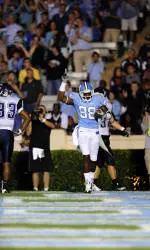
They are counting on him. And that is why, as he cruises down the Kenan Stadium sideline for yet another reception, yet another touchdown, it gets cheers from Carolina fans but it gets something more from places that are very different.
Inside Allenwood Federal Prison in Longwood, Pa.: "That is The Dream!"
Inside Yummy's Restaurant on Market Street in Harrisburg, Pa.: "That is The Dream!"
Inside a house in Charlotte: "That is The Dream!"
Inside the Curran-Fromhold Correctional Facility in Philadelphia: "That is The Dream!"
This is what Hakeem Nicks means to his family. For so long, he has been The Dream. Now, he is very close to being the dream. Which would you rather be?
They called him that almost from the beginning. He was the son of a mother who was too young and a father who was too wild. By the time he was five, he had just two options remaining: foster care or someone who cared.
That's when Dorchina Urrutia began saving her grandson's life. Hakeem moved into her home in Harrisburg, Pa., where Urrutia provided non-medical home care. She was accustomed to taking in those who couldn't find someone to care. Not too long ago, she'd taken in a baby girl named Mary Lou who had been left on a doorstep. The baby was white and her mental acuity would slowly decline over the next two decades, but Urrutia didn't care.
"They tried to take her away from me one time because she was Caucasian and I was black," she says, sounding miffed. "I told them that was not going to happen."
You get the impression that when Dorchina Urrutia tells someone something isn't going to happen, it doesn't happen. In school, when teachers asked Hakeem to draw a picture of his family, he included Mary Lou.
Hakeem has two older brothers, Robert and Alees, who remained in Charlotte rather than moving to Harrisburg. This is the part where we are supposed to say they never had a chance. Not in that neighborhood, where there was alcohol and drugs and guns and fists.
Robert and Alees--especially Robert--got into that house and they could not get out. The pull was too strong. They lived on the west side of Charlotte near Statesville Avenue, a place Hakeem describes this way: "You see drugs. You see people getting robbed. You stop thinking things like that are unusual."
Robert and Alees became a product of their environment. Hakeem did not. Hakeem became a product of...what, exactly?
Love, perhaps?
While Robert and Alees were learning to provide for themselves by any means necessary in Charlotte, Hakeem was ordering Shirley Temples (ingredients: oranges, cherries, Sprite) at a restaurant called Crockenberry's in Harrisburg.
The waiter would take his order.
"One Shirley Temple, please," Hakeem would say.
Amazed at the manners of this five-year-old with the giant hands, the waiter would turn to Urrutia.
"Is he always this nice?"
Urrutia just smiled.
"That's just Hakeem."
At the house in Harrisburg, there were rules. Urrutia's husband, William Daniels, was a Philadelphia police corporal who was murdered in the line of duty 34 years ago. He never got the chance to know his grandson, Hakeem, but his brand of strict discipline remained in Urrutia's home.
Church on Sunday. Yes sir and yes ma'am. While other kids his age were playing in the street, Hakeem's favorite activity was waiting for the mailman so he could open the door to the mailbox. The schedule worked out perfectly. The mail came every day except Sunday, and every day Hakeem was there. On Sunday, the mailman rested. And Hakeem went to church.
"I was the type to be in my own world," he says. "If there was no one outside to play with, I would find something to do, even if it was walking in the creek and skipping rocks."
They would sit at Crockenberry's and eat their lunch, and Urrutia would look at her grandson.
"Hakeem, you're going to be famous," she'd say. "I don't know how, but you're going to be known all over the world."
The child's eyes would widen. "For real, Mom Mom?" he'd say.
Even then, she knew. She can't explain how she knew, but she was already calling her grandson "Hakeem the Dream."
The grandson had dreams, too. In elementary school, he wrote his grandmother a letter. "When I get rich," he wrote, "I'm going to buy you a mansion."
"He's always been the one who is the go-getter," Urrutia says. "When he put his mind to something, he would do it."
When he played football in the street with the neighborhood kids, sometimes they'd knock him down. Occasionally, he was tempted to cry. There was love in his grandmother's house but she knew how to flavor it with exactly the right amount of tough love.
"Suck it up," she'd tell her moist-eyed grandson. "I don't dry tears."
A few years later, the tears were hers. Exactly what happened is open to interpretation.
"I went to visit my dad in Charlotte," Hakeem says. "I really liked it there, so I decided to stay."
"I didn't even know Hakeem was leaving," says his grandmother. "His father really wanted Hakeem to live with him."
Hakeem's father, who is also named Robert Nicks, was unavailable for this story.
No matter how Hakeem arrived in Charlotte, the outcome was the same: he was dropped into the middle of a very different environment than the one he had known in Harrisburg. His father was, as Hakeem puts it, "a dog man," and kept pit bulls and Rottweilers in the home throughout Hakeem's childhood.
"They're not always mean," Hakeem says. "You just have to be a dog person. I'm a dog person."
After a year, Hakeem's father moved his three sons to a marginally safer part of Charlotte in an effort to get them away from the dangers of Statesville Ave. On most afternoons, Hakeem and the younger Robert could be found outside their house, tossing a football or shooting baskets. On the weekends, when Hakeem had football games, his brother would run down the sidelines, mirroring Hakeem as he ran to yet another touchdown.
"That's Hakeem!" Robert Nicks would shout. "Hakeem the Dream!"
Back in Harrisburg, Urrutia worried. At first, she tried sending cash to Hakeem, but it wasn't always delivered. Then she acquired an ATM card and sent a duplicate to Hakeem, with instructions for him to draw out the money he needed to pay for sports uniforms or new shoes for school.
It was at Albemarle Road Middle School where Hakeem, as a sixth grader, walked up to Thomas Farrior and said, "I'm playing football for you next year."
"Don't talk me to death," said Farrior, the school's football coach. "Show me."
 In just three seasons, Nicks's 2,623 receiving yards are a Tar Heel all-time record.  |
|
By the time Hakeem was eligible for football, in seventh grade, he was already showing his new coach. Farrior realized immediately that his new protégé was extraordinarily talented, with big hands, good speed, and solid intelligence.
But Farrior knew other kids with similar talents who had been enticed by the easy money of the streets. By that point, Nicks's older brothers, Robert and Alees, had reputations.
"I told Hakeem I was not going to let him follow that path," Farrior says. "He had a chance to be special and I was going to make sure he became special. I told him I didn't want to be his father, because he had a father. But I was going to keep him on the right track so that one day he could make his parents proud."
Farrior was right to be concerned. The stark reality is that Hakeem Nicks probably had a better chance of being arrested than of becoming a high school graduate. His brother's friends were often on the wrong side of the law, as were his brothers. His environment was poisonous.
And somehow, he was immune.
"Hakeem may look like a 21-year-old, and he may be a 21-year-old, but his choices and decisions are like a 35-year-old," says Butch Davis. "In a dysfunctional environment, the temptation to do the wrong thing or hang around the wrong people is always there. Eventually, some people get tired of that and try to find the way out."
"My brothers are good-hearted people," Hakeem says. "They are still my brothers and I talk to them every week. But they didn't always make the right decisions. And I knew I couldn't let anyone else affect me. If the guys in your crowd are doing the wrong thing, you treat them with respect, but you have to move on."
These words are impressive in our world, where we admire Nicks's ability to see beyond the walls of his home. But imagine how impressive they must be at Albemarle Road Middle School, where kids just like him must make those same decisions every day, having to decide where they fit and which crowd is the place for them.
Farrior is still at Albemarle Road Middle School. On most Mondays, he arrives at school to the same chorus from students: "I saw Hakeem on TV on Saturday!"
They don't mean they see Hakeem. They mean they see themselves, and they see possibility.
"I mention his name all the time," Farrior says. "This is a tough school, and I think it's important for kids to know that just because they're at this school doesn't mean they can't be successful. You can't imagine what it means to them to see him on TV and to know that they can be just like him."
Nicks eventually moved on to powerhouse Charlotte Independence High. The Patriots were in the middle of winning seven straight state titles and 109 straight games, which meant the two-deep was stocked with talent.
At receiver, Nicks was stuck behind star pass-catcher Mohamed Massaquoi, now a starting receiver at Georgia.
"He was similar to me in so many ways," Massaquoi says. "You could see that he had so much talent, and it became a big brother/little brother situation."
The big brother caught most of the passes for Nicks's first three years at Independence. While Massaquoi was sifting through recruiting letters from the nation's best football powers, Nicks was very lightly recruited. Patriots coach Tommy Knotts told Tar Heel head coach John Bunting he had a little-known rising senior who would be a great player. With very little game film available, Bunting went primarily on Knotts's recommendation and offered Nicks a scholarship.
On his first day of practice at Carolina, Nicks leaped and snared a one-handed catch. Bunting turned to the sideline.
"I'm like a kid in a candy store," he beamed.
Nicks's performance was even more impressive because he did it with some heavy concerns on his mind. In 2005, older brother Robert Nicks killed a man who was attempting to kidnap the brothers' mother. Local police immediately agreed with Robert that the killing was justified. But federal authorities, noting that by possessing a firearm Nicks was in violation of previous drug-related paroles, issued a warrant for his arrest.
 |
I've always had a dream. Even when I didn't know exactly what the dream was, I knew I just had to be something successful in life. I want to be somebody.
|
"I had to protect our mother," Robert writes from Allenwood Federal Prison, where he was unavailable for a phone conversation due to prison restrictions. "I can accept my time, but I had to protect our mother from a kidnapping."
This is the surreal world in which Hakeem Nicks lives. In Chapel Hill, he is the star receiver, the smooth junior who is as picky about his gameday attire as he is about his pass routes. But he also has two brothers in jail--Alees is incarcerated at CFCF in Philadelphia.
How did they get there? How did he get here?
"Robert wrote me a letter not too long ago," Urrutia says. "He said, `I wish you would have raised me.' I really do think things would have been different."
At that exact moment, her other line rings. She places the caller on hold and answers her call waiting. When she returns to the line, she sighs heavily.
"I didn't know that person," she says. "It was a lady who said her husband is locked up with Alees. He's not going to be able to call me, because they just put him back in the hole, which means he can't make calls. So he asked his cellmate to have that lady call me and tell me what was going on so that I wouldn't worry."
She sighs again. She sounds worried.
Nicks is Carolina's all-time leading receiver in total yards, and he dots the record book in several other categories.
"When the ball is in Hakeem's area, he will make the play whether it's a practice or a game," says current receivers coach Charlie Williams. "His run after the catch is outstanding, and his speed is deceiving."
He scored four touchdowns in a win over Boston College. Last season against Virginia, he scored on a 53-yard touchdown reception that Davis called "probably the best, single individual play of great effort that I've seen in 33 years in the game." As of this writing, he is the Atlantic Coast Conference's leading receiver, despite the fact that the season-ending injury to Brandon Tate means opponents know Nicks is easily Carolina's best offensive threat.
 Nicks is the first UNC All-ACC first team receiver pick since 1985. |
|
"I try not to let it feel like pressure," he says. "I never like to let anybody down. I've always had a dream. Even when I didn't know exactly what the dream was, I knew I just had to be something successful in life. I want to be somebody."
The way he says it is striking. He is somebody, and he knows it. But he wants to make sure you know his family isn't nobody. They live in a world most of us never see except for on television, a world where killings are justified and people really do go to "the hole." He's seen that world, and he's lived it.
Somehow, he got out. They may never be as fortunate. But they'll always be family.
"My family has been through a lot," he says. "Once they chose a certain life, it was hard to give it up. They let too many things go, like school. But they always told me not to follow that path."
The Tar Heels hold optional chapel services every Friday night before Saturday games. Williams attends regularly, and Nicks has also become a regular attendee.
Just before Carolina defeated Connecticut, Hakeem and his brother, Robert, had their regular weekly talk.
"I've been reading the Bible," Hakeem told his brother.
"Brah, I didn't know that," Robert said.
"I read something that made me think of you," Hakeem told him.
"What was it?" Robert said.
What Hakeem said next might be more than a verse. It might be what he needs even more than a guaranteed NFL contract or a college diploma. Maybe this is the dream. It's what he has wanted all along. Something just this simple.
Hakeem spoke softly into the phone.
"It's this, man," he said. "God, protect the ones I love."
Adam Lucas is the publisher of Tar Heel Monthly. He is also the author or co-author of four books on Carolina basketball.