University of North Carolina Athletics

Lucas: Evolution Of A Pitcher
June 16, 2008 | Baseball, Featured Writers, Adam Lucas
June 16, 2008
By Adam Lucas
OMAHA--There was a time when Alex White without his slider was like Omaha without the Drover.
That was the younger, less experienced White. The one who was a 14th round draft pick of the Los Angeles Dodgers based largely on the potential in his electric right arm. That arm could throw the ball over 90 miles an hour, and that arm could make hitters look foolish swinging at a darting, devious slider. Baseball America's 2006 draft scouting report on White pegged his reliance on that pitch as making up 75 percent of his repertoire.
Two years later, White took the Rosenblatt Stadium mound in the biggest game of his career against the hottest team in America.
Out of 107 pitches, less than a quarter were sliders.
And that's why college baseball is so much fun.
In basketball, we've grown accustomed to watching players go pro off their potential. If White had a hoops twin, he would've left after his solid freshman year. But in college baseball, once players enroll they're in school for the next three years.
Over the last half-decade, that's allowed Tar Heel fans to see progression like Andrew Miller moving from a talented thrower to a lights-out ace. It's Andrew Carignan changing from a freshman who struggled to throw strikes to a junior closer who swaggered to the mound for every appearance absolutely convinced he was about to strike out any opposing hitter foolish enough to step into the batter's box.
And now, we're watching that same evolution with White.
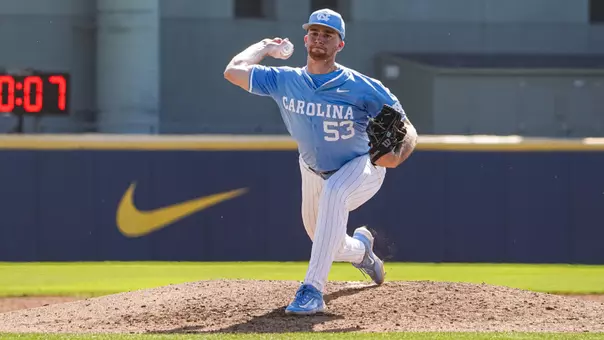
The Greenville native has made his reputation with velocity and movement. But it was a slower, more subtle pitch that enabled him to keep LSU off-balance for seven innings and pitch the Tar Heels to an 8-4 opening-game College World Series win.
"My best pitch was no doubt my split-finger," White said. "It got their left-handed hitters out on their front foot and kept them guessing a little bit."
More than a little bit. The Tigers had six lefties in their starting lineup; those hitters went just 2-for-15 against the Tar Heel starter.
"When he left last summer, we talked about getting a better feel for that split and giving him a third pitch," said Carolina pitching coach Scott Forbes. "He had it before, but it was inconsistent, and he knew he needed more than just a fastball and a slider."
Combine three quality pitches with a competitiveness his coaching staff ranks among the highest on the team, and he's turned into the quintessential ace.
White was voted the ACC Pitcher of the Year on May 19. Up to that point, it might have been a debatable selection, especially with Miami's Chris Hernandez enjoying a terrific freshman season. Since that day, however, White has been spectacular, giving up just eight earned runs in 30 innings over four starts. Add in 31 strikeouts and eight walks over those four games and you've got the raw numbers of a staff anchor.
What makes the quartet of starts even more impressive is that in three of them, White was taking the mound in the biggest game of the season--the pivotal second game of the Cary regional, the first game of the Coastal Carolina super-regional, and Sunday's CWS opener--to that point for his team. It's one thing to post gaudy numbers under normal circumstances. It's quite another to do it under maximum pressure.
In a one-on-one matchup against quality hitters like those that pepper the Tiger lineup, White has always been talented enough to get single outs. His development has come in the way he manages a game, in the way he sets up hitters and then puts them away, and his ability to work through difficult spots.
In the sixth inning, LSU put runners on second and third--thanks solely to White, who walked a pair and then threw a wild pitch--with just one out. They trailed just 7-2 and were sending the nation's leading home run hitter, Matt Clark, to the plate. Remember, this is a Tiger team that came from behind in 18 of their 25 victories during their recent hot streak. Let Clark pop one, tack on a couple more big hits, and Rosenblatt Stadium would soon sound like Bourbon Street.
White threw a first-pitch strike to Clark, ran the count to 2-2, and then retired him on a dribbler back to the mound.
"He threw me a couple great pitches and then I missed the pitch I should've hit, because I fouled off a curveball that he hung," Clark said. "Then he threw a great pitch."
With two down, White capped the inning by getting ahead of D.J. LeMahieu 1-2 and then retiring him on a pop fly to Kyle Seager.
It was a talented athlete maximizing his gifts. But it was also a thrower morphing into a pitcher--and he'll be in Chapel Hill for a full additional season. Consider the jump White has made from last year to this year, and his 2009 potential is limitless.
White could have learned the mechanics of his split-change almost anywhere. He's always had the ability to stand on a mound and make a baseball do remarkable things.
But learning the nuances of how to really pitch--how to survive adversity, how to move on from a bad pitch or bad outing, how to take the mound in front of 22,239 and tame the butterflies while making his competitiveness work for him rather than against him--is something that comes with maturing in one of the nation's top college programs. It's knowing when to be an artist and when to be a gunslinger, and White did both against LSU.
"You hope kids learn in this game," said Mike Fox. "They get older and mature...When he teetered in the sixth inning and walked some guys, he came back and got big outs. I told him that was the biggest difference between last year and this year. Alex has worked really hard and improved, and that's to his credit."
Adam Lucas is the publisher of Tar Heel Monthly. He is also the author or co-author of four books on Carolina basketball.