University of North Carolina Athletics
Extra Points Mailbag
September 10, 2008 | Football, Featured Writers, Lee Pace
Sept. 10, 2008
by Lee Pace, Extra Points
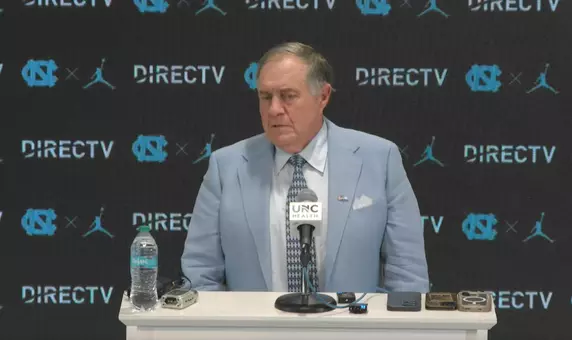
Carolina's recent inability to win many road games in general and particularly those outside the state of North Carolina was front and center on the minds of writers and broadcasters at Monday's weekly media conference.
They probed: "What would it be like to get on the plane and actually have everybody smiling?" one reporter asked Trimane Goddard.
They prodded: "Any idea why you guys can't win on the road?" another queried Garrett Reynolds.
And they reloaded for more, "Garrett, you've probably been asked this before ...."
On this one, Reynolds shrugged, acknowledged he'd heard the question before and noted with a tinge of frustration that the past has no bearing on the Tar Heels' trip to Rutgers for a 7:30 ESPN game Thursday night.
In case you've missed the stream of consciousness on this issue: Carolina has lost 20 straight road games outside state boundaries, last winning such a contest Oct. 5, 2002, at Arizona State. And over six seasons dating to 2002, the Heels' road record is 8-25.
"There are a couple of things," Tar Heel coach Butch Davis said in response to a question about winning on the road. "One, talent helps a lot. If you have the best talent, it's easier to win football games. Two is experience. Sometimes you have to remind young kids that this is a business trip--they're not going to see the Statue of Liberty or to Broadway and catch a play. This is a business trip and you have to remind them to stay focused."
There have been embarrassing losses--by 52 points at Maryland in 2002, by 55 to Louisville in 2005.
There have been stunning losses--witness Virginia's rally from a 21-0 halftime deficit in 2002 to win by 10.
There have been narrow losses--Darian Durant fumbled at the goal line late in the Clemson game in 2003, and Georgia Tech got ridiculously good field position following a punting miscue to set up a game-winning field goal in 2007.
And there have been maddening losses--the Heels were taking control on offense late in the N.C. State game a year ago when a questionable holding call killed a key drive and helped turn the momentum toward State.
Though Davis has experienced only one of these last six years of road worries, he's spot-on where the talent issue is concerned. The Tar Heels simply haven't been very good during this period--at home or on the road. They have not had a winning season since the 2001 Peach Bowl season, their best record being 6-6 in 2004. It's hard to win if you're always hoping for an upset.
And they have had a murderous road schedule, catching a number of non-conference foes at or near their apexes of notable runs high into the national rankings (Wisconsin in 2003, Utah in 2004, Louisville in 2005, Notre Dame in 2006 and South Florida in 2007).
Once the Tar Heels develop a deeper talent base and those players mature, some road wins will follow. Then it becomes a confidence factor, a matter of building on success and actually relishing the challenge of venturing into a hostile environment. Tar Heel basketball coach Roy Williams befriended Hall of Fame golfer Tom Watson while coaching at Kansas more than a decade ago and spoke at length with Watson about winning on the road before Watson captained the U.S. team in the 1993 Ryder Cup Matches in England. Emotions surrounding the event were at a fever pitch after the "War on the Shore" from Kiawah in 1991, and one thing Watson wanted to ask about was the psychology of playing before hostile crowds.
"There's nothing better than quieting the other team's home crowd," Williams told him. "I tell our kids to listen for the silence, because you'll never hear anything sweeter."
***
Last week a question was posed about former Carolina players who have switched positions two or more times such as current Tar Heel Cooter Arnold, who has bounced from tailback to safety to wide receiver. I missed the most obvious recent example of a player making a round trip from offense to defense and back again--Madison Hedgecock.
Hedgecock came to Carolina in 2001 as a fullback, then moved to defensive end midway though the 2002 season as a stopgap measure when starting end Will Chapman was lost to injury. He returned to offense the following year and started again at fullback. Hedgecock also played some tailback during the 2004 season. Thanks to Alex Harrill for pointing the omission out.
Hedgecock is now entrenched as the starting fullback for the Super Bowl champion New York Giants and will be at Rutgers Stadium for the Heels' game against the Scarlet Knights.
Please discuss the traveling squad. How many players are allowed to travel and how is the make-up of the squad determined? Does the home field team make-up differ, and if so why?
Julian Brown, Lenoir
There are no limits on the number of players who can travel. Carolina will take anywhere from 70 to 85 players, depending on various factors. They tend to take more players on road games early in the year, as some freshmen have not yet been deemed as redshirts, and some positions have not settled out on the depth chart. And more players are healthy early in the year. But the team will take essentially the first two units on the offensive and defensive depth charts, as well as the kickers and members of the six special teams units.
Walk-ons and scout team players who have no chance of seeing game action are given incentive to work hard in practice by having the chance to earn a spot on the travel roster. The team is also likely to take a player on a trip to his hometown area even if he's not going to play; a freshman from South Florida, for example, might make the travel squad for a trip to Miami. The size of the airplane can make a difference as well. The team's air travel is handled through Delta Airlines, and the team might travel with a few less players if the airplane is a smaller model. In addition to the players, a team travels with a like number of coaches, doctors, managers, trainers, video staffers, university administrators, broadcast crew members and other guests.
The home team will often give all players--including walk-ons and redshirts--the opportunity to dress out, though many will not play in the game. That's why the home team bench area is packed during games.
I'm wondering about the progress of Mike Paulus at quarterback. I was excited when he was recruited and came on board to our program with high hopes and expectations. After a redshirt year, I had expected that he would be pushing for the starting job, instead of battling for the back-up role. Can you shed some light on what has held him back, and why he didn't capitalize on a showcase opportunity in spring practice (with our starting QB out) and vault to the top of the depth chart?
Tommy Cole, Atlanta
"High hopes and expectations" are the key words here. Paulus's legend upon matriculating to Chapel Hill for the 2007 school year had been built beyond Paul Bunyan status by former coach John Bunting and his staff, by recruiting writers, by message board junkies and by the hullabaloo around Davis's high-energy national signing day in February 2007. Paulus had almost no hope--as a true freshman playing the game's toughest position--of living up to the hype.
That's why quarterbacks coach and offensive coordinator John Shoop appears perplexed when asked about Paulus's perceived lack of progress. T.J. Yates is the starter, with Paulus and Cam Sexton both designated with the second team.
"Mike's a good player," Shoop says. "Sometimes I'm not sure what the expectations are. I'll repeat--he's a good player. But right now, our [starting] quarterback is a good player, too. I think Mike is getting better. He has worked really hard. He has got to learn some of the nuances of the position--the things T.J. learned last year like playing efficiently, getting us in and out of things, seeing how one play affects the next, learning to rally the troops, to sell a play in the huddle. He's doing a lot of things really well.
"Something we say all of the time is very, very true: Coaches don't make decisions. Players make decisions on who plays. Right now, T.J. is a pretty competitive guy. He's going to be tough to beat out."
Shoop is quick to add that Sexton has improved significantly from last spring.
"I'm not purposely being ambiguous," Shoop says. "But I want both to prepare like they are No. 2. I want both to think they are No. 2 and both have to stay loose. That's not a bad way to do it. In NFL, you've got to establish your third quarterback. Here, you don't. I want everyone on their toes."
Who calls the plays on offense and sets the defensive packages for the Tar Heels during the game--the offensive and defense coordinators? If so, what is Coach Davis's role during the game? I know that some head coaches call the plays even though they have an offensive coordinator.
Fred Mitchell '82, Germantown, Md.
Yes, coordinators Shoop on offense and Everett Withers on defense call the plays, each working from the press box. One of the things Davis does so well as a head coach is to be the chief executive officer. He oversees his subordinates, has quite a bit of input during the week and largely leaves them alone to do their jobs as the game unfolds. He looks at the big picture and makes suggestions as he sees fit. Davis is quite involved in the operation of the kicking game during games.
Davis was an assistant coach for 15 years under Jimmy Johnson at Oklahoma State, Miami and the Dallas Cowboys of the NFL, and he's taken his cue as head coach from Johnson's philosophy of being involved in all three phases of the game. Davis coached receivers and tight ends at Oklahoma State, and he coached the defensive line at Miami and Dallas and was defensive coordinator in Dallas as well.

"Something has to suffer if you're exclusively involved in one niche," Davis says. "You can be over there making sideline adjustments and be totally oblivious to what's going on in the game. It's a comfort zone for some guys, that's what they have done before. But there are so many decisions to be made.
"It's important for the head coach to have a total grasp of everything going on, to see trends in the game. Should you throw more? Run more? Up the tempo? Blitz more? Take more shots? Those are the kinds of decisions it's important for the head coach to make."
I'm excited (although somewhat tempered by Saturday's performance) about the season. My question deals with Coach Davis's commitment to a pro-style offense when the trend is toward variations of the West Coast/run-and-shoot/flexbone styles used by so many teams. While I understand his view that kids who want to go on to the pros will gravitate to our system, it still seems to me that we're a college program, not necessarily a feeder system for the NFL. I'd rather win lots of college games and have few players going pro than have lots of pro Tar Heel alums but struggle winning against the Wake Forests and Texas Techs of the world.
Robert Orr, Raleigh
The answer to a good question can be found by looking at a list of college football national champions over the last decade. You start with Tennessee in 1998 and follow with Florida State, Oklahoma, Miami, Ohio State, USC back-to-back, Texas, Florida and LSU.
Florida used the spread option developed by Urban Meyer in winning the 2005 title, but for the most part all of those teams featured a balanced, pro-style offense--one with a dominating offensive line (did you notice LSU's front pound Ohio State in last year's 14-point title game victory?), a marquee tailback or two, athletic wide receivers and a smart, savvy quarterback with great throwing skills, perhaps or perhaps not complimented by fleetness afoot. All these teams could pound out an important two yards on the ground when needed but had the juice to score quickly with big plays when available.
Gimmick offenses are not as sound for creating national champion contenders. That's why you won't see one under Davis's regime. His goal is to win a national title and is convinced that running a pro-style offense attracts the best players.
"We want Troy Aikman and Tom Brady and those kinds of kids at quarterback--those kinds of kids that you can win national championships with," Davis says. "And those kids know that you're going to get great exposure, and the next step to the NFL is not a big step.
"I think it helped dramatically with Kentwan Balmer last year in our program. He was maybe a late-round draft choice--some people said free agent. And he ended up going in the first round just simply because I think he benefited from the scheme defensively that we were doing and people could draw the conclusion of how good he can be on the next level."
We can't mention recruiting prospects by name on the school's official website, but if you explore the stories available in the Internet about some of the offensive prospects the Tar Heels are currently courting, you'll see positive references to the fact Carolina runs a "pro-style" offense.
Send your questions about Tar Heel football to Lee Pace at leepace@nc.rr.com and include your name and hometown. No recruiting questions, please. Pace will answer your questions regularly throughout the season on Tarheelblue.com and on the Tar Heel Sports Network's pre-game show.