University of North Carolina Athletics
Extra Points Mailbag
September 19, 2008 | Football, Featured Writers, Lee Pace
Sept. 19, 2008
by Lee Pace, Extra Points
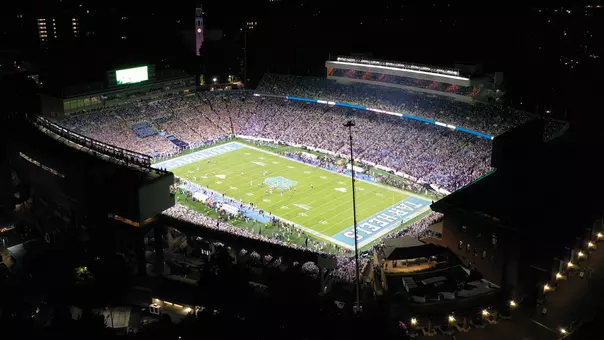
You have to go back 11 years to find a late September home game that carried as much kinetic energy and importance as Carolina's encounter Saturday against Virginia Tech. Coolers are stuffed with cold beverages at Franklin Street bars and clothing stores have stocked up on T-shirts and other souvenirs in anticipation of big crowds with ample time to eat, drink and shop before a 3:30 kickoff and after the game as well.
Sad to say, but by week three or four each season the last decade, the Tar Heels have always lost an early game--sometimes by a lopsided margin--and the shine of the annual and eternal preseason optimism has been wiped away.
Those Septembers have included a 49-point loss in Tallahassee in 2000, a 16-point loss at Maryland in 2001 and a 32-point shellacking at Virginia in 2004. My arrival home from those road trips would invariably include opening my email program to a blistering barrage of angry fans wanting to fire the coach, the offensive coordinator, the quarterback, the tailback and the second-team punter.
"And you stink as a writer, too," they'd say.
Not so this year. The Tar Heels rallied in the second half to nudge McNeese State in their opener and then hammered Rutgers in a nationally televised game last Thursday. So it was quite a contrast to have my Blackberry ping shortly before midnight as the team was readying for its departure back home and already have a question from a Tar Heel fan in throes of giddiness over the Heels' 44-12 thumping of the Scarlet Knights.
"I've been a die hard Tar Heel fan for my whole life, and have never seen the Heels play quite as inspired as they did at certain points against Rutgers," wrote John Bailey of Anderson, S.C. "How much of that was the Heels' impressive talent, speed, and coaching--and how much of it was Rutgers' poor execution? Any shot at the ACC championship game?"
The Tar Heels' win was impressive on many fronts. It was a combined effort of the offense, defense and kicking game, and each side fed off the success of the others as the game evolved. Carolina's athleticism was on display--from Brandon Tate's catching passes and running end-arounds to Bruce Carter's speed and dexterity returning an interception 66 yards. And the coaching job on the part of Butch Davis and his staff to bounce back from a lukewarm opening win over McNeese State was noteworthy.
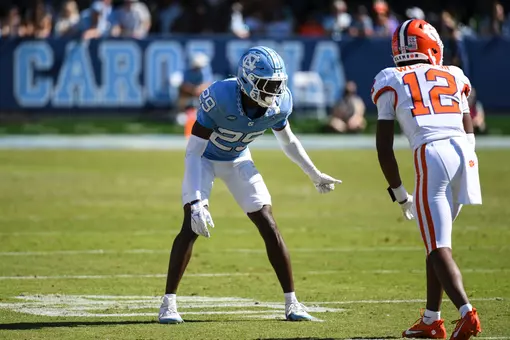
The victory provided concrete evidence to the players and their fans that maturity and preparation indeed count; the momentum changing tackle by sophomore cornerback Kendric Burney late in the first quarter was the result of him correctly recognizing a play the team had rehearsed in practice and Burney having the physical skills and strength to nail the receiver and send him to the sidelines wounded.
"We had practiced that route in that coverage and we played it perfectly," defensive coordinator Everett Withers says. "It was perfect timing. For it to happen that way was great for our kids' confidence. It was like, `Wow, we saw that in practice. Boom, it worked. Hey, this is fun.'"
Davis noted Burney's mental and physical improvement after having played baseball his red-shirt freshman year but focusing on spring football last March and April.
"A year ago Kendric probably gets sucked in and chases the other crossing route and lets this guy catch it, turn up the boundary and get 15 yards," Davis says. "Missing spring practice a year ago, it took until the middle of the football season before he could be somewhat consistent. He's a much, much better player this year."
It's way too early to draw major conclusions from one win, and admittedly Rutgers is not as potent without tailback Ray Rice as it has been the last two years. But it was certainly a solid brick in the foundation to Davis's evolving program. Whoever wins Saturday will get a leg up in the race for the Coastal Division crown, and since Tech has won the division two of the three years since the ACC expanded, the Hokies are the targets.
"When I was with the Chicago Bears, the division champion every year was Green Bay," offensive coordinator John Shoop says. "So Green Bay was who we had to beat. They were the champions. It started with them. We beat them and won the division. It was the same thing when I was with the Carolina Panthers. San Francisco won the Western Division every year. That was who we had to beat. And we did."
***
Last week a reader inquired about the style of offense the Tar Heels were using under Davis and Shoop. This week several fans inquired about what appears to some to be a somewhat passive or soft defensive scheme. Garland Bradshaw wondered about the Tar Heels' "prevent defense," and Tim Paschal noted that "it seems the linebackers play very deep in our defense."
This is a good opportunity to touch on the big picture philosophy on defense from Davis as the head coach and Withers as the coordinator as we did last week with the offense. As with the offense, Davis has an NFL mindset on defense. The Tar Heels employ a 4-3 scheme and their base defense is a "Cover 2" scheme.
The scheme was pioneered by Bud Carson with the Pittsburgh Steelers in the 1970s and more recently heralded by Tampa Bay defensive coordinator Monte Kiffin. It relies on the defensive line to supply much of the pressure and use sound gap control to thwart the running game. The concept is to prevent the big play by keeping everyone in front of the safeties and, when possible, making big plays with the knowledge that someone has your backside covered. There isn't much all-out blitzing with zero coverage (no safety in the middle, corners one-on-one). The defense is about taking calculated risks and being patient.
The base Cover 2 is a zone defense where you have a four-man rush and every defender behind the line is responsible for an area of the field and not a specific man. Withers talks about dropping linebackers and the secondary into zones and "building a wall in the quarterback's windows." By that he means there is an opponent in each of the quarterback's passing lanes. And one key to making Cover 2 work well is generating a good pass rush with four down linemen.
Thus, the Tar Heels will hardly ever have a ferocious and madcap look before the snap of the ball. That's simply not part of the plan. But that doesn't mean they cannot have an outstanding defense once the unit is populated with talented, mature and smart players.
Carter's interception, for example, was a staple result of Cover 2. The offense was taking what it was given, it made an almost inevitable mistake, and the defense was there to capitalize. A Scarlet Knight running back missed an easy pass over the middle, the ball popped into the air and Carter pulled it down.
"We always talk in two-coverage that they will complete the check-down to the backs, they will complete the stuff underneath," says Withers. "Just make sure you tackle them for a short gain. What happens is, the back gets pounded all night, and eventually he'll start to flinch. He'll feel the tackle coming before he makes the catch. That's exactly what happened on Bruce's interception. The quarterback didn't have a clear window, he threw it sidearm and it bounced off the back's hands. That always happens in Cover 2. And we preach, `Tipped balls get caught. Let's catch them."
***
I was wondering if you could give me an idea of how a team fills out its roster. I'm especially interested in how the coaches locate and recruit offensive linemen. It seems this may be one of the more difficult position groups to judge talent.
Todd Freeman '98, Wake Forest
That's a question that could fill gigabytes of cyberspace, so I'll restrict my answer to the offensive line. The Tar Heels enter each recruiting year with the goal of signing an entire offensive line--two tackles, two guards and a center. It's rare that would happen, but they at least set their sights on finding five potential starters. They will over-sign at tackle if the opportunity presents itself. There are some size parameters, for example tackles being at least 6-5 and preferably 6-6 or taller. Weight isn't as crucial provided the body frame is there as diet and weight training will fill players out.
"The No. 1 thing you look for is work ethic," says offensive coach Sam Pittman. "You want good character kids. You want smart kids, because this is the most difficult position to learn. You've got to get good athletes, because in our offense they have to run. And then you want guys who will fit into your [meeting] room. So far, knock on wood, we've hit the jackpot with our two classes."
A team is allowed 85 scholarship players and it fills out its roster with walk-ons. The Tar Heels have targeted 16-17 offensive linemen for scholarships, though they have 15 at the moment with four walk-ons. That will change as the current staff's recruiting efforts take shape over a three- to five-year period.
This weekend the Tar Heels take on a tough ACC opponent, but one that seems to be somewhat vulnerable. What is Virginia Tech's weakness, and what do the Tar Heels need to do to capitalize?
Brian Hunt '08, Rutherfordton
Tech's only "weakness," if you want to call it that, is that the Hokies have a lot of new starters across the board. They have a veteran offensive line, and quarterback Tyrod Taylor played extensively last year as a freshman. But beyond that, they have no experience among their skill players on offense. And they lost six starters on defense, including linebackers Vince Hall and Xavier Adibi.

Tech's plan was to play senior Sean Glennon at quarterback, but it became apparent in its first game against East Carolina that with newcomers at tailback and receiver, it needed a play-maker at quarterback. Thus the insertion of Taylor, who brings Michael Vick-style running and athletic skills to the attack.
"The most important thing defending him is to be disciplined," Davis says. "The minute you try to do something that is not your responsibility, they can make you look foolish."
"Who do you think will be redshirted this year from the good freshman recruiting class, and will we see Dwight Jones play any this year?"
Casey Bradwell, Gaston, S.C.
There are still many questions to answer among the freshman class, and you never know how the season will evolve in terms of injuries and the potential raiding of a red-shirt class in order to populate the special teams. So far, five freshmen have played--Robert Quinn, Quinton Couples and Michael McAdoo at defensive end, Zach Brown on special teams and Casey Barth as a kicker.
Quarterbacks and offensive linemen rarely play as freshmen, and the Tar Heels have four tailbacks in front of Jamal Womble, so it's not likely anyone from those positions would play. Linebackers, fullbacks and tight ends often get a chance as freshmen to help on special teams, so you might look for players like Dion Guy and Ebele Okakpu.
Jones, the highly touted freshman from Burlington, got a late start following his 11th hour admission to Carolina. Davis says no decision has been made on whether he'll play this year, but with the deep corps of receivers ahead of him and the circumstances of his joining the team, I'd guess the odds are good he would redshirt.
I was wondering when was the last time Carolina went a game without any turnovers like they did against Rutgers?
Jordan Falls, Grover, N.C.
I figured this would be a pretty easy question to answer--just go back through a couple years worth of the annual Tar Heel media guide and check turnovers in each game until I found one with no fumbles and no interceptions. But then I figured why bother--surely Woody Durham has already done the work.
Sure enough, I asked Durham that very question Thursday morning and he was quick with an answer. "It's been 152 games--the Ohio game in 1995," he said, a 62-0 victory.
That surprised me. It would have taken 13 years of checking the record books to figure than out one. Hopefully, that's a new trend for the Tar Heels. Through two games, Carolina has lost one fumble and one interception and gained one fumble and five interceptions. They have not had a positive turnover margin for a season since 1999--interestingly, a 3-8 ledger.
"Protecting the football is priority No. 1," says Shoop. "We want every drive to end with a kick--hopefully an extra point, but we'll live with a field goal."
Chapel Hill writer Lee Pace is in his 19th year of chronicling Carolina football through "Extra Points." He'll answer questions about the Tar Heels weekly throughout the season through his "Extra Points Mailbag" and on the pregame show for the Tar Heel Sports Network. Email him at leepace@nc.rr.com and include your name and hometown. No recruiting questions, please.