University of North Carolina Athletics
Lucas: Focus Shifts To Line
September 24, 2008 | Football, Featured Writers, Adam Lucas
Sept. 24, 2008
By Adam Lucas
Leave it to an offensive lineman to provide the simplest, most accurate explanation of Carolina's offensive task on Saturday at Miami, when the Tar Heels roll into Dolphins Stadium without T.J. Yates. Either freshman Mike Paulus or junior Cameron Sexton will start at quarterback--as of Tuesday afternoon, the decision still hadn't been made.
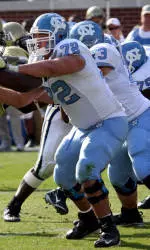
But whether it's the freshman Paulus or the junior Sexton, left tackle Kyle Jolly knows exactly what the offensive gameplan will be.
"We have to give the quarterback as much time as we can, and we have to run the ball to take the pressure off him so he doesn't have to win the game with his arm," Jolly said.
He's exactly right. If only it was just that simple.
Sexton hasn't thrown more than one pass in a game in nearly two years--he attempted 10 passes against Wake Forest on Oct. 28, 2006. Paulus, meanwhile, has nine career throws--three of them have been completed to his teammates and two to the opposition.
It's unlikely that Miami's new home, Dolphins Stadium, will be as inhospitable as the Orange Bowl, which had all the charm of a condemned apartment building. But either Sexton or Paulus will still be facing a hostile environment, which means Jolly's prescription for Saturday success is essential.
Step one: give the QB as much time as possible.
The Tar Heels have allowed seven sacks in three games, which puts them in the lower third of the ACC statistics in that category. That might be deceiving, however, because the pocket has actually held up fairly well.
"The pass protection is pretty well developed," center Aaron Stahl said. "The leaks have come when there's a new scheme thrown at us, but for the most part it's been pretty good."
Blitzes come in two varieties: the kind a line has seen during the previous week's film study, and the kind a crafty offensive coordinator unveils for the first time during game action. In the ACC--and especially against a team like Virginia Tech or Miami--linemen expect at least a couple new looks in every game.
The Hokies, for example, unveiled a trio of new blitz looks on Saturday.
"We picked up almost every blitz," Jolly said, "until the time T.J. went down."
That might sound a little like asking Mrs. Lincoln how she enjoyed the play other than the one unfortunate incident, but the simple fact is that in every football game, sometimes a defense sends more blitzers than a line has blockers. When that happens, there's no option other than returning to the sideline and making adjustments.
"When you look back on those situations, usually it's a little thing," Stahl said. "Maybe a set is a little bit wide. It's usually something little rather than something big like a huge mental error or a pre-snap tip."
Saturday will provide an interesting contrast between Miami's youthful, speedy defense and Carolina's veteran line. On UNC's previous two trips to Miami, the Hurricanes have a combined eight sacks.
"Miami's defense has been outstanding," said Butch Davis, who knows a little something about speedy Miami teams. "They have absolutely suffocated the other team."
Step two: run the ball.
The perception of the Tar Heel running game so far has been meager. Carolina running backs have carried the ball 77 times for 283 yards, an average of 3.7 yards per carry. That's roughly the same as last year's running back average of 3.9 yards per carry.
But take a look at the league rushing stats and the Tar Heels surprisingly rank fifth in the conference in yards per carry at 4.3. How is that possible?
There's a tendency to discount Carolina's rushes from the wide receiver position, but that has become an essential part of the offense. UNC receivers already have 10 rushing attempts in three games; last year the receivers notched just 14 carries in a full 12-game season.
"Running the football is an important part of the offensive gameplan," Davis said. "But it's not all-inclusive of the running backs. Running the football with the wide receivers is still running the football."
Still, the linemen acknowledge there needs to be progress on developing a ground attack that can make tough yards through the heart of the opposing defense. Results on the ground have been mixed, and Virginia Tech stacked the line of scrimmage with defenders to further clog running lanes. With an uncertain quarterback situation, that's a strategy the Tar Heels may see more often until they prove they can beat it.
"With the running game, it's been a variety of things," Jolly said. "Sometimes it's the offensive line not staying on our blocks long enough. Sometimes it's not fitting the right person. And sometimes it's the running back not finding the hole. It's something the entire offense needs to improve on."
They've already got the perfect example of what can happen when everything goes right. On Paulus's first play in relief of Yates on Saturday, he turned, handed the ball to Greg Little, and watched the sophomore sprint 50 yards to the end zone. That's exactly the kind of play that will be needed to slow an aggressive Miami defense.
"We've seen what can happen," Stahl said. "When it comes together, you get plays like Greg Little going 50 yards untouched. When we're all on the same page and we're clicking, we'll get more plays like that."
Adam Lucas is the publisher of Tar Heel Monthly. He is also the author or co-author of four books on Carolina basketball.