University of North Carolina Athletics
Duke Game Guide
November 6, 2009 | Football
Nov. 6, 2009
By Lauren Brownlow
Every Friday, check TarHeelBlue.com for the latest edition of the Game Guide, which provides all the information you need to get ready for gameday.
The Basics
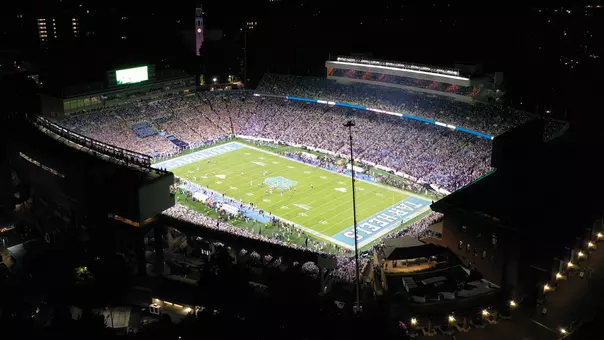
North Carolina (5-3, 1-3) will host Duke (5-3, 3-1) for its Homecoming Game on Saturday. Carolina has one more home game next weekend and its final two games are on the road. This is the first time both teams have entered this game with a winning record since 1994. Both teams were ranked, Carolina at No. 21 and Duke at No. 24; Carolina won, 41-40. This Nov. 7th meeting is the earliest Duke-Carolina game since 1938 (October 29th). It has been played on the last weekend of the season for 46 of the last 56 years. The last time it was not the regular-season finale for Carolina was 2005. North Carolina is coming off of a 20-17 win at Virginia Tech. Duke is coming off of a 28-17 win at Virginia. The Blue Devils are tied Yellow Jackets at the top of the Coastal Division; both are the only teams with one ACC loss (Duke has fewer wins). Carolina leads the all-time series, 56-35-4. Carolina has taken 18 of the last 19 games, including 13 straight from 1990-2002. The Tar Heels have won the last five games in a row. However, Carolina's last three victories in the series have come by a combined 15 points. Carolina holds a 28-17-2 edge in the rivalry in ACC games and a 22-15-2 record over Duke in Kenan Stadium. Duke's last win in Kenan Stadium came in 2003; it was also Duke's last win in the series.
Game Time: Duke at North Carolina, 3:30 PM, ESPNU Carolina's game notes can be found here and Duke's official football site is here.
Last Time: Carolina beat Duke 28-20 in Durham last season in the regular-season finale for both teams on November 29. It was a back-and-forth game with neither team ever leading by more than eight. Duke scored a touchdown on its first possession and Carolina responded with a touchdown on its first drive, during which Shaun Draughn rushed seven times for 61 yards. Duke missed a 53-yard field goal and then Draughn lost a fumble that was returned for a touchdown by Duke's Vincent Rey, giving the Blue Devils a 14-7 lead. Draughn caught a touchdown on Carolina's next possession to tie it. To end the first half, T.J. Yates had a 25-yard touchdown pass to Hakeem Nicks and Duke responded with a 55-yard field goal to cut the margin to 21-17. In the third, Duke hit another field goal to make it 21-20 and Carolina ended the third on a Yates to Richard Quinn touchdown pass to make it 28-20. Carolina's defense held Duke to a three-and-out twice and then Quan Sturdivant forced a fumble with 2:43 to go. Duke had one more chance, reaching the Carolina 16-yard line before Trimane Goddard intercepted Thaddeus Lewis' pass on the Carolina four-yard line on 4th and 6.
T.J. Yates completed 15-of-19 passes for 190 yards, three touchdowns and one interception. Shaun Draughn rushed for 110 yards on 29 carries and a touchdown, adding four receptions for 28 yards and a touchdown. Greg Little was the leading receiver with four catches for 67 yards. Hakeem Nicks had three catches for 38 yards and a touchdown. Quan Sturdivant led the team in tackles with 13 (11 solo) and a forced fumble. Trimane Goddard added a forced fumble and an interception. Duke's Thaddeus Lewis completed 34-of-49 passes for 278 yards, one touchdown and one interception. Jay Hollingsworth led Duke in rushing with 50 yards on nine carries. Donovan Varner led the blue Devils in receiving with 10 catches for 73 yards. Eron Riley had five catches for 63 yards and a touchdown. Michael Tauiliili led Duke in tackles with a ridiculous 20, including seven solo. Vince Oghobaase had 1.5 sacks. Gameday Weather: Check the local weather forecast before heading for the game.
Radio Coverage: Tar Heel Sports Network coverage begins 2:30 PM. The radio broadcast is also available on XM Channel 190/Sirius 215 at 3:30. Since it's a home game, the Tar Heel Sports Network broadcast can be heard on XM.
TV Coverage: The game will be shown on ESPNU.
Game week TV/radio coverage: "Butch Davis Live", Coach Davis' weekly radio show, will be broadcast live from the Top of the Hill restaurant on Franklin Street every Wednesday at 7:00. Inside Carolina Football with Butch Davis airs Saturday morning at 9 a.m. on FOX Sports South. Inside Carolina Football with Butch Davis will air on Sunday at 11:30 a.m. on WTVD ABC 11 in the Triangle and will review Saturday's game. The show will also be available On Demand on Time Warner Cable channel 1234 for free. The Tar Heel Football Review show featuring highlights of the previous week's games will air Tuesday's at 7 p.m. and Thursday's at 8 p.m. in the Triangle and Fayetteville on the local Time Warner Cable station.
Storylines
The best defense is a good offense: In Carolina's first five games, it began 60 drives and just 11 lasted eight or more plays. In the last three games alone, Carolina has had 12 drives of eight or more plays out of 39 total drives. Carolina's third-down effort against Virginia Tech - 10-of-19 - was by far its best of the year. "One of the best ways to play defense is to keep their offense on the sidelines, regardless of who the team is," Butch Davis said. "The less number of plays, the less possessions that you want any really good offensive team to have certainly helps your opportunity to win the game." Duke is third in the league in time of possession, and that's not just because of their offense. If the Duke defense was bad or even just mediocre, teams would be able to play keep-away. But they're not able to do that against this defense. "They're a very well-coached defense. They're very good at diagnosing the plays that are in front of them. They make good reads," T.J. Yates said. "They're kind of a bend, but don't break defense. They're going to make you go the long and hard way, those long drives. We're just going to have to be patient, find out some of the weaknesses they have in their defense and try to exploit them."
Still, Carolina's offensive line is slowly gaining continuity and confidence. Ryan Houston noticed a difference against Virginia Tech, when - albeit briefly, the entire offensive line was back together. "Even with the young offensive line, I feel like there's a little something there but now as everybody's back together and everybody's healthy, the holes are opening up even wider," Houston said. "Me and Shaun (Draughn) the last couple of weeks, with back-up linemen in there it's kind of hard to squeeze into the holes. But with the offensive line back, they're better picking up blitzes. T.J. (Yates) didn't get hit as many times as he normally gets hit."
Carolina showed it was willing - and able - to mount long drives against a very good defense. Carolina had two drives of 84 yards or more, but they weren't necessarily built on big plays as they would have been last season. Carolina's 10-of-19 third down conversions played a role, but considering ten of those 19 third-down tries were of distances of less than four yards, that certainly doesn't hurt. The average distance Carolina faced on third down was 5.9 yards, by far the smallest average deficit this season. "There was a pretty dramatic shift in our ability to stay in makeable downs and distances because it allows you to be multi-dimensional. We were able to run for some first downs on third down and two, three, four and five instead of always having to throw the ball," Davis said. "That just plays into the defense's hands. They pin their ears back, they can rush the passer, they can go loaded coverages and they can blitz when they know that you've got only one opportunity to try to pick up the third own. As long as you're in that either-or situation, they've got to play a little bit more honest. They can't just throw caution to the wind."
Defending the Duke passing attack: Tyrod Taylor and Virginia Tech gave Carolina quite a challenge through the air; Taylor was the ACC's most efficient quarterback entering that game and had big-play potential with his mobility. But when asked about the challenge Duke's offense presented, Davis compared it more to the Florida State passing attack that ripped the Tar Heel defense to shreds in the second half. Similarly to Florida State, and perhaps even more so, the Blue Devils are not going to try too hard to run the ball consistently, at least not conventionally. Thaddeus Lewis' mobility is somewhat like Tyrod Taylor's, except he is also a very accurate and dangerous passer. So he is more like Christian Ponder than Taylor, but certainly just as dangerous as Ponder, if not more so.
"The quarterback (Lewis), his ability to get them into some of those second or third down situations or him run a quarterback lead draw or him just scrambling around and breaking containment, it's enough of a threat that you always have to honor what they're doing running the football," Davis said. "What they're doing in the passing game, they're spreading the field. They really try to isolate receivers on certain people. They've got a scheme and a philosophy in the way in which they try to throw the football. It picks on people. It picks on zones. The one thing I think that I have been very impressed with is that their receivers, they run adjusted routes extremely well. If it's against zone, they know exactly where to sit down and be in the open holes. If it's against man, they do a great job of rubbing guys off. You don't see them make receiver mistakes where a receiver is confused and you get two guys sitting in the same area or you get two guys clustered up. They're pretty crafty about the way in which they throw the ball."
Four Duke wide receivers have 25 or more receptions and 14 different players have caught at least one pass. That's just the wide receivers - the running backs have four players with 34 catches between then and the tight ends have three players with 22 catches and six touchdowns. At Kansas, 12 different players caught a pass. That helps make up for a lack of a running game. "They're going to try to get the ball in the hands of guys in certain isolated areas that can give them a chance to make plays. It's a lot easier to play pass defense if somebody's just got one guy. If he's the go-to guy and he's getting 90 catches and everybody else has got five, you can load up coverages. But this makes you defend the entire field," Davis said.
The Carolina secondary went into Blacksburg last week reeling from allowing Florida State and Christian Ponder pass for 281 second-half yards. Those 281 passing yards - in the second half only - were still more than the Tar Heels had allowed in any game this season. It was the first time all season an opponent had passed for more than 200 yards on Carolina (East Carolina came closest with 192 yards). Ponder completed all 16 of his final passes. One of the issues with the secondary was Jordan Hemby's absence; he went out with a concussion and forced the defense to make quick adjustments and put in freshmen to play against a potent offense. Hemby went down right before the Seminoles scored their first touchdown to cut the lead to 24-13 with six minutes left in the third.
But the Carolina defense had not been completely stopping Ponder. Before Hemby's injury, Ponder had completed 18-of-25 passes for 166 yards, which would have been the second-highest number Carolina had allowed all season with more than a quarter left. But the stats the defense let Ponder have after that point were much worse - 15-of-15 for 189 yards. The defense saw the Seminoles' yards per attempt increase from 6.6 to 12.6 in that span. But to its credit, the secondary was able to regroup. Deunta Williams said the secondary's mistakes against Florida State that led to big plays came from being too aggressive rather than too loose. "You can be aggressive if you're doing the fundamental things right. But we were aggressive and our fundamentals weren't right, so that was the major thing and that was how we got beat for those big plays," Williams said.
Williams said the team had the opposite problem at first at Virginia Tech, having to fight off some nerves and over-cautiousness, not wanting to get beaten again for a big play. But the defense tightened up and the secondary has shaken off the body blow issued by the Seminoles over two weeks ago. The similarities between Florida State and Duke offensively give them the chance to permanently exorcise some of those demons as well. "We have a second chance to go back and correct some of those mistakes from the Florida State game," Williams said. "They come out and it's pass-first. Some of the route combinations are the same (as Florida State) so some of the same calls are going to be played. Discipline and execution are the words that we have to have in the secondary and in our linebackers as well because we need that underneath coverage that Florida State was exposing sometimes. I think the major thing is when we're in zone coverage, the backside corners, Thad (Lewis) may be looking to his left so the right corner has to not slip up or not go to sleep because he works his progressions so well that he can come all the way across the field and hit that guy on the out-route. ... What we've got to do is get d-line pressure on him and the underneath coverage be where they needs to be and the guys over top just need to lock up."
But Florida State wasn't just the fault of the secondary, just like the success against Virginia Tech wasn't just one unit. To effectively stop the pass, teams have to get pressure on the quarterback. Carolina's defensive linemen were chasing down Tyrod Taylor all night last week and making sure he never got comfortable. They did that in the first half against Florida State but weren't able to pressure Ponder late and he completed his last 16 straight passes. On Monday, Williams said he had yet to see a team on tape that had successfully blitzed Lewis. He said Lewis is able to find open receivers on those blitzes, partially because of how good he is but also because the other team blew its coverage.
The best offense is a good defense: It's only logical - if the best way to keep a lethal offense from scoring is to keep them off the field, then the best way to get your offense going is to get them a lot of chances, and in good positions. That's something that the Carolina defense has not been able to do consistently this year, as dominating as they have been. Third downs have been an issue for this defense, as have turnovers. But a big reason Carolina was so successful against the Hokies was that they were able to get them off the field and stop their momentum, either on third downs or forcing turnovers. Carolina was forced to punt after the defense forced a turnover at the Carolina 27-yard line, but the Hokies had been driving and the crowd was going crazy. Carolina's fumble recovery stymied the Hokies' momentum and after Virginia Tech gained 45 yards on its first two plays of the first half, it would gain 63 yards on its next six drives combined.
The biggest difference in Carolina's wins and losses overall has been in the second half defense. Carolina's opponents have completed 28-of-39 passes (71.8%) for 365 yards (121.7 yards in the second half through the air) and gained 265 rushing yards on 80 attempts (3.3 yards per carry), averaging 5.3 yards per play overall and 11.3 first downs in the second half of Carolina losses. In losses, Carolina's opponents have converted 15-of-29 third downs (51.7%) after the Tar Heels held them to a combined 7-of-22 in the first half. In Carolina wins, opponents have completed just 50% of their passes in the second half for 376 yards (75.2 second-half yards on average) , gaining just 99 yards on 70 rushes (1.4 per carry) and averaging just 3.3 yards per play and 5.6 second-half first downs. The most important stat is Carolina has held them to 10-of-38 third down conversions (26.3%) in the second half of wins. Carolina's FCS opponents have gone three-and-out on 13 of their 32 drives and have turned it over ten times, making it 23 of 32 times Carolina has either forced a three-and-out or a turnover. But against its FCS opponents, Carolina has forced a turnover or three-and-out on 29 of 73 drives (23 three-and-outs) and in three FBS wins, Carolina's opponents have begun 36 drives and 18 times have turned it over or gone three-and-out. But in three FBS losses, that number drops to 11 of 37 drives, still very good but just one of those was a lost turnover and that was against Florida State. Carolina was rolling in its first two games this season, forcing Connecticut and East Carolina to go three-and-out or turn it over (not counting the game-ending safety against the Huskies) on 13 of their 25 drives. But Georgia Tech and Virginia went three-and-out on 7-of-25 drives and had no turnovers. Virginia Tech went three-and-out three times and turned it over twice.
Duke's +4 turnover margin is second in the league and its ten turnovers are tied for fewest with Virginia Tech. In Duke's first four games, it lost five turnovers and gained five, turning those into four touchdowns and a missed field goal. Opponents turned five Duke turnovers into two touchdowns, a field goal, a fumble and a possession to run out the clock. But in the last four games, Duke has lost five turnovers but gained nine, turning those nine turnovers into three touchdowns, one field goal and three possessions to run out the clock. It punted just once. Its opponents have managed just four punts and one field goal off of the five Duke turnovers. In a low-scoring game at Virginia, Duke turned it over just once and its defense forced a three-and-out. Virginia turned it over twice and Duke turned that into ten points. Duke is not turning it over on third down, either. Here's the odd thing - in the first three games this season, Duke converted just 9-of-42 third downs (21.4%) and in the last five games, it has converted 43-of-87 (49.4 percent). The last three games, the Blue Devils have converted a blistering 29-of-54 third downs (53.7 percent). After holding the ball for an average of just 25:17 in its first two games, it has not had the ball for less than 30 minutes the rest of the season and has had it 32 minutes or more in the last three games (including 40:24 at NC State) and in four of the last five games.
Here's a frightening number: in its last three games, Duke has converted 15-of-18 third downs of four or fewer yards and when facing that distance, Lewis has completed 10-of-11 passes for 144 yards and ten first downs (four touchdowns). Carolina was nearly dealt a crippling blow when Virginia Tech converted a third down and 17 yards in the third quarter, marking only the third conversion of 11 or more yards Carolina has allowed this season. In fact, Carolina's opponents have converted just 7-of-55 third downs of eight or more yards. The problem is that in Carolina's three losses, 32 of the 51 third downs opponents faced were of seven or fewer yards and of those, 20 were turned into first downs (62.5 percent). In five wins, Carolina's opponents have faced 42 third downs of seven or fewer yards and converted 13 (30 percent). In fact, Carolina has held opponents in five wins to just 37.5% conversions on 3rd down and 1-4 yards; in losses, that conversion rate jumps to 68.4 percent.
At The Game
Listening to the Tar Heel Sports Network at the game: WCHL 1360 is the local affiliate.
Parking/construction update: For the latest information, click here.
Pregame activities: Tar Heel Town will open at 12:30 PM on Saturday and the Countdown to Kickoff radio show will broadcast live there beginning at 1:30. The Old Well Walk will be at 1:00 and then the Marching Tar Heels will perform on the steps of Wilson Library at 2:30 before heading to the stadium. Then at 2:45, start making your way to Kenan Stadium and make sure you're in your seats early. For more information, see the new <"http: tarheelblue.cstv.com/auto_pdf/p_hotos/s_chools/unc/sports/m-footbl/auto_pdf/2009fanguide"="">2009 Fan Guide on TarHeelBlue.com. Postgame activities: See the Fan Guide on TarHeelBlue.com for the latest information on postgame parking and activities.
Watching At Home
Turn down the sound: If you're watching at home while listening to the radio or over the computer via Carolina All-Access, there will inevitably be some delay. For the reason - and a possible solution - click here.
A full list of THSN affiliates can be found here.
ESPNU coverage: The game will be shown on ESPNU. Todd Harris will have the play-by-play and JC Pearson will be the analyst.
Names To Know
Greg Little: There are some players who seem to shine in big games, and understand what they mean. Greg Little is one of those players and he has had very good games against Duke and made huge plays in his two years as a part of the rivalry so far. As a freshman, he led Carolina to an overtime win with 154 yards on 26 rushes (5.9 yards per carry) and two touchdowns. He also had two catches for 11 yards. In the fourth quarter and overtime, Little had 84 yards on 12 carries and scored both touchdowns, participating in 12 of Carolina's final 18 plays and scored the game-winner in overtime that season. Last year, he had 42 yards on two rushes and was the leading receiver with four catches for 67 yards. He had a 45-yard run in the fourth that set up a missed field goal but came right after Carolina had taken the final lead of 28-20. He had a 19-yard catch to set up what was ultimately the game-winning touchdown drive and a 32-yard catch at the beginning of the fourth. Of Carolina's 213 fourth-quarter and overtime yardage against Duke the last two seasons, Little has had 151 of those yards himself.
But this season, Little has shown the ability to consistently shine in big moments, and he has had two straight great games on Thursday night in primetime. In the last two games, Little has been targeted 13 times and has caught ten for 118 yards (11.8 per catch); in his previous six games, he was targeted 40 times and caught 27 for 230 yards (8.5 per catch). In the last two games, Little has rushed for 86 yards on ten carries (8.6 yards per carry) in addition to his receiving numbers. He had five of Carolina's 20 first downs against Florida State. Against Virginia Tech, he had four of Carolina's 17 first downs (three of seven passing first downs) and converted three of Carolina's ten successful third downs, also adding a fourth down catch that saved the game for the Tar Heels. He has also become reliable on third down; in the last two games, he has been targeted four times and caught three for 27 yards and two first downs. In the first six games, he caught six of the 12 passes thrown to him on third down for 57 yards and four first downs. "Greg, he's a multi-threat guy. He can do pretty much anything," Yates said. "If we need him to run in between the tackles, he's going to do it because he's a big guy, he's strong, he's physical and he's got all the moves. He can do it all for us and we're going to try to find different ways to get the ball in his hands."
Quan Sturdivant: Carolina's linebackers were a dominant force last season, led by the heady Mark Paschal and anchored by the very talented - but still somewhat raw - Quan Sturdivant and Bruce Carter. Now, Carter and Sturdivant find themselves leading a young group that includes freshman Kevin Reddick and sophomore Zach Brown. Sturdivant shifted to the MIKE linebacker spot, typically known as the quarterback of the defense. Then the defensive staff made an adjustment and against Virginia Tech - partially due to necessity - Sturdivant spent quite a bit of time back at his old weakside linebacker spot. He had seven tackles, one pass breakup, one tackle for loss and two quarterback hurries.
He has at least one tackle for loss in four straight games and has averaged 6.8 total tackles, adding 4.5 tackles for loss, a sack, three quarterback hurries, a forced fumble, an interception and a pass breakup. His move to the weakside - temporary or not - allows Davis and the rest of the defensive staff to play freshmen comfortably, even during big games. Sturdivant found the speed and ability to hurry the speedy Tyrod Taylor twice. Last year against Duke, his play-making was at its best when he had 13 tackles (11 solo) and a forced fumble. As Carolina tries to get something consistent going with the defense, Sturdivant is likely to be a big part of making plays right when they need to be made.
Thaddeus Lewis: The senior quarterback is leading the fifth-ranked passing attack in the nation. Three of Lewis' receivers are in the top four in the league in receptions per game; two are in the top three in receiving yards per game. Lewis has been on a tear in the last four games, passing for 343 or more yards in all of those games and throwing ten touchdowns to just two picks. On the year, Lewis has 15 touchdowns and four interceptions. After throwing for two scores and 359 yards against Virginia Tech in a narrow loss, Lewis has completed 94-of-133 passes for 1,173 yards in the last three games (all wins), averaging 391 yards through the air. His game against NC State (40-of-50, 459 yards, five touchdowns and no interceptions) prompted his coach to say it was the best game by a quarterback he was coaching. He has coached both Manning brothers.
Lewis has been one of the better-kept secrets in the league for a long time, managing to be productive despite Duke's lack of a running game for all four years of his time at Duke. He has played 2,692 snaps of football; there isn't much that he hasn't seen in his career. Deunta Williams hesitated to compare him to Tyrod Taylor, but mentioned a play he saw on film against Virginia when a defensive end rushed up the field, and in Tyrod-esque fashion, Lewis saw the gap right away and sprinted through it. "He has enough athletic ability that when the play breaks down, he can make plays with his feet but he's not looking to do that. He's always looking down the field and trying to throw deep bombs," Williams said. "I think what he's going to do is nickel and dime us down the field. He does a great job of cross-reading and working his progressions as the play goes along and as the play breaks down, making plays with his feet sometimes."
He has been a fourth-quarter presence, but he has taken it to another level this season. In the last three games, Lewis has completed 20-of-32 passes for 304 yards, two touchdowns and one interception. In the last two alone, he has 247 fourth-quarter yards on 15-of-25 passing. Against Virginia, Lewis had 153 passing yards on 7-of-13 passing and was involved in 11 of Duke's 14 fourth-quarter plays. Against Carolina, he has averaged 260 yards passing and has seven touchdowns, three interceptions, a lost fumble and has been sacked seven times. In the fourth quarter against Carolina, he had completed 29-of-42 passes for 270 yards, two scores and one pick. Last season, he completed 13-of-21 passes in the fourth and was involved in 21 of Duke's 24 fourth-quarter plays. Win or lose, Thaddeus Lewis is going to be a big part of the outcome for both teams.
Vincent Rey: Duke's senior linebacker always seems to be involved in a big play. He has a fumble return for a touchdown (one of Duke's five defensive scores this year) and he has recorded nearly every defensive statistic this season except for safety, blocked kick and forced fumble. He has a team-high 67 tackles (31 solo), 5.5 tackles for loss (tied for the team lead), one sack, one interception, one pass breakup, one quarterback hurry and one fumble recovery. In his last two games against Carolina, he has 14 tackles, 0.5 tackles for loss, one forced fumble and one fumble recovery. Last season, he returned a fumble 36 yards for a touchdown. Rey always plays well against Carolina but for the first time in his career, a win over the Tar Heels would mean more than pride.
Lauren Brownlow is the managing editor of Tar Heel Monthly.
Players Mentioned