University of North Carolina Athletics
Connecticut Game Guide
September 11, 2009 | Football
Sept. 11, 2009
By Lauren Brownlow
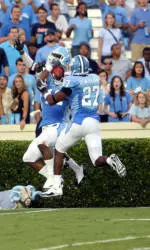
Every Thursday, check TarHeelBlue.com for the latest edition of the Game Guide, which provides all the information you need to get ready for gameday.
The Basics
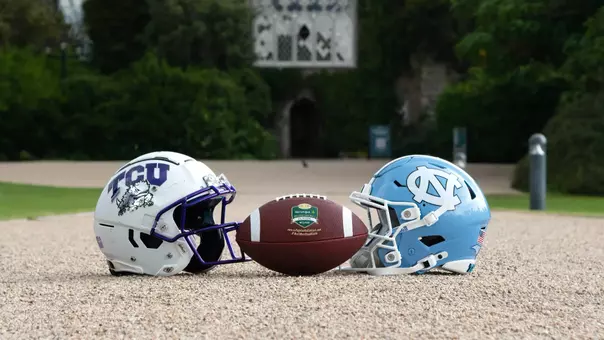
No. 19 North Carolina (1-0) will face Connecticut (1-0) on Saturday at 12:00 PM on Rentschler Field in East Hartford. The Huskies are coming off of a 23-16 win over Ohio University (the game was played on a neutral site in Athens, Ohio). Carolina is coming off of a 40-6 win over the Citadel, its largest margin of victory in the Butch Davis era and largest since a 35-point win over Duke in 2001. Carolina's 40 points were its most in a season-opener since 2004.
This will mark the eighth straight season that Carolina has faced at least one Big East opponent. Carolina's win at Rutgers last season marked the end of a seven-game losing streak to Big East opponents. It was its first on the road against a Big East opponent since 2002 when it beat Syracuse. Carolina had been outscored a combined 106-24 in its next two Big East road trips until it beat Rutgers 44-12. Then Carolina beat Connecticut 38-12 at Kenan Stadium. Carolina is now 3-8 on the road in the last two seasons and 4-4 against non-conference foes. Connecticut is 29-10 at Rentschler Field and 18-3 in non-conference games.
Game Time: North Carolina at Connecticut, 12:00 PM, ESPNU
Carolina's game notes can be found here and Connecticut's official football site is here.
Last Time: The Tar Heels are 2-0 against Connecticut with both previous meetings being played in Chapel Hill, one in 1990 and the other last season when Carolina won 38-12. The game featured Bruce Carter and his three blocked punts, one of which was recovered by Matt Merletti for a touchdown. The Huskies actually got off to a 3-0 lead in the first quarter, but it was the aforementioned Merletti touchdown that gave Carolina a 17-3 lead five minutes before the half. In the third quarter, Connecticut hit another field goal but Carolina responded with 21 unanswered points on a Shaun Draughn 39-yard run, a Marvin Austin interception return for a touchdown and a Hakeem Nicks touchdown.
Donald Brown scored the Huskies' only touchdown in the fourth quarter; Brown (now an Indianapolis Colt) was a highlight for Connecticut with 161 rushing yards. D.J. Hernandez added 103 yards receiving. Quarterback Zach Frazer, who was making his first start, completed 24-of-44 passes for 210 yards and three interceptions. For Carolina, Draughn rushed for 109 yards on 19 carries. Cam Sexton completed 9-of-16 passes for one touchdown and one interception. Hakeem Nicks had three receptions for 55 yards and a touchdown. Quan Sturdivant combined with Bruce Carter for 18 tackles, four for loss; Sturdivant led the team with 11.
Gameday Weather: Check the local weather forecast before heading to the game.
Radio Coverage: Tar Heel Sports Network coverage begins at 11:00 AM. The radio broadcast is also available on XM Channel 193/Sirius Channel 217 at 12:00 PM. Since it's an away game, the Connecticut broadcasters will be heard instead of the Tar Heel Sports Network crew.
TV Coverage: The game will be shown on ESPNU.
Game week TV/radio coverage: "Butch Davis Live", Coach Davis' weekly radio show, will be broadcast live from the Top of the Hill restaurant on Franklin Street every Wednesday at 7:00. Inside Carolina Football with Butch Davis airs Saturday morning at 9 a.m. on FOX Sports South. Inside Carolina Football with Butch Davis will air on Sunday at 11:30 a.m. on WTVD ABC 11 in the Triangle and will review Saturday's game. The show will also be available On Demand on Time Warner Cable channel 1234 for free. The Tar Heel Football Review show featuring highlights of the previous week's games will air Tuesday's at 7 p.m. and Thursday's at 8 p.m. in the Triangle and Fayetteville on the local Time Warner Cable station.
Storylines
The battle of the special teams: To say Connecticut Desi Cullen had a disastrous day against the Tar Heels in Kenan Stadium last year would not be doing it justice. But Cullen told the Hartford Courant that he didn't need off-season therapy to cope with Bruce Carter blocking three of his punts in the second quarter. Turns out, Carter has not been haunting his nightmares per se. "As much as you want to get it out, there's something in the back of your mind it could happen again," Cullen told the Courant. "Unfortunately, it did happen a few more times last season. As far as this season, no, not at all. I don't have that game or any other blocked punts in my head."
Connecticut head coach Randy Edsall always says that a blocked kick will result in a loss 75 percent of the time. Cullen went on to have three more punts blocked that season in three different games. In all, Connecticut had at least one punt blocked in four games and the Huskies went 2-2 in those games. But the two losses came by a combined score of 72-22.
After the Carolina game, Butch Davis had said that it was a strategy for Carolina to go after Cullen's new personal protector, C.J. Marck, to get pressure off the edge. Cullen said he had been probably taking too long, trying to angle the ball away from Brandon Tate. But either way, Connecticut has tweaked its protection to a shield, where seven players stand on the line and three of them literally form a human shield around Cullen. It's also a simplified formation, according to what Cullen told the Courant.
Against Ohio, Cullen punted six times for a 39.5-yard average. Ohio did not gain any punt return yards and four of his punts were inside the 20-yard line. He had a 56-yard punt that pinned Ohio back at its own eight-yard line. Cullen also handles kickoff duties for the Huskies and of his four kickoffs, two went out of bounds. Edsall later blamed himself for asking Cullen to try directional kicking and the senior still averaged 68.8 yards per kick. He wasn't the only kicker to have issues for the Huskies as field-goal kicker Dave Teggart missed a 42-yarder. Teggart made 13-of-15 field goals last season. Cullen's 40.3 average yards per punt going into this season ranked as the highest average in Connecticut history.
Carolina still has Carter on its side, who is still capable of blocking a punt and actually got close at least once against the Citadel. But the Tar Heels are still taking their own special teams issues on the road. There were some bright spots and some problem areas, sometimes in the same special teams' phase. Casey Barth made a field goal but missed his first-ever extra point. He also struggled with his kickoff distance. Then Carolina's punt return unit, not thought of as a problem area, was a disaster, particularly late, as the Tar Heels lost two fumbles that led to all of the Citadel's points. Still, Da'Norris Searcy returned a punt for a touchdown and Kendric Burney had a fantastic 21-yard return that seemed to jump-start the Heels. But Carolina can't afford those kinds of mistakes on Saturday.
After Barth's kickoffs, the Citadel began just one drive at its own 20-yard line or farther back and it began four drives at the 30-yard line or better. Five of Barth's eight kickoffs were at least 65 yards but Carolina and its kickoff coverage unit can't afford to allow drives to start that far out or to allow 22.4 yards per return. Carolina averaged just 18 yards on two kickoff returns but still started each drive at its own 30 or better. Grant Shallock averaged 41 yards per punt and taking out a 27-yarder, it would have been 48 yards. The Citadel did not return any of his punts and started two of its three drives after punts inside the 27 yard-line.
Despite issues in other areas, Connecticut's kick returners did have a fairly good day. Robbie Frey, a return man who earned a special teams' game ball, returned three kickoffs for 85 yards, including a long of 39 yards. The Huskies averaged 24.8 yards per return and Frey averaged 28.3 yards. Frey, UConn's 2008 special teams' player of the year, averaged 21.2 yards per kickoff return last season. Veteran punt returner Jasper Howard returned four punts a total of 14 yards but he had a long return of 10 yards. Howard averaged 10.9 yards per punt return last season, 28th in the nation.
Carolina's inexperienced units stepping up: Handling the jump in competition will be something that the entire Carolina team will have to deal with on Saturday afternoon. But the young and thin offensive line will experience a significant jump in talent. The five starters out-weighted the Citadel's defensive line by over 50 pounds on average (305 to 256). Connecticut's starters weigh nearly ten pounds more and have quite a bit more quickness and athleticism. Connecticut has two substitute nose tackles that weigh more than anyone on the Citadel defensive line.
Carolina's offense was hardly dominant at all, despite scoring 24 points (the defense and special teams scored one touchdown apiece). All four scoring drives were set up by the special teams or defense; three of the four drives began in Connecticut territory and the fourth at the Carolina 43-yard line. Two of the drives were aided by Connecticut face mask penalties. Hakeem Nicks was held to just three catches. Carolina's offensive load was shouldered by Shaun Draughn and Ryan Houston who combined to rush for 148 yards on 22 carries (6.7 yards per carry) and neither had any negative yards. Carolina beat Connecticut partly because it was willing to do what the Huskies normally do so well - run the ball effectively and grind out long drives.
But with a revamped offensive line and young wide receivers, that won't be an easy task. This young line that played well against the Citadel will have a much more difficult task blocking against the speed of the Connecticut defensive line. It's worth nothing, however, that even though the Carolina offensive line allowed one sack, it was one of only 16 FBS teams last week to allow two tackles for loss or fewer. "There will definitely be some ups and downs for them," Alan Pelc said. "But I really think those guys, they've really transitioned well into this program. I really think they're going to do very well if they just keep at it and keep working as hard as they can."
The transition was easier for the young linemen - and even for some of the older ones - in part because of the competition they face each week in practice. The speed and athleticism of Connecticut's defensive line and linebackers will much more closely simulate what they have already faced. "Going against guys like Quan Sturdivant and Bruce Carter and Zach Brown, guys that can fly, it's made us tremendously better," Pelc said. "This week, we're playing Connecticut and their linebackers are some of the fastest linebackers that I've seen. But I've gone up against Bruce Carter and those guys can fly too. So it kind of helps us out. It helps us out in the fact of we know how to take our angles with these guys flying."
T.J. Yates' decision-making will of course be important, but nothing he does will matter if he spends the entire game on his back or his receivers are dropping balls again. An interesting fact: Yates targeted two players five times each, most on the team: true freshman Josh Adams and Shaun Draughn. Each had drops but each also showed the potential to be reliable targets, particularly Draughn as Yates will face considerably more pressure. Zach Pianalto caught the longest pass of the day for 25 yards and he was targeted just once; he could also be a steady target.
This Connecticut team is also a group that won't beat itself. It's generally not a team that will give up big plays, but it is also not just content to let a team march up and down the field and does not often give up long drives. Even though it's early, Connecticut's four sacks last weekend ranked them 17th in the nation. "Last year we felt like that they, structurally, were one of the most sound defenses that we played against. There's really, truly no drop-off this year," Davis said. "They've got six returning starters. They also have two additional players that started the last three games of last season, so you could almost make the case that they have eight returning starters. They're very, very fundamentally sound. They're good tacklers. They don't give up a lot of big plays and they make you earn everything that you get."
The Connecticut defense saved the day last weekend on more than one occasion. The only two touchdowns it allowed were on drives that began at the Connecticut 41-yard line or better after turnovers. On two other Connecticut turnovers in its own territory (one returned to the six-yard line), the defense stood firm, once forcing a fumble and another time forcing a 50-yard field goal after Ohio had gotten as close as the six-yard line again. It was two straight sacks by dominant senior defensive end Lindsey Witten, who will be a load for the Carolina offensive line as well, that pushed Ohio back 17 yards on what ended up being a crucial series. Even at the end of the game, it was a Connecticut interception that sealed the victory as time expired.
Out of 15 Ohio drives, the Connecticut defense forced eight punts, two turnovers, one turnover on downs and one safety. The Connecticut defense shut down the Ohio running game, particularly in the first half, allowing just 13 rushes for 19 yards. The defense held Ohio to three plays or fewer on eight of their 14 drives (not counting one three-play touchdown drive). Three-quarters of Ohio's offensive yards came through the air; they managed just 1.9 yards per carry for the game. "If you go back and take a look at it, they were sixth in the nation last year in total defense," Davis said. "They are fast, they are athletic, they're very experienced, they make a lot of plays, they run sideline to sideline, and they really fit plays well."
The Carolina defensive line: Carolina was able to play 70 players last Saturday night, and ten were defensive linemen. But rather than just seeing some garbage time, all ten of them could potentially play during any game this season, even a close game in a crucial situation. The only true freshman to play, Donte Paige-Moss, recorded a quarterback hurry. The other five reserves combined for three tackles for loss, one sack and two quarterback hurries. To put that in perspective, Carolina's defensive line had just 3.5 total tackles for loss - including its starters - in the final three games combined last season.
Davis mentioned that, although the defense clearly outmatched its FCS opponent physically, he was impressed by the fundamentals and effort displayed by his defensive line, two factors that figure into grading film. Grading on the fundamentals involves looking at technique, fitting correctly in the right gaps, being in the right stance, using their hands well, shedding blocks and getting separation. If they don't do those things correctly - even if they recover and make a play - they get a "minus". But what stood out to Davis was the effort grade, which looks for attitude, determination, and penalizes "loafing".
"We were very much impressed with our effort. We thought that we chased and pursued the ball well on defense," Davis said. "When balls did get completed or when the ball carrier did kind of get to the perimeter, there was a lot of guys pursuing well and getting around the football. Fundamentally, we were in the right places. We weren't gap-unsound.
"But we played to our strengths. We ran fast. We made plays. We put pressure on the quarterback. I think we would have been very, very disappointed had we not played that well. We were fortunate that we held them to 30 yards as far as trying to run the football. When you can kind of turn some games into a one-dimensional game, it certainly helps your defense."
The Tar Heels' defensive line will be tested by not only a better offensive line but also a better running game. But this group has begun to show that it is working hard to turn all of its potential into results. And it will need to do that by putting constant pressure on Connecticut's Zach Frazer and doing what it can to corral the potentially dangerous Connecticut running game. The defensive line's five tackles for loss in the opener were tied for the most they had in any game last season; ironically enough it was a mark set in the season opener against McNeese State.
The defensive line began last season with 14 tackles for loss in Carolina's first four games and had just 13 in Carolina's final nine games, beginning with notching just 0.5 tackles for loss against Connecticut. The offensive line is largely intact, returning three of five starters with the other non-starters either juniors or seniors. If this defensive line has truly taken that next step, it will show on Saturday afternoon.
At The Game
Listening to the Tar Heel Sports Network at the game: The in-stadium frequency at Rentschler Field will be 98.5 FM.
Tickets: Tickets are available for purchase here.
How to get to the game: On the Connecticut website, there is an A to Z guide available. For parking and directions, click here.
What to do in Storrs/East Hartford: The game will be played in East Hartford rather than Storrs, the city that houses the Connecticut campus. East Hartford is about 20 miles away from Storrs. For information on what to do in the area, schedule of pregame events.
Watching At Home
Turn down the sound: If you're watching at home while listening to the radio or over the computer via Carolina All-Access, there will inevitably be some delay. For the reason - and a possible solution - click here. A full list of THSN affiliates can be found here.
ESPNU coverage: The game will be shown on ESPNU. Clay Matwick will handle the play-by-play and David Diaz-Infante will provide color analysis.
Names To Know
T.J. Yates: In a season with a lack of veteran wide receivers, it's fortunate the Tar Heels have a quarterback like Yates, a junior who is naturally one of the more even-tempered signal callers in the league. He never gets too high or too low, though he does get pumped up. He doesn't seem to let much bother him, and that's good, considering this offense will have some setbacks. But Yates was a bit more passive before this season - now, he has taken it upon himself to be the one on the sidelines encouraging his wide receivers to keep their heads up after dropped passes. There is no ego when it comes to Yates, and now that he sees the big picture both on and off the field, it has made him more effective. Not only does he encourage his younger teammates, with a broader knowledge of the offense he is also able to correct them quickly if they are lined up wrong or let them know right away what their mistake was on a play.
As Carolina goes on the road against a very good defense, that even keel Yates has will certainly come in handy. Cam Sexton did not have a fantastic game against the Huskies last season although it wasn't a bad one either. Sexton did manage to end the game completing 4-of-5 passes for 69 yards, including a touchdown pass. Prior to that, he had completed 5-of-11 passes for 56 yards and thrown one interception. Connecticut finished last season ninth in the nation in both pass defense and pass efficiency defense, allowing 168 yards per game. The Huskies were also 15th in interceptions with 18.
But what Sexton often did well last season - and what Yates did well last week - is not force the issue as the offense finds its rhythm. That will be crucial against a defense just itching for Carolina to make a mistake. "In the beginning of the game, we didn't really get things going until the second or third series, (and) then we started moving the ball well," Yates said. "So we're definitely going to have to be patient and just sit there and try to let things work themselves out. I know our defense is going to hold strong so they're going to give us a little leeway out there."
Charles Brown: Last Saturday, the junior cornerback quietly reasserted himself as a force in the Carolina secondary and reminded the Tar Heel faithful of how much of an impact he can make in a game when healthy. Brown had five tackles (four solo) and one of Carolina's three interceptions, also adding a tackle for loss. It was his best game since probably last year's contest against Connecticut, when he had one tackle but two passes defended. Brown was never really fully healthy in 2008, missing the opener and then going out in the Maryland game again with a twisted ankle, missing that game and the State and Duke games. With the year Trimane Goddard had, it was easy to forget how much of an impact Brown had as a freshman who started nine games.
As a freshman, he averaged 6.5 tackles in Carolina's four wins and had at least one pass defended or intercepted in three of the four wins. In the narrow NC State loss, he had a 92-yard interception return for a touchdown and posted ten tackles. He saved the Miami win earlier that season in his first start at nickel back with his first career interception at the Carolina eight-yard line, saving a potential Miami score. Even last season, his impact was shown as Carolina lost three of the four games that he missed and Carolina's opponents passed for 234.3 yards in those four games compared to 222 yards in the other nine games. Also, Carolina's opponents threw four touchdowns to two interceptions in the four games without Brown compared to 11 touchdowns and 18 interceptions in the other nine games.
Granted, Brown was just playing nickel most of last season, but he is a smart player that has a knack for being where he needs to be. Last year during Carolina's first non-conference road win in what seemed like 100 years, Brown had ten tackles and won the Player of the Game award from the coaching staff. Carolina could use that kind of performance again on Saturday.
Jordan Todman/Andre Dixon: Many assumed Connecticut's offense wouldn't be nearly as lethal with the departure of last year's national leading rusher for most of the season, Donald Brown. Judging by the performance of Connecticut's two running backs, sophomore Jordan Todman and senior Andre Dixon, that will not be an issue. Davis compared the duo to the types of fast, play-making running backs Miami has had recently. "One of the things that just immediately jumps off the film is their ability to hit home runs," Davis said. "They are very fast. They can stick their foot in the ground. They can cut in little, bitty, tiny holes. They can really move the sticks and they can run."
Todman was the third-leading rusher last season with 318 yards on 47 carries (6.8 yards per carry), adding three touchdowns. In his collegiate debut last season against Virginia, he had 81 yards on 13 carries. Todman led the way against Ohio with 157 yards on 25 carries (6.3 yards per carry), adding a touchdown. Although it's early in the year, that effort made him fifth in the country in rushing while his teammate Andre Dixon is 39th. Dixon was the main guy in Connecticut in 2007 and earned second team All Big East honors with 828 yards, starting eight games. He won the offensive game ball for his work against Ohio, notching 100 yards on 19 carries. The decisive drive ended up being an eight-play march in which both Todman and Dixon literally carried the load. Todman rushed four times for 31 yards (including a five-yard touchdown) and Dixon rushed three times for 31 yards, including a 24-yarder that gave UConn the ball at the Ohio 12-yard line.
"They are an outstanding tandem of running backs. They don't miss a beat when one guy is in to give the other guy a rest," Davis said. "They both catch the ball very well out of the backfield. They're fast. They are guys that literally when they get the ball and they get to that second level, you start holding your breath. We'd better have great pursuit and we'd better have guys taking good angles, because these guys could make you look bad real quick."
Zach Frazer: Carolina is one of 11 teams to have intercepted three or more passes last week. As a result of Zach Frazer's three-interception day against Ohio last weekend, Ohio is also in that group. The redshirt junior has had a rough beginning to his career, to say the least. He transferred from Notre Dame to Connecticut in 2007 and sat out that season. He had been regarded as one of the ten best quarterbacks in the nation in 2006 when he entered Notre Dame. His first start came in 2008 and it was against Carolina in Kenan Stadium. He threw three interceptions but did complete 24 passes in 44 attempts, both career highs. He would have just one more start. Against Rutgers in the next game, he suffered a head injury late that put him out several weeks. But prior to the injury, he had completed 14-of-20 passes for 236 yards and one touchdown, by far his best outing.
Like Carolina, Connecticut is a team that has had to adjust to its personnel on offense. Donald Brown is no longer there to carry the Huskies' offense, so the passing game has become more important. Zach Frazer's two touchdowns against Ohio last Saturday were nearly half of the Huskies' entire 2008 total passing touchdowns - five. Randy Edsall has installed a no-huddle offense designed not so much to trick opponents as to attempt to balance things out. His running game has carried the load over the past few seasons and he wants to balance the yardage out at the very least, even if that means a few big pass plays combining to come close to the total rushing yards. He wants to capitalize more on his running game to be able to set up big plays down the field, but that won't work if Frazer and his receivers can't connect.
Frazer certainly struggled in his first game in the offense against Ohio, completing just 11-of-24 passes for 127 yards and turning the ball over four times, including three interceptions. He did throw two touchdown passes, however. Two of his four turnovers set up Ohio scores and all four gave the Bobcats the ball in Connecticut territory. His disastrous fourth quarter included him touching the ball four times and turning it over twice.
But he was one of the top quarterback prospects in the nation for a reason, and he was able to show that he could keep drives going at times. On third down against Ohio, Frazer had 13 attempts to convert either by rush or pass and made four first downs. He completed 5-of-11 passes for 62 yards but threw two third-down interceptions and lost a fumble on a rushing attempt. If he is able to get into a rhythm in Connecticut's first home game, Carolina could be in trouble. The Tar Heels will need to be wary of being lulled to sleep by the ground game only to give up a big play down the field.
Lauren Brownlow is the managing editor of Tar Heel Monthly.

Players Mentioned