University of North Carolina Athletics
Extra Points: High and Tight, Take Two
September 3, 2009 | Football, Featured Writers, Lee Pace
Sept. 3, 2009
by Lee Pace
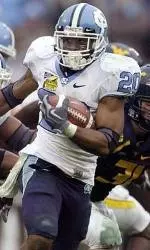
For two years there have been signs throughout the second floor hallways and meeting rooms in the Kenan Football Center picturing a ball carrier clutching a football to the numbers of his jersey with the words "High And Tight." The reminder is constant to Tar Heel running backs to remain diligent in their efforts to protect the ball.
"We're getting obsessive about it," running backs coach Kenny Browning says. "You have a chance to win every game if you protect the football."
The Tar Heels have taken "high and tight" to a new level this season as they work to improve their turnover ratio and, as offensive coordinator John Shoop preaches, have every possession end with a kick--a point-after, a field goal or a punt.
"If you go back and look at games we lost last year, ball security was pretty much the main factor," senior fullback Bobby Rome says. "Pick out any loss we had. If we win the turnover battle, we're 11-1 instead of 8-4. Every last one of those games we were leading going into the fourth quarter, we should have won."
It's not like Tar Heel runners have had a white-hot issue handling the ball. The Heels have lost 11, nine and 10 fumbles each of the last three seasons, that average roughly near the median in college football. But it's the timing and circumstances of many of the mishaps--one at the goal line in a tight game at Virginia Tech two years ago, one in Maryland territory in the second quarter last year in a two-point loss, two early in last November's N.C. State game that helped the Wolfpack take control of the game, one at the West Virginia 30 late in a two-point bowl defeat last year.
"Every possession is critical," tailback Ryan Houston says. "We emphasize it every day. I keep thinking back to my freshman year when I fumbled against Virginia Tech. We could have won that game. It was a heavy burden on my shoulders. But we've all had to grow up and learn to protect the football and move well with the ball high and tight."
The Tar Heels this year have taken a lesson from the trials of former New York Giants running back Tiki Barber, who blazed for thousands of yards in his NFL career but was hounded in his early years by a propensity to drop the ball.
Browning remembers editing highlight tapes of opposing players prone to indiscretions of ball security while coaching defense for the Tar Heels in the 1990s. Barber's proclivity to be careless with the ball was usually included in the tape the week of the Virginia game, and Browning remembered that weakness following Barber into the NFL.
"It almost put him out of the league," Browning says. "He was a gifted runner, but you could take a swipe at the ball and punch it out of there. We made sure our guys were aware of that whenever we played Virginia."
Barber entered the NFL in 1997 and became an integral part of the New York Giants' offenses of the early 2000s, notching nearly 2,000 rushing yards in 2002. Still, his problems handling the ball haunted him as he lost six fumbles in both the 2002 and 2003 seasons, including three in a single game against Philadelphia in December 2002. The arrival of head coach Tom Coughlin and running backs coach Jerald Ingram in 2004 were pivotal in Barber's exorcising his demons.
Ingram and Coughlin taught Barber to change the way he held the ball and built the new technique around the position of the elbow. Barber had carried the ball like many running backs with his elbow out, feeling it was best for his balance, but he learned to carry the ball with his elbow tucked into this body and the ball against his chest. He learned to hold his forearm in a vertical position, 90 degrees to the ground--like you would in an arm-wrestling match. That position tends to secure the ball better against defenders coming head-on or from the side and it denies an opponent from behind access to the ball.

There are other elements to the story as well. Barber improved his upper body strength. He learned to deliver blows to defenders instead of taking them. He learned that second-effort plays are made with the legs and not the arms.
The result was a stronger and more technically sound tailback and the proof was in the statistics from the 2004 season--he lost only two fumbles.
Browning knew parts of the Barber story when he began looking during the off-season for ways to improve the Tar Heels' ball security skills. He investigated through his coaching network, got some background and direction from the Giants' organization and integrated some of the same principles into the Carolina way.
"We call it the `Tiki Technique,'" Rome says, demonstrating his ball-handing motion with a makeshift arm curl. "You hold your arm in an upright position. Your arm is stronger in a full curl position than holding it lower. We work hard on it every day. We're trying to replace a bad habit with a good habit. You keep it high and tight no matter what you are doing."
Browning showed the running backs clips of a mistake-prone Barber and then the 2004-06 metamorphosis years. He showed them one study of how much stronger an arm is held at 90 degrees than at a lower angle, another study that shows a runner actually only needs to move his shoulders to run fast--swinging the arms is not a prerequisite and thus slinging the ball outside the body frame is not compulsory. He instigated a regimen whereby the running backs carry footballs covered with a silky material during stretching and flex periods each day in practice; the balls are harder to hold covered with the slick fabric and force the players to focus at all times on arm and ball position.
"I haven't fumbled in practice, so I see a definite improvement," says Shaun Draughn, the Tar Heels' starting tailback. "Your arm is definitely stronger in this position."

Draughn was a beginner in every category of tailbacking last fall--running, cutting, spinning, waiting for blocks, dodging tacklers, breaking tackles, fighting for more yards, stiff-arming, you name it. One nuance to develop this year is the sense of balancing a maniacal quest for an extra yard with the good sense to go down and live to fight another snap of the ball.
"Shaun's problem was not so much securing the ball while he's running straight up or making a cut," Browning says. "His was in a pile, trying to get one more half yard. With six guys ripping on him, at some point you have to tell him to go down. If you think about it, the harder a guy is to tackle, the more chances they have to get the ball out. If you go down easy, there's no second chance to rip it out."
Butch Davis notes there are two types of fumbles--the first where a player is careless handling the ball, the second where he's trying to scrape and claw for an extra yard and loses the ball in a scrum. Davis told Draughn the story of a game when Davis was coaching at Miami when tailback Edgerrin James lost five fumbles to Virginia Tech.
"We could've benched him," Davis says, "but that wouldn't have been very bright. He was trying to score on every carry. Sometimes when you're a young running back learning how to play, you have to learn when you're still in traffic and how to protect the ball. You don't change the ball from one side to the other just because you think you're about to break free. That comes from experience, and Shaun had none."
Of course, protecting the ball on a running play is only one element to winning the turnover tug-o-war. There is the quarterback making precise throws and there is the defense stripping the ball and snaring passes from their intended targets. The Tar Heels got much better at the overall process in 2008--finishing No. 29 nationally in turnover margin with 23 giveaways and 29 takeaways. That was their best total in years and followed a rut of being abysmally bad on the turnover ledger--in six of the previous eight years, Carolina was in the bottom fifth nationally in turnover margin and in five season was in the bottom 10 percent.
"Turnovers are going to happen, they're just inevitable," Davis says. "Someone is going to come out of the clear blue and hit a running back, but if you're doing the right things often enough, you should see that number shrink. It is the one, biggest, greatest difference in winning and losing--turnovers."
Lee Pace writes "Extra Points" twice weekly on Tarheelblue.com. He and the broadcast crew for the Tar Heel Sports Network answer reader email on the pre-game show, so send your questions to asktheheels@gmail.com.