University of North Carolina Athletics
Extra Points Archives: Memory Lane
September 30, 2009 | Football, Featured Writers, Lee Pace
Sept. 30, 2009

by Lee Pace
The problem was that there simply weren't enough seats for spectators interested in watching the Carolina-Virginia football game each fall. Duke? There was a 28-year lag a century ago when the Tar Heels and Blue Devils didn't play one another. N.C. State? Carolina pounded the Aggies, as State's athletic teams were known in the early days, 204-to-zip over six games in the late 1800s, so there was no point scheduling that comedy again for some time.
No, the game was the Tar Heels vs. Cavaliers. "The Carolina-Virginia game is to the South what the Yale-Harvard game is to the North, and with this idea in view perhaps can be understood the intense and enthusiastic interest which this game always arouses," noted the Yackety Yack in 1906.
The rivalry over three decades was normally consummated in Richmond over Thanksgiving weekend, but by the end of World War I the schools switched to a home-and-home arrangement. Emerson Field served as the Tar Heels' early home venue on ground now occupied by the UNC Student Union and Davis Library, and fans were turned away in 1921, '23 and '25 when Virginia came to Chapel Hill. One account said some 16,000 fans attempted to watch the 1925 game in a stadium with only 2,400 permanent seats augmented by temporary wooden bleachers.
The solution was a new and larger stadium. UNC officials in 1926 introduced plans to construct a football-specific venue and leave Emerson Field for baseball and track and began soliciting contributions from fans and alumni. When contributions stalled in the $28,000 range, an alumnus who had been a halfback during his collegiate days before developing significant business interests in chemicals, power, railroads and hotels stepped up to cover the entire budget. William Rand Kenan Jr. spent some $330,000 on a stadium to memorialize his parents, William R. Kenan Sr. and Mary Hargrave Kenan. Kenan Memorial Stadium was dedicated on Nov. 24, 1927, with the Heels, appropriately enough, claiming a one-point win over their arch-rivals from Charlottesville before a capacity gathering of 28,000.
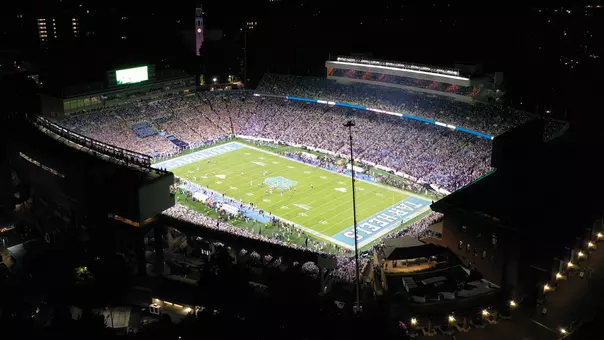
More than 80 years later, one of Kenan's few living descendants is poring over a collection of postcards and photos chronicling the evolution of the stadium--beginning with the aerial view shown in this 1930s postcard from the Barbour Collection in the N.C. Collection Photo Archives in Wilson Library.
"Gosh, it's amazing when you look at the woods around the stadium," says Thomas S. Kenan III. "These are wonderful pictures. Look at all those beautiful trees. That's what Mister Kenan loved. He always talked about the trees. If a tree died, he'd be talking to someone about replacing it."
James Kenan of Duplin was one of the original trustees of the fledgling campus in Chapel Hill and was present on Oct. 12, 1793, when the cornerstone to Old East was laid. William Jr. was his great grandson, and along that generation ridge were eight grandsons and granddaughters.
"Ours was once a large family, but of the eight in that generation, only two had children who survived," says Tom Kenan, UNC '59, who remains active today in the Kenan Management firm that oversees the family's real estate and investment interests. "So the family should have been three times larger but today it's actually very small."
Tom's father was Frank H. Kenan, a Tar Heel football player in the 1930s and a successful businessman with interests in oil, trucking and real estate, and his grandfather was Thomas S. Kenan, who was a first cousin of William Jr. Tom references William R. Kenan Jr. as "Mister Kenan," though at times growing up he and his brother would also call him "Uncle William" since there were so few uncles up the family tree.

As another Virginia week unfolded--Saturday's game will be the 114th between the schools--and as news of further developments concerning the continued expansion of the facility looms in the near future, I thought a visit to Tom Kenan to ferret out some reflections on the family and its stadium was in order.
"Football was always big in our family from the time I can remember being taken to the games," Tom said in launching a stroll down memory lane. "Father always worked hard to get seats on the fifty. I remember the wooden benches in the very early days of my going to games. We brought cushions to sit on so you'd not get splinters in your pants. Then they improved those and then put backs on the benches. Later I was astounded by the plushness of the Chancellor's Box and the Pope Box--who would have dreamed of that after the early days?
"The games were quite an event with a lot of pageantry surrounding them. Everyone dressed for a football game--even students wore coats and ties. When I was in school in the fifties, I remember the cheerleaders being a very prominent part of the game. They were more like movie stars. We've had some memorable ones--Billy Arthur was fantastic and Kay Kyser was a cheerleader."

William Kenan Jr. was a chemistry major at Carolina and during his days in Chapel Hill he and Professor F.P. Venable made the discovery of calcium carbide and pioneered its eventual use in the production of acetylene gas. Kenan graduated in 1894 and later moved to upstate New York to work at what would become the Union Carbide Corporation. He had a home in the town of Lockport and later purchased a 475-acre farm outside town and developed it into one of the world's first scientific dairy farms (direct descendants of those cows graze today in pastures at N.C. State University). Young Tom Kenan visited him there in later years (William Kenan Jr. died in 1965) and came to appreciate his ancestor's love of nature and the aesthetics of landscaping.
"Mister Kenan had a beautiful estate in Lockport," Tom says. "He loved his farm and he had a beautiful garden. He and his wife loved pretty landscaping. So that was an important element to him in looking at this new football stadium.
"He personally inspected the campus and looked at the spots they thought of for the new stadium. What he loved about the one they eventually selected was that it was in a natural bowl and completely surrounded by trees. It was a beautiful setting and convenient to campus and the town. There was a small river that ran through the middle, so they built a culvert to channel the water underneath the field. As I remember, students were sneaking in and walking from one end to the other. It was five or six feet in diameter and you could walk through it."
John Swofford was the Carolina athletic director in the mid-1980s when the university began thinking of removing the stand-alone press and chancellor's boxes that sat at midfield on either side of the stadium and build atop the south side upper deck a new press box. Having heard that Kenan had decreed no part of the structure should ever rise above the tops of the trees surrounding the stadium but having no written proof of the directive, Swofford met with Frank Kenan. He was told by Kenan there was no such stipulation, and Swofford moved forward with the project that was completed before the 1988 season.
"Mister Kenan did want to preserve as many of the trees as possible," Tom says. "But the story that he said the stadium should never be higher than the trees was just mythology, but it's not a bad idea if you ask me. He did love the trees and loved the landscaping around it. He thought that was the real beauty of the stadium, because there were very few stadiums in the country that had any setting like this one. That's why it became known as one of the most beautiful stadiums. Most of them were downtown or they just dug a huge bowl in the ground and built the seats around the hole.
"Someone asked not long ago if Mister Kenan were here today, what would he think? Well, you know, it would be a shock to him, of course. But he certainly was a progressive man and he would have been for progress. But even with the enlargement from 12 years ago and what's coming on now, he would have wanted to concentrate on the landscaping and trees and would have wanted to plant new trees to take the place of the old growth when it dies out. I have seen some of the plans for the stadium's future, and it looks like they are giving quite a lot of thought to the landscaping, to make it more of a park on a year-round basis, not just the days of a football game. I think that element would interest Mister Kenan very much."
On Saturday nearly 60,000 spectators will flock to the venerable stadium to watch another installment of the South's oldest rivalry. A new addition to the west-end football center named for Frank Kenan has just been completed, and further developments to the 82-year-old facility are in the offing still. Fans will still walk along the wooded sidewalks to the game--though admittedly the pines have thinned out considerably by campus growth over the decades. And the words from a 1927 editorial in the Greensboro Daily News bear repeating:
"One moment you are deep in the green and the blaze of autumn leaves, and the next the curtain has disappeared, the land falls away and the panorama of long, graceful lines and gently sweeping curves spreads out. The fitting of concrete into the earth has been achieved with no indication of effort or struggle. The picture fits exactly; it was made for its frame and its frame for it."
Lee Pace writes about the past, present and future of Tar Heel football twice weekly in his "Extra Points" column. He and the broadcast crew for the Tar Heel Sports Network answer your questions before each Carolina game, so pass them along to asktheheels@gmail.com.