University of North Carolina Athletics
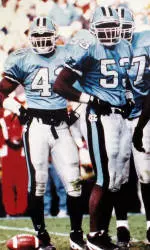
Extra Points Archives: Ultimate Defense
September 9, 2009 | Football, Featured Writers, Lee Pace
Sept. 9, 2009
Editor's Note: Following is one in a series of pieces to run as the 2009 season evolves capturing the story behind a great photograph in Tar Heel football history.
by Lee Pace
It's odd that a sports photograph so void of action and energy should be so appealing. But this image captured by Bill Richards during the second half of the 1996 Louisville game in Kenan Stadium, showing the defensive front between snaps looking to the sideline for the next play call, has long been one of my favorites.
Shame on those of us around that team who wield words for a living for not coming up with an appropriate moniker for the group. This defense was as good in its own right as the Purple People Eaters, the Fearsome Foursome, the Steel Curtain and the Orange Crush. Several years later, a new Tar Heel defensive coordinator named Marvin Sanders looked at this era as the standard and applied the name "Light Blue Brigade" to the 2004 defense. But when the Tar Heels were chopped and slopped by Virginia for 549 yards in week two, the name was unceremoniously chucked into the compost pile.
The lighting on this late afternoon in November lends a surreal quality to the image that shows (L-R) Brian Simmons, Kivuusama Mays, Greg Ellis, Vonnie Holliday, Russell Davis, Keith Newman and Omar Brown. The players are bathed in darkness, the sunlight awash on the far grandstand, and no faces are visible, even up close in an enlarged version. Opposing offenses ventured into the dark hole of this defense and never came out alive. There's unity, a sense of purpose and a calm-before-the-storm element that resonates from the image.
Several years later, defensive coordinator Carl Torbush was reflecting on this group and said, "I've never in my life had a group where you went into every game and felt like whatever you did, you'd be successful."
Louisville gained only one yard rushing as the Tar Heels collected a 28-10 win on the way to a 9-2 regular season and sound thumping of West Virginia in the Gator Bowl. Over two years, the Tar Heels posted a 21-3 record and the defense combined allowed an average of 217 yards and 11.5 points per game and was No. 1 nationally in one of those categories each year.
"That was a sick defense, they were insane," Allen Mogridge says with a broad grin.
Mogridge was a reserve linebacker that year before moving to offense and starting at tackle in 1999. He is now is in his first year on Butch Davis's coaching staff. "They could do whatever they wanted," he says. "Those guys could flat-out run, every single one of them. I don't know what K. Mays ran in the forty, but tackle-to-tackle there was no one faster. Dre Bly had 13 picks that year because no one could throw on Robert Williams."
"It was a dominating defense, the best I'd ever been around in 35 years of coaching," says Ron Case, the secondary coach who today is retired and living in Gibsonville. "I got spoiled. It was the first time I'd been around a head coach and never caught any flak from him for two years. Coach Brown didn't have anything to say, it was like being on a honeymoon for two years."
Mack Brown was in his ninth year as the Tar Heel head coach in 1996 and had led the program through stages of rebuilding, stabilizing and ascending toward a 10-3 record, a pounding of Southern Cal in the season opener and a Gator Bowl berth in 1993. There was a two-year leveling-off period--marked by a "bend-but-don't-break" defensive mindset in 1994 and an interception-ravaged offense in 1995--but in the background Brown and staff were razor-sharp in the recruiting arena and were stockpiling a defense loaded with fast, smart and aggressive athletes.
"By 1995 you could see there was a very good defense developing at Carolina," says Ken Mack, an assistant on George Welsh's staff at Virginia through 1995 who joined Brown's staff for the 1996 season. "When we were studying tape the week of our game in '95, we were a little worried. We put a strong emphasis on running north and south and protecting the football. We knew how fast they were. If we tried to run east and west, we knew we'd get run down."
The Tar Heels upset the No. 9 ranked Cavaliers 22-17 in early October of '95 as Omar Brown, the Tar Heels' free safety, broke up two Mike Groh passes on Virginia's last-gasp offensive threat. That year the Tar Heels started five sophomores and a freshman on defense and had chucked a conservative defensive mindset from '94 into an aggressive scheme designed to showcase the Heels' newfound speed.
Another key piece of the puzzle was the 1996 arrival of Case, an old coaching ally of Torbush's who was a proponent of teaching press-man coverage to his cornerbacks. Case came from LSU in the spring of '96, and it was a startling new look when the Tar Heels lined up against Clemson in the first game with Bly and Williams aligned in the faces of the Tiger receivers, their hands in front of their chests, triggered and ready to fire out at their opponents' numbers on the snap of the ball.
"Ron Case changed the whole philosophy," Mogridge says. "They called him `The Hands Man.' When you played DB for Ron Case, you played with your hands and you played in their face. Of course, it didn't hurt we had the kind of guys we had on the front line pounding the quarterback. That made the DBs' job pretty easy."

By the time Case saw what Bly, Williams, Reggie Love and Terry Billups could do in spring practice in 1996, the Tar Heels had their plan.
"We were playing 75 percent press coverage at LSU, and I wanted to do it here but didn't know if we could," Case says. "That first spring, we locked our own receivers down really good, so I knew we could do it. The kids thrived on it. But you've got to have a great front seven to make it work really well."
Work well, indeed.
Carolina whitewashed Clemson and Georgia Tech and didn't allow any team more than one touchdown the first six weeks of the year. They issued a stress test each week with any combination of linebackers and backs coming after the quarterback from multiple angles. The Tar Heels whipped their opponents mentally and physically.
The following spring, I asked several players what it was like to watch the avalanche of anarchy take hold on their opponents.
"Their blocking schemes get confused and they start arguing with one another," said Mays, the middle linebacker. "It leads to chaos and you keep coming with more and more and more."
"By the third quarter, you can see it in their eyes," said Ellis, an end. "Like they are saying, `Oh no, I've got to pass block this guy one-on-one.' I'm watching for that look. When I see it, I'm gone. You know you've got them beat."
"You can see them start to get frustrated," added Holliday, a tackle. "They'll start arguing. You see that and you start talking and egging it on a little."

Darrell Moody helped recruit some of those players during the early 1990s on Brown's staff and then played against the Tar Heel defense from the offensive staffs at Clemson in 1996 and N.C. State in 1997.
"From coaching against them two years, the thing that stands out to me was what great chemistry they had on defense," says Moody, today a scout with the San Diego Chargers. "Everyone took care of their assignment, and no one went off on a tangent. They had some really good players and some good role players in there, too. They had great depth, which meant people didn't get tired."
Moody remembers Tiger QB Nealon Greene having some open receivers in the 1996 opener, a 45-0 Tar Heel landslide, but never having time to find them.
"Their pass rush never gave a quarterback time to make decisions," he says.
Those two teams had nine players who started both years: Ellis, Holliday and Mike Pringley on the line; Mays and Simmons at linebacker; and the entire secondary of Williams and Bly at corner and Brown and Greg Williams at safety. Senior James Hamilton started at linebacker in 1996 and Newman replaced him in '97; senior Rick Terry started at tackle in 1996 and Russell Davis was next.
Of those 13 players, all but one went on to NFL careers and three are still active--Bly with San Francisco, Ellis with Oakland and Holliday with Denver. Plus, the only starter on that group who did not play in the NFL, Greg Williams, found his way to the league as a coach. He's assistant linebackers coach for the San Diego Chargers.
It's premature, certainly, but some have looked at the array of talent on the 2009 Carolina defense and drawn some tentative parallels to those juggernaut groups of a dozen years ago. One of those happens to be a starter this year, cornerback Kendric Burney. He was familiar with that era of Carolina football from his family's close friendship with Marcus Jones, the behemoth tackle from Jacksonville who started for the Tar Heels from 1992-95.
"I am definitely aware of how good they were, and that's what we're trying to do this year," Burney says. "That was a special group. You talk to any of them or people from that era and what you hear about is the chemistry they had, the fun they had, the speed they had. They were having fun flying to the ball. Why can't we play that way? There's no reason we can't. We have the talent from the D-line down to the secondary, and we have the heart."
That's setting quite a high standard, but why not, indeed?
Lee Pace writes "Extra Points" twice weekly on Tarheelblue.com. He and the broadcast crew for the Tar Heel Sports Network answer reader email on the pre-game show, so send your questions to asktheheels@gmail.com.