University of North Carolina Athletics
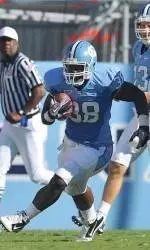
Walking The Walk
October 15, 2010 | Football
Oct. 15, 2010
The Pound Sign
Seventeen players have a pound sign (#) next to their names on the roster in Carolina's 2010 football media guide. That signifies that they `walked on' to the team, as in, were not offered a scholarship and made the team in a manner very much like a high school tryout. The student-athletes paid their own tuition and have dedicated themselves to the program without promise of a scholarship. Sometimes, the work pays off and players are awarded scholarships. Sometimes, walk-ons don't play in games at all. But in all cases, their dedication is to be admired.
Walk-on players are often recruited, but under different circumstances. They must qualify academically on their own merits, and then can join the program. Thirty years ago, Butch Davis was an assistant to Jimmy Johnson at Oklahoma State. The Cowboy football program was reeling from probation and suffered a significant loss of scholarship. To find players to even hold a meaningful practice, Johnson's staff had little choice but to recruit from the student body in Stillwater. That effort produced players like All-Big Eight linebacker Rick Antle, and future New York Jet Matt Monger.
While Oklahoma State was a public (and relatively affordable) institution, that was not the case for Davis at Miami. Still, an occasional walk-on made an impact, like Joaquin Gonzalez, who went on to play for the NFL's Cleveland Browns and Indianapolis Colts. Carolina too has had success with walk-ons, as David Thornton went from a walk-on from Goldsboro High School to second-team All-ACC to starting for the Colts and Tennessee Titans.
Carolina's 2010 roster has been severely affected by a two-pronged investigation that to date has cost the team 39 man-games among starters. With holes to fill in the lineup, less-experienced players have moved up a line on the depth chart and are being asked to play more significant roles than perhaps they anticipated. Whether that's providing more practice reps to starters or seeing more snaps on Saturdays, walk-ons are among those stepping to the forefront.
The Best Christmas Pageant Ever
Senior Trase Jones was a standout at Roanoke Rapids High School. He played quarterback, kicker, punter, safety and wide receiver for the Yellow Jackets. That took care of Friday nights. Needing something to do during the rest of the week, Jones took up soccer. And basketball. And baseball. Carolina assistant Ken Browning contacted Jones at Roanoke Rapids. "He told me once I got here and worked hard, I would be able to get a spot in the starting lineup, maybe on special teams, so I came in and took advantage of that."
Prior to making his decision, Jones weighed offers from smaller programs. Perhaps he'd have had an opportunity to play a larger role at an FCS or lower-division school, but ultimately the chance to play in the Atlantic Coast Conference sealed the deal for Carolina. "I was a recruited walk-on, so I knew what I was getting myself into," he says.
Jones worked out in practice with the Tar Heel kickers but couldn't unseat scholarship players. "I started holding, and that's how I got onto the field." He began holding for field goals and extra points. But when Brandon Tate tore his ACL in a game against Notre Dame in 2008, Jones found himself attempting to fill the shoes of the NCAA's all-time leader in combined kick return yards. The holder had been shagging punts for Grant Shallock and Terrence Brown, and Davis liked what he saw from Jones. "He put me in on special teams and I did well and never dropped anything. He told me he could trust me, so I started against Boston College," Jones says. He had five returns for 36 yards that season.
Since then, Jones has been the key cog between deep snappers Mark House and Trevor Stuart and kicker Casey Barth, and Barth's backup at kicker. "I love my role on the team," he says. "It's very important, because Casey has to be able to trust me, and I have to be able to trust Trevor and Mark. We're all really good friends. It's not like Casey and I are jealous of one another, because we're not at all. We just want to help the team win. We want to make every kick when we go out on the field."
On Christmas Day 2009 - the eve of Carolina's Meineke Car Care Bowl matchup with Pitt - Davis notified Jones that he had earned a scholarship."That was a pretty good Christmas present," Jones says. "I told my parents, and they were very excited." Secondary Option
Junior Pete Mangum waited until well after his graduation from Raleigh's Leesville Road High School before deciding on his next step. His high school coach, David Green, had conversations with Carolina offensive coordinator John Shoop about Mangum possibly walking on to the Tar Heel football team. "I decided I was more comfortable here," Mangum says. "The coaches were nice, and I felt like I fit in."
A high school running back and safety, Mangum impressed the coaches in a tryout period enough to earn a place on the roster. He decided to look past the built-in obstacles that come with walking on to a college football team. Mangum had spent the summer prior to arriving at Carolina working out on his own to get in football shape. When it was time for fall camp, he was ready. "I took every day like it was an opportunity, and when I did get the chance, I gave it my best shot and capitalized on it," he says.
In 2009, Mangum appeared in six games, on special teams. That would probably have been the way things went in 2010, too, until everything changed. Just prior to the Chick-Fil-A Kickoff Game, two players in the Tar Heel secondary were declared ineligible for the season opener. Four more were withheld from the game. All four starters at cornerback and safety would miss the game. Suddenly, Mangum's role became much more important. Young and inexperienced defensive backs that would have gotten their feet wet on special teams were now starters. Players like Mangum, who provided depth, were thrust into roles of their own. Mangum has appeared in all five of Carolina's games in 2010 on special teams, and has been used as the nickelback (the fifth defensive back on passing downs). For his three special teams tackles against East Carolina, Mangum was awarded a game ball.
"They're definitely going to get the opportunities, the first shots," Mangum says of scholarship players. "But I just kept working hard and if [the coaches] need me, they know they can trust me to be there."
And Mangum - like all his fellow walk-ons - has earned the respect of his scholarship teammates. "Pete works his butt off," says Matt Merletti. "He really is one of the hardest workers on our team, and I'm just glad that he's been able to help out."
The Waiting
Adam Curry has never played in a game. The junior has appeared on the depth chart each week of the 2010 season as the backup to Donte Paige-Moss at defensive end, but has yet to see a snap. Carolina assistant Ken Browning was a longtime coach and athletic director at Northern Durham High School, so Browning knew of Curry. The coach allowed Curry to be a preferred walk-on. Curry attended the second summer school session and training camp of 2008 to solidify his spot. "I just worked hard and kept going at it," Curry says. "They see you, and they want to give you a chance to play. A lot of those guys were able to build themselves up and gain scholarships and a lot of playing time."
Curry admits he is a bit undersized for a defensive end, at 6'4 and 240 pounds. But Paige-Moss says he is a model teammate. "He knows the playbook just as good as the coaches. I roomed with him during training camp, and he was able to help me understand the playbook even more, which turned me into a better player."
According to Paige-Moss, Curry also possesses a trait that is essential to a player of his status. "He's not selfish. He's not like, `Why am I number two? I'm getting all these reps, but they're not playing me?' Never once has that come up. He's just for the team."
But like anyone wearing a college football jersey, Curry wants to play. Two Carolina defensive linemen will not play at all this season, and a third is still being withheld. The opportunity for Curry to play would appear to be there. Still, he understands the situation and bides his time. "Everybody wants to play, don't get me wrong, so I just keep working hard at practice and try find a way to reach the field," he says. "They've got some good freshmen in there and they're spectacular athletes and they're able to play, which is good for them."
As for Curry, he will continue to be counted upon in the days leading up to a game, helping the Tar Heel offensive line prepare for the weekend's opponent. "I go out there, give them a look and don't take it easy on them. I make sure they're getting their work in practice. Football's a team sport, so everything I can do to help the team win, I'm going to do." Accountable
When he prepared to graduate from high school, Curtis Byrd knew he wanted to go to a school known for its academic reputation. On the strength of his academic performance at Riverside High School, Byrd was accepted at Carolina. Then, there was the matter of extra-curricular activities. "I was like, `You know what? I was pretty good at football in high school. Maybe I should stick with it.'" Having recruited Byrd's high school teammate Weslye Saunders (a tight end who ultimately committed to South Carolina), Carolina's coaching staff was familiar with Byrd. "I guess it was an easier decision for them," Byrd says.
Still, it was no cakewalk for the walk-on. "Being a walk-on, you have to earn every single opportunity," Byrd says. "The coaches have talked to me like, `We believe you can play, but at the same time we have an obligation to our scholarship guys.'"
Byrd says he actually earned his first measure of respect from the team's linebackers. "There's a drill we call inside run. It's basically isolation with the fullback and linebackers, and my first respect came from them. They said, `Byrd, you can play.' They thought I was scholarship-worthy, whatever that means."
In 2009, Byrd stepped in as the backup to fullback Devon Ramsay as Bobby Rome battled an illness. Rome graduated in May, and Byrd stepped in for a banged-up Ramsay at Rutgers this season. "(It was a ) close ballgame, in the fourth quarter, and I had to finish the game. I was a little nervous, but at the same time, I was ready."
With the Tar Heels nursing a one-point lead early in the fourth quarter, Byrd was targeted on 3rd and 5 at the Rutgers 11. He was tackled after gaining three yards, setting up a 25-yard Casey Barth field goal to push the lead to four. Later, the Tar Heels had two possessions to attempt to run the clock out. "I had to go in there and make some blocks, and there it was: ballgame."
Since the game against East Carolina, Ramsay has been held out due to the ongoing NCAA investigation. That leaves Byrd and converted tailback Anthony Elzy at fullback. Byrd admitted that more playing time represents a step up in mental intensity, even as the business major balances his academic demands. The season actually makes time management easier, as routines are set and followed. "For my future, I know I need to get this degree, so it's all a matter of focus and staying true to what you want to do and the necessary path you have to take to get there."
While Byrd is an academic senior, he will have a year of eligibility remaining in 2011. He anticipates he'll stick with football as he enters Carolina's Masters of Accounting Program. "I'm playing a significant amount of time, the coaches have been telling me I'm doing a good job, so I'm feeling good," he says.
"He's paid a lot of dues, just coming out here just trying to get noticed," Davis says of Byrd. "It's rewarding for him and it's good for the team to see somebody have that kind of success."
Walking Tall
Carolina fans are accustomed to seeing the men's basketball Blue Team, four or five walk-on players that burn the final few minutes of clock off the scoreboard or occasionally steal time to rest regulars in the middle of a game. On the football side of things, that simply hasn't been possible, at least in 2010. With the conditions this team is facing, Davis and his staff have used every avenue to find contributors. "There's just been a lot of guys that have made some really good contributions," Davis says. "We're getting probably six or eight of them every single week that are having to play on special teams, that are playing some back-up roles."
Some fans may call walk-ons `scrubs,' but Paige-Moss says no one within the program looks down at them. "If you're here, if you go through training camp, if you go through the practice, if you go through the stuff that Coach [Jeff Connors] puts you through, why wouldn't you get the respect?" he says. "They're paying to do this stuff that some of the times I don't even want to do. For me, as a person, I respect them even more than some of the scholarship people, just because they actually show more love for the game."
For their part, the walk-ons will continue to work hard. And they'll play hard, if and when that chance arises. "Getting an opportunity to make tackles and help my team out," says Mangum, "I don't see a downside to that."
Turner Walston is the managing editor of Tar Heel Monthly. Turner's weekly Tar Heel football podcast, The Walkthrough, is available on iTunes.
Follow the THM staff on Twitter.