University of North Carolina Athletics
Extra Points: The Rest of the Story
October 4, 2010 | Football, Featured Writers, Lee Pace
Oct. 4, 2010
by Lee Pace
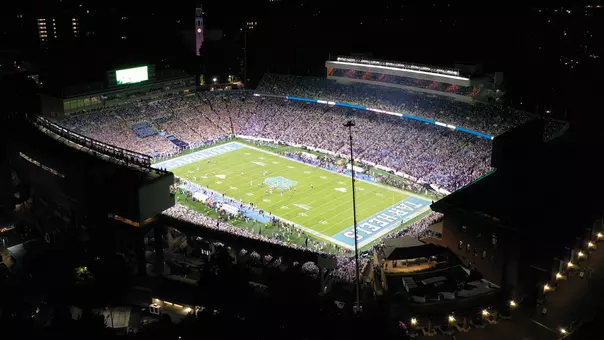
Another of those gleaming football Saturdays in Chapel Hill was winding down, one where the blue of the sky and green of the pines are channeled through a prism and seemingly ratcheted up ten degrees, and up on the fifth floor of Kenan Football Center the main characters were grinding out sound bites and snippets of information for the assembled news media.
Coach Butch Davis saluted his team's resolve to win its second straight game, a 42-17 decision over East Carolina that got easier as the afternoon wore on. Safety Da'Norris Searcy told of getting weepy on the eve of the game at his surprising eleventh-hour clearance after three games of suspension and the thrill of his pivotal second-quarter interception. Receiver Dwight Jones spoke of his quiet moment of prayer following his first collegiate touchdown. Alan Pelc smiled broadly as he catalogued the abilities of tailbacks Johnny White and Shaun Draughn and how blissful it makes the goliaths of the blocking front when a team churns out 263 yards of rushing.
Indeed, two victories after two narrow misses amidst all the off-the-field tremor of 2010 left the Tar Heels in a modest degree of radiance as the sun settled early in the evening.
"We're pretty happy right now," quarterback T.J. Yates said. "We're getting guys back game by game. Everyone's excited, energetic. We can't wait to play next week."
One onlooker with more than a casual interest in the proceedings, those both on the field and far beyond it, had been in the football center for much of the afternoon. Steve Reznick, a 1973 Carolina grad and presently a professor in psychology, had visited with recruits and their parents in town for the game and answered their questions about majors, classes and things they needed to think about as their high school careers continued. He watched Davis conclude his press conference, lingering in the background and keeping to himself some opinions about the media coverage that had lambasted Davis and the Tar Heel program over the last two months and built to a crescendo over the last week.
What follows, as Paul Harvey might say, is the rest of the story, a perspective from a UNC faculty member who has nine years at Harvard and 11 at Yale to vouch for his academic bonafides; who enjoys recreational sports like tennis but is not a jock and doesn't even consider himself a serious sports fan; who for many years knew little about Carolina athletics beyond men's basketball until being elected to the Faculty Athletics Committee in 2006; and who, over the last half decade and in his third term as chair of the FAC, has gotten an insider's view of the football program and athletic department.
Reznick was a bit surprised to learn early on that such functions as academic support and tutoring were supervised by the College of Arts and Sciences, and that Sports Medicine is administered through the Office of Student Affairs. Neither one falls under the auspices of athletics and the department's director, Dick Baddour.
"That is unusual," he says. "Often those functions would fall within athletics at other institutions."
Reznick, an associate dean for undergraduate education and a member of the admissions committee, also learned there is no free pass for incoming athletes.
"I am sure at some schools the football coach hands the director of admissions a list of players to admit," he says. "That is not the way it works here. Every student-athlete is screened carefully to make sure they have a good chance of being a successful student."

He admits he doesn't know every coach on Davis's staff well enough to make a blanket character appraisal, but he has gotten to know enough of them quite well.
"I have been impressed with their character and commitment to the educational mission of the university," he says. "If you were to lower me down the well in a bucket, I'd be comfortable with Sam Pittman holding the rope," he adds, citing the offensive line coach as one example.
Certainly, the allegations of impropriety on both the academic and agent side of the ledger are troubling. No doubt some individuals have made bad decisions and some structures have broken. That doesn't mean the foundation is riddled with termites. Reznick cites the Carolina Leadership Academy, an athletic department initiative created to help players and coaches become better leaders in academics, athletics and life outside Carolina, as a resource that serves a valuable purpose.
"Part of leadership is helping student-athletes learn what it's like to be in a position where people are watching you and are always expecting you to do the right thing," Reznick says. "We have leadership training already, and now we need to consider if there are additional aspects of training we need to embellish. Perhaps we need to put more emphasis on the idea that, `in summer you are still a Carolina student-athlete,' that sort of stuff. I am confident that we will make appropriate adjustments."
Another man with some interesting opinions is standing in the gloaming outside Kenan Football Center as Tar Heel players, now showered and dressed, exit the building carrying their post-game pizzas and wearing broad smiles. Just as Steve Reznick has proper credentials to offer his views on the cleat-and-gown relationship, so too does Lew Merletti on the subject of leadership.
This is a man who earned a Bronze Star as a member of the U.S. Army Special Forces (a.k.a. the Green Berets) in Vietnam in the late-1960s; who worked for a quarter century for the U.S. Secret Service, 13 of those years in the White House under Presidents Reagan, H.W. Bush and Clinton and two as director of the Secret Service; and who, after retirement from the service, joined the Cleveland Browns as a senior vice president and is in charge of running background checks on potential Browns players and supervising security at Cleveland Browns Stadium.
"I believe I know something about leaders," Merletti says. "I have seen them in the White House. I have seen great ones and poor ones. On the ground in Vietnam, you have true leaders and some of the others who don't even make it out. There, it is life and death. I know what a good leader is."
Merletti offers that as a preamble to speaking of his son Matt's experience at Carolina and his iron-clad support of Butch Davis as the Tar Heels' coach. Merletti Sr. first met Davis when Davis was the Browns' head coach. He remembers Davis's instructions in compiling data on college players, his directive to beat the bushes for insights into players' character, his views that bad people quit on you when things get hard. He also remembers Davis taking the time to speak to the ball boys on game-day Sundays, something young Matt never forgot as well.
"I know this man," Merletti says. "He is an extremely good leader. He's a man of integrity, a man of character. I know this. I saw it first-hand. I haven't the slightest reservation about him. My son came here a boy. He'll leave soon a man. Butch Davis and these coaches have taught him about integrity and commitment. I couldn't have asked for a better place to send my son--a school with a high academic reputation and a coach of high values and character. Those were the two things I was looking for when Matt was looking at college."
"I have seen this play out in Special Forces, in the White House, anywhere in life," he says. "There is always 10 percent that are not going to accept lessons, not going to accept the principles we're talking about. People are human. They are going to make mistakes. Some are going to go with the system and do extremely well. Some are going to test you. Unfortunately, that's the nature of mankind.
"I am so happy for this football team and this university that we have a strong leader like Butch Davis," Merletti says. "If you didn't have a strong leader, this program would collapse. This team would collapse, the people would collapse. There would be devastation. But look what's happened the last two weeks. These players are rising to the challenge. It's wonderful to see. In adversity, there's opportunity. You're seeing proof of that in front of your eyes."
With that, Merletti welcomed and congratulated his son, a safety who recovered from a knee injury in 2009 to start four games this year and improve each week--with an interception at Rutgers, a nice break-up against ECU and always expert management of the punt team from his "personal protector" position. Their group heads out into the night, the traffic still snarled around Kenan Stadium as happy Tar Heel fans make their way out of town or down to Franklin Street for an evening of overdue revelry.
There are still lights shining on the fourth floor as the Tar Heel coaches exit to dinner with family or recruits, but eventually those are turned out as well. Darkness falls in the office of defensive coordinator Everett Withers, where a grease board hangs with a quote from legendary UCLA basketball coach John Wooden:
"Things turn out best for the people who make the best of the way things turn out."
1979 Carolina graduate Lee Pace (leepace7@gmail.com) is in his 21st year writing about Tar Heel football under the "Extra Points" banner. Look for his missives each Monday during the season. Pace and the broadcast crew of the Tar Heel Sports Network answer questions from fans on the pre-game show; submit them to asktheheels@gmail.com.
Players Mentioned