University of North Carolina Athletics
Extra Points: TJ On Tape
November 12, 2010 | Football
Nov. 12, 2010
By Lee Pace
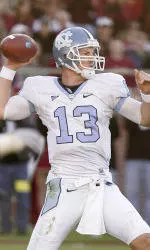
Through nine games, Tar Heel quarterback T.J. Yates has completed 66 percent of his passes for 2,312 yards and 15 touchdowns and has only four interceptions. His efficiency ranking of 153.4 ranks second in the ACC. He has hit strikes of 97, 81, 52 and 51 yards.
Those are the cold, hard facts, the details apparent to anyone watching.
What's more interesting about Yates' performance in 2010 is prying beneath the surface, dissecting the minutia that turn an average quarterback into an outstanding one.
Offensive coordinator and QB coach John Shoop has his computer mouse, laser pointer and database of digital clips of every offensive snap of the 2010 season at the ready to highlight some of the nuances behind Yates' senior season.
First Shoop cues up footage from the East Carolina game Oct. 2, a 42-17 Tar Heel win. There are five minutes to play in the first quarter, the Tar Heels have a first down at midfield. Yates is over center, the Tar Heels are lined up in a three-wide set.
"If they have two safeties, we're running the ball. If they're in single safety, we're passing," Shoop says. "T.J.'s making the decision and the call."
ECU moves a safety up closer to the line of scrimmage. There are no sudden or sharp moves from Yates, no backing out of his stance under center, no tell-tale sign that Yates is switching to another play.
"The thing I like is that watching on film, you can't tell that he's checking," Shoop says. "If I can't tell he's checking, the defense probably can't either. That's good for us."
Yates has checked into a pass play since ECU was looking for a run and as the play develops, Yates has a defender in his face and another diving at his legs. But he has the wherewithal to get the ball pass off, hitting tight end Zack Pianalto downfield for a 26-yard gain, helping set up a touchdown.
"Someone will say, `He's throwing off his back foot,'" Shoop says. "Well, you have to do that a lot. You have to take real short steps or make no-step throws. We talk in terms of a batter in baseball--you have to swing more like Albert Pujols or Nomar Garciaparra than Barry Bonds or Sadaharu Oh with that big leg kick.
"So here he's getting us into the pass because they have a single safety and he's throwing with people at his feet. That's a big deal to me. Seventy percent of the balls you throw, you're off-balance. If you watch us practice, you'll see us throwing off-balance quite a bit."
Shoop moves ahead to later in the ECU game, just under six minutes to play in the first quarter. Carolina has the ball second-and-10 at the Pirate 13. The Tar Heels are in a five-wide formation, and Yates is about to hit Dwight Jones on a quick slant pattern from the left for a touchdown. The Pirates look to be sending six men, giving them the edge of a six-on-five pass rush, but what evolves is a good example of adjustments by the line and Yates knowing where the danger is coming from.
"We're out-numbered, but the thing we're concerned about is protecting the A and B gaps," Shoop says, referring to the inside gaps from tackle-to-tackle. "If we force them outside, we're okay. Anything that comes on the edge is T.J.'s responsibility to beat. This is not just a great job by him, but by the line as well. We had this play against Miami last year and it's a touchdown if our tackle adjusts and blocks down. Instead he let a guy come free up the middle and it's a sack."
Shoop directs his pointer to James Hurst, the Tar Heels' freshman left tackle who correctly ignores a linebacker looping to the outside and instead blocks to the inside against an end slanting toward the middle. Yates delivers the ball in time and nails Jones for the touchdown.
"That's good," Shoop says. "We're protecting the A and B gaps. One guy comes free on the edge. All T.J. needs is a millisecond."
Shoop cues up a big play in the Clemson game a week later, a 21-16 Carolina win. The Tar Heels are nursing a 14-10 lead midway through the fourth quarter and are going for it on fourth-and-four at the Clemson 30.
"This is probably my favorite play of the year," Shoop says, then goes on to show how Yates checks into the proper protection and Johnny White runs an excellent route against Clemson defender DeAndre McDaniel. White runs about six yards on a slight angle toward the sideline, then cuts sharply to the inside--"He breaks the safety's ankles," Shoop says--and is open for a 12-yard gain, setting up a Tar Heel touchdown.
"The important thing here was how T.J. checked the protection," Shoop says.
He notes that Clemson is in what's called a "solid front," meaning that Tiger defenders are lined head-up on the Tar Heels' two guards and center. He highlights Pianalto, lined up on a wing to the left and scheduled to run a pass route downfield. But Yates' knowledge of Clemson's tendencies in this front alerts him to audible the protection and tell Pianalto to adjust his assignment and stay in to block. That allowed the line to slide its protection and pick up the twist executed by two Tiger linemen.
"Changing the protection was a big deal," Shoop says. "T.J. feels the pressure and makes a short-step throw. We didn't want five-on-five, we wanted the extra guy and that's why it worked."
Shoop scrolls ahead to Carolina's 44-10 win at Virginia a week later and finds two more plays that highlight the evolution of Yates and the offense. Yates' completion to Jones for an 81-yard touchdown--Jones sprung by Ryan Taylor's punishing block on a defensive back--jump-started the Tar Heel offense. But two plays Shoop really likes are a 46-yard completion to Pianalto to set up a field goal and a 20-yard strike to Jones for a touchdown late in the first quarter.
Carolina has second-and-20 at its 27, and Shoop notes the call is similar to one he dissected moments ago from the ECU game.
"This is a `run-pass check-with-me,'" he says. "We have a pass on. But if they're in two safeties, he checks to the run. I don't know what he's going to do. Watching upstairs, I was thinking they might blitz and he might go to a blitz audible."
Shoop shines his red pointer on the Cavalier linebackers, two of whom are looming ominously at the line of scrimmage, snorting as if they're ready to storm the line.
"T.J. said he just didn't feel those guys were coming," Shoop says. "He could have checked and kept Zack in. But he felt they were bluffing. That's hard to coach. How did he know that? Instinct, experience, hours watching film."
Yates is correct--Virginia doesn't blitz. He has ample time to find Pianalto in the seam of Virginia's zone defense. Pianalto reels in the ball and races 46 yards downfield.
On the Tar Heels' next possession, they drive to the Virginia 20 and face third-and-20. Jones is split to the right, runs seven yards hard off the ball, feigns an inside cut and turns back to the right side of the end zone.
The first thing Shoop likes is the fact Jones fights off the jam from the Virginia cornerback. The week before against Clemson, the Tiger defensive backs were inordinately physical against the Tar Heel receivers, banging them, disrupting their routes and making their day miserable in general.
"Clemson really challenged us," Shoop says. "We asked our guys the next week, `Can you beat bump coverage or is this the blueprint for shutting you guys down the rest of the year?' Dwight took it to heart. Getting beat up wears on you. But Dwight blows by him."
Shoop doesn't like the fact that a Tar Heel blocker is whipped and Virginia's Zane Parr storms the middle of the line and is in Yates' face at the very instant that Jones is coming out of his hitch move. But he loves the way Yates stands calmly amid the heat and lofts the ball to Jones, who collects it for a score and a 17-3 Carolina lead.
"This is what life is like as a quarterback," Shoop says. "Dwight is not even close to coming out of his route and the ball's already out. Someone might say, "Well, he under threw him a little.' Come on, man, T.J.'s getting his butt handed to him. That's what's special.
"I am telling you, there are quarterbacks in the NFL whose eye-level would drop right now. A lot of quarterbacks I've coached, that's a sack. But he's keeping his eye level up and the ball leaves his hand. That's how you avoid sacks--by throwing it, not by running. He got nailed. Against Clemson and Virginia, T.J. got bloodied, beat-up. He was hurting. So that's big-time standing in there."
Shoop runs the pass over and over in short sequence.
"Boom, boom, boom," he says. "So he's on his back foot? The TV commentators drive me crazy, talking all the time about throwing off your back foot. He's throwing off his back foot for the same reason Kobe Bryant's shooting the ball off-balance--he has no other choice."
1979 Carolina graduate Lee Pace (leepace7@gmail.com) is in his 21st year writing about Tar Heel football under the "Extra Points" banner. Look for his missives each Monday during the season. Pace and the broadcast crew of the Tar Heel Sports Network answer questions from fans on the pre-game show; submit them to asktheheels@gmail.com.

Players Mentioned