University of North Carolina Athletics

Extra Points: Curtains Up
September 3, 2012 | Football, Featured Writers, Lee Pace
By Lee Pace
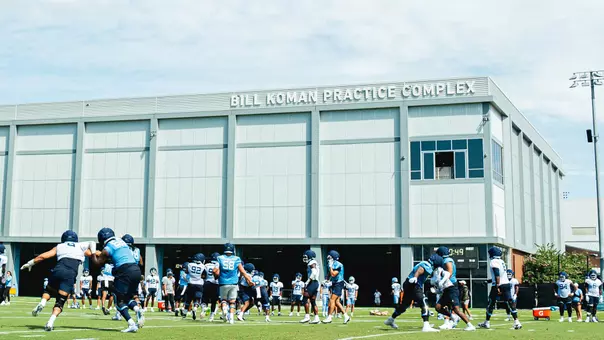
Almost daily on the practice field during spring and August camp, the Tar Heel receivers and return specialists lie prone on the turf, their heads in the direction of a curious contraption set some 40 yards away. A manager drops a football between what looks like two spinning tires, and the ball spurts out of the apparatus in a tight spiral. Receivers coach Gunter Brewer whistles at the launch of the ball, and the player fires off the grass, spins, locates the ball and tries to make the catch—all in the blink of an eye.
At other times, receivers attempt to field balls while two defenders jab and grab at their arms, shoulders and hips. Still another drill has one player standing between the quarterback and receiver; his job is to tip the ball before it arrives to the target, forcing the receiver to learn to focus on the ball's new trajectory.
“It all comes down to concentration,” Brewer says. “The great ones can find it and go get it, no matter what the distractions.”
Case in point: Young Quinshad Davis, a freshman from Gaffney, S.C., who made a highlight reel catch in the first quarter of Saturday's 62-0 win over Elon. Racing down the Phoenix sideline near the 10 yard-line, Davis turned for a pass from Bryn Renner. The ball was tipped by an Elon defender. Davis left his feet, grazed the ball, then was hit from behind and upended by an Elon cornerback. He kept the ball in his sights and pulled it in just as he was landing on his backside. The completion went for 18 yards to the Phoenix five, setting up the Tar Heels' second touchdown. It was 14-0 Carolina at the first-quarter gun and the outcome was never in doubt as the Tar Heels overwhelmed the visitors from Burlington.
“I just kept my eyes on it and caught it,” Davis said. Caught in the maelstrom of a post-game media crunch, the 18-year-old was wont to pump his chest out, though when prodded he did acknowledge: “You have to be confident in yourself. I know I'm a freshman, but I think I can play at this level, I can play with anyone.”
Watching on the Tar Heel sideline was Sam Aiken, who caught 146 balls from 1999-2002 before spending eight years in the NFL. Aiken has returned to Chapel Hill to finish work on his degree and is a volunteer student assistant coach, working with Brewer and the receivers.
“Quinshad is very talented and very coachable,” Aiken says. “He takes pride in his position and his ability. He's always asking what he can do to get better, to learn more. It was a great catch. He never took his eye off the ball, no matter what was going on around him.”
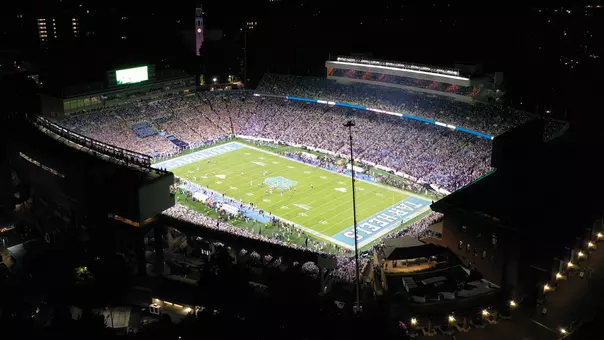
One photo of the catch, taken from the end zone and showing Davis falling to the ground with the ball in his grasp near the northwest corner of the Kenan Stadium, is eerily reminiscent of an image of Aiken cradling a touchdown pass against Florida State during the Tar Heels' epic 41-9 win in 2001.
“That's a special corner down there,” Aiken says with a chuckle.
Also smiling over Davis's potential is offensive coordinator Blake Anderson.
“Quinshad's got a chance to be a big-time player for us,” Anderson said. “He will do some things this year as he gets more comfortable that people will go, 'Wow.'”
Davis caught only the one pass Saturday, but he represents the template of what could and hopefully will happen with Coach Larry Fedora's program in time. He was a big-time recruit offered by every premier school in the South, but he didn't have Carolina on his radar until Fedora came to Chapel Hill last December. He liked Fedora's energy and enthusiasm and the spread offense Fedora runs similar to the one Davis knew in high school. He was impressed by the work Brewer had done with receivers like Dez Bryant and Justin Blackmon at Oklahoma State. He saw Carolina as a comfortable academic fit that matches his 3.4 high school GPA credentials. He said no to Clemson, South Carolina, Tennessee and Wake Forest just hours before signing with the Tar Heels in early February.
“His coach told us in January, 'You're not even in the picture with this kid,'” Fedora remembers. “Guys had been recruiting him for years. Gunter did a great job building a relationship with him and his family in a very short period of time. You could tell the weekend they visited, he wanted to be a Tar Heel. The kid fell in love with Carolina.”
Davis was just one of a number of warm-and-fuzzies in the Tar Heel camp Saturday. Certainly the result has to be tempered against the backdrop of playing an FCS school that finished in a tie for sixth place in the 2011 Southern Conference race. But in other such games over the years, the Tar Heels have been taken to the wire by Furman in 2006 and William & Mary in 2010 and were losing to McNeese State in the third quarter in 2008 before taking control late in the game. The game was far more significant than another intra-squad scrimmage and not nearly as testing as what the Tar Heels will find Saturday in Winston-Salem, when they face Wake Forest.
“It was only our first game, we have a lot more games and a long season ahead,” senior linebacker Kevin Reddick said. “We knew what to do, we flew around and made some plays. The DBs stepped up like they were supposed to and stopped their screens. There might have been a couple of missed assignments, but overall no one got beat deep. We didn't give up a big play.”
The coaching staff was nervous opening on a sunny day with temperatures eclipsing the 90-degree mark (the official high was 92) after a fall camp conducted in unseasonably cool conditions. Five days in August had temperature highs that reached only into the 70s. But the summer regimen under new strength and conditioning coach Lou Hernandez and a tighter focus on nutrition that has helped a number of players trim excess weight combined to put a svelte and cardio-healthy team on the field Saturday. The lopsided score helped, allowing the coaches to play everyone they're not planning on red-shirting.
“It was great not carrying those 30 pounds around,” said defensive tackle Sly Williams, who along with offensive guard Travis Bond and running back A.J. Blue are among those benefitting from a tauter waist. “It was easier to move around and you could breathe a lot better.”
Two turnovers and three penalties stuck in Fedora's craw afterward, and he lamented that the offensive tempo seemed stuck in molasses at times. That's relative, of course. An offense that was snapping the ball by the 15-second mark on the play clock most times and reeled off 74 plays despite taking its foot off the gas late in the third quarter seemed lickety-split to everyone else.
“Coach was on me the first couple of drives to push the tempo harder,” Renner said. “We've got to get better at that. But we will. It was the first time against a defense other than our own. It took a while to adjust and see what they were doing. Once we got in a rhythm, we got better. We'll be better next week, I'm sure.”
“It was not fast enough for what we want, but we'll get there,” Anderson added. “It takes a while. All camp you're going against a quick whistle and in a controlled environment. As hard as you try, you just can't create in practice the speed and tempo and chaos that come in a real game.”
The Tar Heels certainly have the weapons on offense—among them running back Giovani Bernard, who had 203 all-purpose yards in less than a half of play; guard Jonathan Cooper, who looked like a fullback pulling and leading the way on several Bernard runs; and tight end Eric Ebron, who had two catches for 53 yards and will be a beast this fall.
They were also efficient in special teams—kicking, snapping, covering, returning. Carolina has good legs in Casey Barth and Tommy Hibbard, and Fedora's philosophy of placing special teams workhorses atop the team hierarchy is not lost to his players.
“Special-teams starters, we're the first in line to eat,” said Romar Morris, a running back and key member of the punt and kick-off cover and return squads. “We ride in the first bus from the hotel. Coach Fedora loves special teams. They're a priority.”
Perhaps among the most encouraging elements of the game was the defense, which limited Elon to 170 yards and no points—the first shutout a defense has delivered since Carolina whipped Duke 38-0 to close the 1999 season. Elon's NFL prospect at wideout, Aaron Mellette, had only two catches for nine yards. Co-defensive coordinator Vic Koenning has shown a penchant to clamp down on big-time receivers, witness his Clemson defenses holding Georgia Tech's Calvin Johnson to four catches in 2005 and zero in 2006.
“If we want to zero in on a guy, we've shown an ability to do that,” Koenning says. “Our guys did a good of executing and taking away No. 3. We pretty much shut down the run and made them one-dimensional. We created a couple of takeaways, a couple of them on strips, which we work really, really hard at. We had a couple of interceptions. We tried to take away their best guy, not give up any big plays and continue to be aggressive. That's the nature of what we do and what we'll continue to try to do.”
Koenning spoke of a football team being like a herd of horses, each animal with a blinder strapped to his head: You can't look behind, you can't look to the sides. You look only forward.
“You've got to give credit to the kids and the strength staff, they worked really hard this summer and during camp,” he said. “The work paid off. One's game in the books. You keep your nose to the grindstone and move on to the next one.”
Koenning and Reddick had only one major quarrel—that the defense itself didn't score a touchdown. That's a high standard that bears watching as the 2012 season unfolds.
Lee Pace ( leepace7@gmail.com) enters his 23rd Tar Heel football season writing “Extra Points” and ninth reporting from the sidelines for the Tar Heel Sports Network.
Players Mentioned