University of North Carolina Athletics

Pickeral: Fedora's Tempo Rooted At MTSU
September 4, 2013 | Football, Featured Writers
by Robbi Pickeral, GoHeels.com
CHAPEL HILL - Wes Counts insists he could run. He even had a 100-yard-plus rushing game his senior college season.
The former Middle Tennessee State quarterback just couldn't run quite fast enough. Which, in a twist, has become a boon now for North Carolina.
"Thank goodness I was slow or there would be no Larry Fedora today,'' the 2001 Sun Belt Conference Player of the Year quipped earlier this week, laughingly tongue-in-cheek. "I need to send him a bill for that."
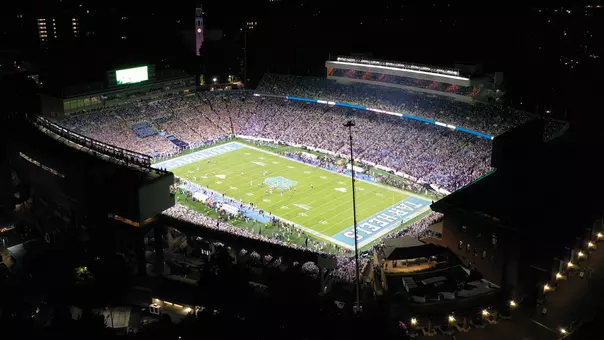
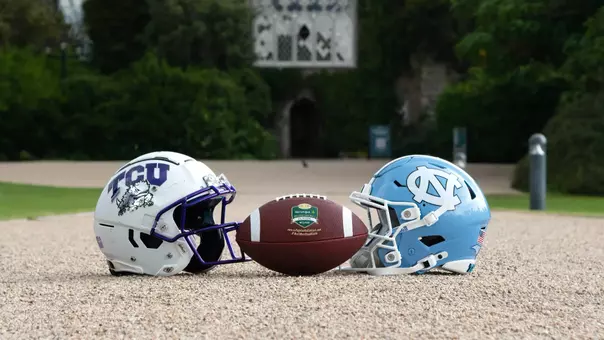
When UNC faces the Blue Raiders at Kenan Stadium on Saturday, it will be playing the program that first gave Fedora, the Tar Heels' second-year head coach, the chance to try the high-octane offense that has become his (and now North Carolina's) staple.
The story goes something like this: When Fedora got his first offensive coordinator job, under Andy McCollum at MTSU in 1999, he had two choices. He could run the option, similar to his previous job at Air Force, or install something he had always dreamed about: a multi-tempo, no-huddle spread.
The decision was made, Fedora said, when he got a look at the 6-feet-1 Counts.
"He was a left-handed kid, and didn't have a whole lot of ability, but ... knew where to go with the ball and how to get it there, and he was very, very accurate,'' Fedora said.
So accurate that Counts finished his career as MTSU's top passer in yardage and touchdowns, and boasted the best completion percentage in the nation (72.6) in 2001. But that came later, after a lot of snaps, a lot of sweating. And a whole lot of ear-ringing.
"We had run some spread -- some four-wides (sets) -- in the past, but we weren't no-huddle and we didn't have the up-tempo speed that Coach Fedora wanted us to,'' Counts said. "I think we all were introduced, rather rigidly, the first couple of weeks of practice - because it was a bunch of yelling and screaming and hurry up and line up. I think we were a little overwhelmed for a while."
That is, before they started overwhelming defenses.
MTSU won only three games in 1999, the season it jumped from I-AA to I-A. But under Fedora, all of its numbers quickly increased. The next season, the Blue Raiders went 6-5. In 2001, Fedora's third and last season in Murfreesboro, they went 8-3 and finished as co-Sun Belt Conference champs.
By the time Fedora left to become an assistant coach at Florida, his three MTSU teams had averaged 424 yards of total offense and 31 points per game. They also had set 43 school records.
"The speed of that offense was foreign to everyone, and that was part of the reason we were successful, because no one was going as fast as we were back then,'' Counts said. "We heard rumors where [an opponent's] defense was going against two offenses in practice, trying to do what we did.
"During games, we were waiting on the referee to get the ball down: 'Hurry up, put the ball down, because we've got to go.' So the speed is where Coach Fedora and that staff took a bunch of players who couldn't really play and made them pretty successful."
After Fedora left, Blake Anderson - now UNC's offensive coordinator - became co-offensive coordinator of the Blue Raiders, "and the bar was set pretty high. We did our best to continue it. ... It was some big shoes to fill, because you came in there, and people were pretty excited about offense."
Sort of like around Chapel Hill now.
These days, Counts - who hopes to be in the stands this weekend, supporting both his former coach and former team -- can still see Fedora's early roots in the way the Tar Heels play: "I could sit there during a game, and see a certain formation and say, 'Oh, this is coming,' or 'Oh, that is coming.' And 70, 80 percent of the time I'm right."
There are differences, too, tweaks and twists that come from more than a decade of building and collaborating and adjusting to defenses. But he believes that under Fedora, the Tar Heels are sure to rise quickly, too.
"He wouldn't settle for mediocre,'' said Counts, who now owns a remodeling and renovation company in Tennessee. "He demanded that we give great effort, but then he made us believe that we could play with anybody week-in and week-out.
"Coach Fedora, if the players will let him, he'll turn them into winners. Just take all the yelling, all the hurry up, and if you just let him show you how, you're going to be pretty successful."
In retrospect, Counts said he can't imagine how his MTSU teams, and their ultimate success, might have changed if he had been a wee bit fleeter of foot and if Fedora hadn't hurried up the offense. Fedora, in turn, said he doesn't know how his career path might have changed, either.
"I might be doing what [Georgia Tech coach] Paul Johnson's doing now,'' he said, obviously kidding.
"I already knew that what we're doing now is what I wanted to do, always. That's always been in my blood, and I just had that opportunity at that time. Now, it is fortunate that I didn't have a quarterback that could run. At all. A lick. Because if he would've, we probably would have battled then a little bit more [with what offense to play]. But Wes couldn't run out of sight in a day, so it was an easy decision."