University of North Carolina Athletics
CAROLINA: Offseason? What offseason?
January 10, 2014 | Football
By Mike Ingersoll
This story is featured in the January 7 issue of CAROLINA: The Magazine.
A 2012 share of the Coastal Division title led to high offseason expectations entering the 2013 Carolina football season. Those expectations led to a 1-5 start, which in turn led to a 6-1 finish, a 7-6 overall record, and a convincing win in the first bowl game in the first year following our postseason ban.
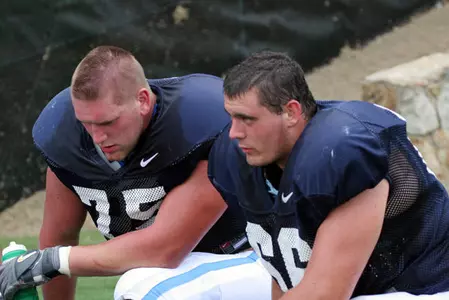
So here we are again. We enter another offseason with hope and expectations for the 2014 season, one that will return the majority of Carolina's offensive weapons from an offensively-heavy team. The fan base will lend its focus to our mercurial and bipolar basketball team for the next few months, then to the Bosh and our Diamond Heels in the spring. Football will be an afterthought until the Spring Game in April (with the exception of National Signing Day in February). For the players, however, the pressure cooker just keeps burning away. The offseason will consist of five grueling days of workouts – heavy weights, heavy running, and heavy legs. It won't be any easier to keep your eyes open during class following your early morning conditioning session. And based on how the strength staff has scheduled you, it's even harder knowing you have afternoon weightlifting following that class which you convince yourself shouldn't double as nap time. It looks like a break in the schedule for the football team, but that 'break' only lasts a couple of months until spring ball kicks back up. Then it's right back to an in-season schedule for the duration of those practices. So for the players, it's business as usual. Doesn't matter if it's August, October, or February. The clock gets punched every day, regardless.
These next few months, however, do offer somewhat of a reprieve. During this time, players will have a chance to catch their breath academically, take some of their more challenging courses, and be able to devote more time to tutoring and study hall (time is always spent there, year-round, but let's be honest, in season, the players' minds and focus is, understandably, sometimes elsewhere). It's typical that the greatest strides made in the classroom are during this time, and it's welcomed by the players.
From a physical performance standpoint, they'll have time to bulk up or drop weight from the season and invest in their physical make-up, preparing themselves for the spring. Some of the greatest gains in strength, speed, and flexibility are seen during these couple of months where there is no actual football looming overhead, and these are certainly the expectations of the coaching staff. This “dead period” gives the players the opportunity to change themselves, physically. Between my sophomore fall and spring, I saw a complete change in my physical appearance, drastic improvements in my strength and an increase in muscle mass and body weight while still maintaining my speed. It was that specific offseason that made me a believer in the program and the schedule in that time between the end of the season and the start of spring practice. In subsequent years, I actually developed excitement for the offseason program because I'd seen the fruits of that labor in myself as well as my teammates.
The weeks immediately following the bowl game also serve as recovery time from all the wear and tear of the season. This could be the most beneficial aspect of the offseason. The time between the culmination of the bowl and returning to campus for the spring semester give players time to relax and take the physical stress off our bodies, which works wonders in preparing us for the rigors of our impending offseason training program.
The 'offseason' is simply a term used for identification purposes, defining the period between seasons. As players, we are fully aware that there is no down time, there is very little, if any, time off, and the work only amps up in the months between the final game and training camp. As athletes and students, our greatest gains are made during this time. As athletes, it's physical and on the field. As students, it's cognitive and in the classroom. So the next time you see a football player sitting in a morning class, wearing only sweats and slumped over in his seat, just remember, he's probably done more by 8 a.m. than most people will do all day, and his day is just getting started.
But hey, if he starts nodding off, nudge him, or hit him with a pencil or something. Because nap time? Yeah, we get in trouble for that kind of stuff. He'll thank you when his afternoon lift isn't made longer than it has to be.
Here's to expectations in 2014. And here's to the offseason making them a reality. Go Heels.
Mike Ingersoll is a Carolina letterman who spent the 2013 season with the Hamilton Tiger-Cats of the Canadian Football League.