University of North Carolina Athletics
Turner's Take: Mr. Marquise
October 12, 2014 | Football, Featured Writers, Turner Walston
By Turner Walston
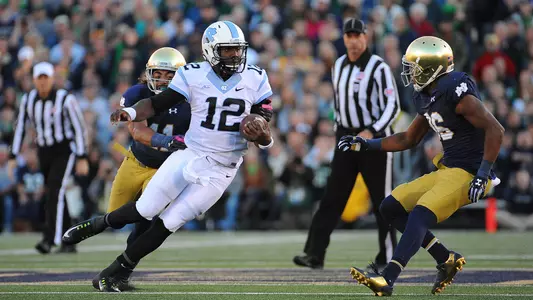
Saturday evening in South Bend, Indiana, under the watchful eye of Touchdown Jesus, a 2-3 North Carolina team went into Notre Dame Stadium and stood toe-to-toe with the No. 5 Fighting Irish. The Tar Heels didn't earn a win, but they earned respect, and they did so on the back of Marquise Williams.
Throughout training camp, Carolina head coach Larry Fedora was hesitant to name a starting quarterback, and only did so five days before the season opener against Liberty. Williams, the junior who started five games a year ago, would get the nod, but redshirt freshman Mitch Trubisky would rotate in and get meaningful reps.
That's the way it went through five games, with Williams starting and Trubisky directing the offense on the third series of the game and at various other points throughout the contests. And so when the third series of Saturday's game rolled around, it was expected that Trubisky would jog out with the offense. Instead, it was Williams. To that point, he had directed a touchdown drive (after starting with a short field) and a drive that ended in a missed field goal, and the Tar Heels were up two scores.
“We were going to play it by ear and see what the feel was, and Marquise had a good feel for what was going on,” Fedora said after Saturday's game. “He was seeing everything. We had a little bit of a rhythm going, so we didn't want to interrupt that rhythm. We decided to stay with him.”
Both Williams and Trubisky played the good teammates through training camp and the first half of the season. If they were troubled by the rotation, they wouldn't admit it, though in reading Williams' face after losses, one could tell he was a bit frustrated. So perhaps the difference on Saturday was Williams appreciating the coaches' confidence in him. He rewarded that confidence with a standout performance on one of college football's grandest stages.
“It's unbelievable,” Williams said of playing at Notre Dame Stadium. “This is what I dreamed of as a child. On NBC, 3:30, one of the best teams in the country. Not just number six, but they're always going to be one of the best teams. I got the chills.”
Chills, maybe, but Williams still had a job to do. The Tar Heel offense ran through him on nearly every single play. He was the Tar Heels' most dynamic offensive player, and he simply had to be on the field. As soon as Notre Dame took a 21-14 lead, Williams and the Tar Heels marched 75 yards downfield –with Williams running or passing for 58 of those yards (9 more came via penalty), including the final three yards for a touchdown– to pull the Tar Heels within a point. Just before the half, Notre Dame went up a touchdown after an Elijah Hood fumble. Carolina could have folded there, but Williams directed another scoring drive, capping it with a 20-yard bullet to Quinshad Davis.
“It felt good,” Williams said. “I was getting a rhythm, and I was going with the flow and the guys were behind me. Everybody comes to me to look to me the lead the guys, and it felt good.”
Last year, Marquise Williams was the team's leading rusher. Last week, this very column bemoaned that fact, and the fact that Williams was leading the Tar Heels in 2014. Ideally, you'd like to have running backs atop that list, and using a quarterback on change-of-pace plays and when flushed out of the pocket. But for this team, at this time, Marquise Williams is moving the football on the ground. So be it. Hood led the Tar Heel tailbacks with 17 carries on Saturday for 38 yards. Williams ran 18 times for 132. “My running game comes when I'm in a passing down and they come and cover down, and they just leave a big gap open,” Williams said. “That's where my running comes from. My running doesn't come from a quarterback draw, it comes from read, going through my reads, it's not there, and just taking off, trying to avoid a sack.”
Williams didn't just take off every time, however. He read the coverage and found passing lanes, exploiting the edges and relying on former walk-on Mack Hollins, who continues to be a pleasant surprise in the passing game. When the pocket collapse, he found room to run. For the second time in his career, he scored via the pass, the run and the catch. He became the first Tar Heel to throw for 300 yards and run for 100 in the same game. He was brilliant.
“Mister Marquise,” Hollins said afterward. “He's something else. He's like a running back, quarterback, he's everything. It's great to have him.”
Late in Saturday's game, Williams tossed an interception inside the Notre Dame 20. It was 3rd and 4, with the Tar Heels down seven, and after a scramble, the ball found the hands of Cole Luke. “I'm playing it over now. I wish I had just ditched it out of bounds at the time,” he said afterward. “As a quarterback you've got to know those things but at the time I was just wanting to make a play and help my guy make a play and get the ball in his hands in the wide receivers hands I take the blame for that and I'll punish myself for that.”
And yet even after that, even after the Irish went up 50-36 with 2:19 to play, Williams led his team on a touchdown drive. The Tar Heels were a recovered onside kick away from having a chance to win or tie.
A loss is a loss, and Carolina is now 2-4 on the season after beginning 2-0. They're in an eerily similar situation that they were last year, when the team began 1-0 and was 1-5 before winning five of six to close the regular season. That's the hard reality of the win and loss columns and the box scores. But anybody watching on Saturday night, whatever color they wore, whether in Notre Dame Stadium or watching at home on NBC, saw a team that played their hearts out and the quarterback that led them.
After the game, Williams was down on himself for the interception, but staying positive.
“The season's not over,” he said. “We were in the same predicament last year when we lost like three straight, four straight, five straight and then we went on a roll. I think that roll's coming.”
With Williams having validated his choice to stick with a single quarterback, Fedora was proud of Williams. “He ran hard, he threw the ball,” the coach said. “He gave us a chance.He gave his team a chance to win a football game tonight.”
Saturday, Marquise Williams gave his team a chance to win. He may yet give his team a chance at a winning season.
Players Mentioned