University of North Carolina Athletics
Extra Points: Belief System
October 12, 2014 | Football, Featured Writers, Lee Pace
by Lee Pace, GoHeels.com
Beyond drawing Xs-and-Os and teaching blocking and tackling technique, beyond seeing his players are honed to the nth degree in muscle mass and cardiovascular endurance, Larry Fedora spends countless hours attuned to the psychological makeup of his football team.
Just this summer he had all his players read The Energy Bus, the international best-seller by Jon Gordon that sets out in simple, direct terms how the tenets of desire, vision and focus are the mother lode to winning in business or on the athletic fields. The players presented their takeaways from their readings to their teammates during evening meetings in training camp.
Two years ago as N.C. State was coming to Kenan Stadium, Fedora preached to the punt return team the exercise of visualizing making a momentus play and told the group at the beginning of the week, "You will make a game-changing play on Saturday." Giovani Bernard's epic return is now the stuff of Carolina legend.
"I try to be as detailed as possible and tell them exactly how it's going to happen so they can visualize it," Fedora says. "I ask them to visualize themselves making those plays, actually see the dirt come up, see the grass on a guy's pants, feel the way the wind's blowing. They need to see every aspect over and over again in detail. And then it happens."
Last week Fedora talked about how as a former college receiver and then a receivers coach a player elevates his game from being sure-handed with good throws to the jersey numbers to being able to levitate and gyrate and elevate to snare the difficult ball.
"I remember learning from my dad at a very early age, if you don't believe that every ball that touches your hands should be caught, you're not going to make those catches," Fedora says. "If you truly believe that if that ball touches your hands, no matter where it is, it's your responsibility to make that catch, then you start to do it. You start to make those catches you shouldn't be able to make."
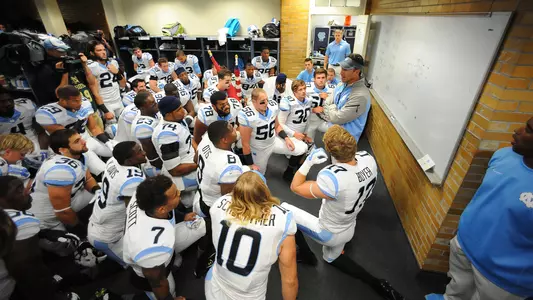
In that vein Fedora stood before his team last Sunday afternoon, the sting of a 34-17 loss to Virginia Tech still sharp, and told his players they were going to win the next weekend at Notre Dame. He talked of Notre Dame's history and said it was time that the Tar Heels of 2014 made some of their own. He stressed there had been enough good things in all three phases of the Tar Heels' season so far that if they could put all the good together in one game, good things might happen.
"I'm a firm believer anybody can beat anybody on any given Saturday," Fedora said. "It's been proven many times. We need to create some takeaways, take care of the ball, get rolling and get the guys some confidence. Do that and who knows what might happen."
It played out almost exactly as Fedora scripted it mentally on a picture-book afternoon in historic Notre Dame Stadium, the Wrigley Field of college football. Carolina got two early turnovers and turned them into 14 points. The Tar Heels withstood a fierce Fighting Irish rush in the second quarter, maintained their composure and trailed by only two points at halftime, leaving Fedora to say leaving the field, "Our guys are fighting hard, they came here to win a football game and they're going to keep fighting." They wielded a delicious piece of trickery at the end of the third quarter—a hand-off, a pitch and a pass, Quinshad Davis hitting Marquise Williams in the end zone—to take a one-point lead into the final quarter.
But two penalties on third downs when the Tar Heels were set to get possession—one a personal foul for roughing the snapper on a punt and another a pass interference thrown against Brian Walker from the back judge 30 yards away after two officials with better looks passed it as a good play—in the end were Carolina's demise. The Irish used new life on both drives to score touchdowns and emerge with a 50-43 win.
A victory over Notre Dame, ranked No. 5 and 6 in national polls, would have been the biggest road win in Carolina history. Never have the Tar Heels beaten a team on the road ranked higher than No. 8—that a 21-7 win in 1966 at Michigan.
"Coach said on Sunday we were going to win," said receiver Mack Hollins, who caught six passes for 84 yards and a touchdown. "It was not he thought we would win or might win, but we would win. The whole week, we're all thinking the same thing. We really came out here believing we'd win.
"We know we can play at a high level. That's the number five team in the nation. We competed with them and, honestly, we should have won the game. We know the rest of the season if we play like that, we'll win out."
The Tar Heel offense led by Williams made an outstanding recovery from last week's miseries against Virginia Tech, accumulating 510 yards against a stout Irish defense that was yielding a scant 335 yards and 12 points a game. With starters Jon Heck and Landon Turner returning in tandem on the right side of the line for the first time since the first half of the San Diego State game, the blocking front gave Williams reasonable time to throw, and freshman tailback Elijah Hood was jacked after choosing the Heels in a tight recruiting battle with Notre Dame and staked Carolina to an early lead with runs of seven and six yards at the outset of the game.
The defense forced three turnovers, broke up five passes and had seven quarterback hurries and one Nazair Jones sack. Noticeable in the first half were a pair of deep strikes down the middle by Irish QB Everett Golson that were well-defended, in contrast to problems at various times versus East Carolina, Clemson and Virginia Tech. The Tar Heels forced five punts on drives of five plays or less. But the unit still allowed 50 points, 510 yards and couldn't make the big stop after the crucial penalties.
And special teams couldn't supply the jolt of energy and turn field position the Tar Heels' way to the degree Fedora seeks and demands—Carolina missed one field, had a PAT blocked and had negative return yards on punts.
"Our kids are hurting," Fedora said. "They know that was a heckuva football team they played today. You play a game like that and feel like you're not that far away and you just need to get over the hump. We've got to get better in all three areas.
"We came in here believing we were going to win the game. All 71 guys who made the trip believed they were going to win. But we came up short."
Halfway through the season, the Tar Heels are in much the same position they were in 2013—some abysmal performances early and a watershed "what-if" game and close loss to Miami last year and Notre Dame this weekend.
"That's the No. 5 team in the nation, and there's not that big a difference between us," Quinshad Davis said. "We see now what we can do. We know what we can do. We just have to keep believing."
Chapel Hill writer Lee Pace (leepace7@gmail.com) is in his 25th year writing "Extra Points" and 11th reporting from the sidelines for the Tar Heel Sports Network. His unique look at Tar Heel football will appear regularly throughout the fall. Follow him on Twitter @LeePaceTweet.
Players Mentioned