University of North Carolina Athletics
Turner's Take: Grounded Game
October 4, 2014 | Football
By Turner Walston
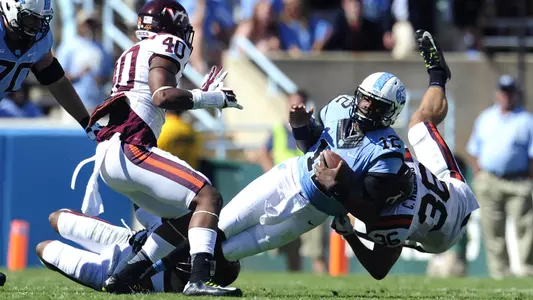
T.J. Logan was a Parade All-America. Elijah Hood was an U.S. Army High School All-America. Khris Francis and Romar Morris were considered among the nation's Top 30 running backs in high school. The talent of Carolina's running backs is not in question. What is troubling, however, is why they aren't more involved in the Tar Heel offense. In Saturday's 34-17 loss to Virginia Tech, Logan, Morris and Hood combined for just nine carries and 15 yards –a number that won't often add up to victory.
Carolina quarterback Marquise Williams is a talented runner and passer, and the nature of Virginia Tech's defensive scheme dictated that Williams would take the ball himself often on Saturday. Williams rushed 19 times for 94 net yards (sacks and tackles for loss cost him 45). It was the second time this season that Williams led the team in rushing, but never had the disparity been this dramatic.
Last year, Williams started six games for the Tar Heels, was three yards better (536) on the ground than Logan, who missed the season's first four games due to injury. It's terrific to have a dual-threat quarterback, but in order for both of those threats to be legitimate, a team needs the threat of other runners. And, in addition to talented running backs, the Tar Heels have terrific wide receivers at their disposal. When the Carolina offense is clicking, they're tough to stop: defenses can't go all-in on run or pass because the Tar Heels can beat you the other way. But in order to force a defense to pick its poison, both the run and pass need to be poison in the first place.
It's not the fault of any one person (or unit) that the Tar Heel running backs haven't been able to get off the ground (figuratively). A young offensive line hampered by injuries has not consistently gotten the push up front to move the football. With defensive fronts closing in, Williams can save some of the time it takes for a running play to develop by taking the ball himself. Saturday, Larry Fedora and his staff expected to see some eight-man fronts from the Hokies, and so determined that Williams would have his number called quite often. “We expected them to run some bear defense against us and they did in some situations,” Fedora said. “We knew that that would take some of the running game away. We had to do a little bit more with 'Quise than we probably wanted to, and he ran the ball very well. He was the bright spot in a lot of situations there, but yeah, we've got to get our running backs much more involved in the run game.”
Penalties continue to set the Tar Heels back. Saturday, it was ten flags. Four false starts will set you back five yards apiece. Tack on another five for ineligible downfield. Suddenly, 1st and 10 becomes 1st and 15, limiting the plays a team can call. There's a big difference between 3rd and 2 and 3rd and 7, and the Tar Heels simply weren't giving themselves a chance with all the miscues. “There are breakdowns every play,” right guard Landon Turner said. “There's a breakdown in someone's position somewhere, so we've all got to come together and put a whole game together by doing our own jobs.”
The team was just 2-13 on third down Saturday, and 0-4 on fourth down. That adds up to losing the time of possession battle by more than 22 minutes, keeping the defense on the field longer and making the road to victory all the more treacherous. “We've got to move the chains,” Fedora said. “If we don't move the chains and get into a rhythm on offense and have some type of tempo, then we'll make it very tough on our team.”
The last two Saturdays, Tar Heel opponents scored 70 and 50 points, respectively. Today, the offense gave Virginia Tech short fields on two scoring drives (a pair of fumbles led to touchdowns) and an interception returned for a touchdown. That's 21 points that ought not be ascribed to the defense. “I think that game was on us as an offense,” Turner said. “We had plenty of opportunities to win the game and score.”
Mistakes and penalties hurt everyone, and don't allow a team to play to its potential. A game plan ought to allow teams to take advantage of players at their best, not negotiate around miscues and turnovers. “We shot ourselves in the foot a lot and that just kind of limited what we could do offensively,” Hood said. “We had a lot of drives that we couldn't really get a good flow going so that kind of just threw us off. When our offense can't get a rhythm, we struggle to move the ball, so that was pretty much it. It was mostly us.”
It's frustrating to watch a group that you know is so talented succumb to mental mistakes. The Tar Heels are capable of playing so much better than what we're seeing, but they need each piece of the machine to work to maximum efficiency. Get a push up front, make the opponent expect both the pass and the run, and the team will start moving those chains.
“We've just got to keep attacking,” Williams said. “Our offensive line is going to do a much better job. I know a lot of guys are in there feeling down, but they're going to do a tremendous job.”
If they do that, the Tar Heels can put the ball in the capable hands of their running backs. Then, it's up to them. “If we get them to the safety, they're going to make them miss,” Williams said. Here's hoping we get to see that soon.
Players Mentioned