University of North Carolina Athletics
Saturday Special
November 18, 2014 | Football, Featured Writers, Turner Walston
By Turner Walston
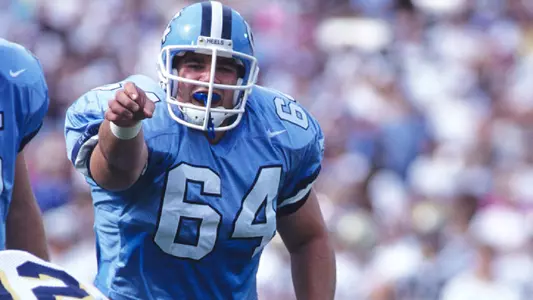
“Leadership made all the difference in the world,” Jeff Saturday said of his Tar Heel teams that helped head coach Mack Brown go from starting 1-10 in each of his first two seasons at Carolina to winning ten games in the mid-1990s. “Player leadership. Mack did a really good job. We were young, and he gave us the ability to lead even when we were young.”
Even before Jeff Saturday made a snap, he'd been empowered by his coaching staff. Saturday redshirted in 1993, when the Tar Heels went 10-3, falling to Alabama in the Gator Bowl. “Coming off of that, we had a lot of guys who were coming off redshirt, and I remember us all talking: 'This is now our team,'” Saturday said. “Mack said, 'This is your team. If you're good enough to play, you should get on the field. This is your opportunity. We're on the cusp, but there's a lot of places we can fill holes with young players.' All of us took that as a challenge, and once we took ownership and leadership, we weren't relinquishing it.”
Brown empowered his players as leaders, but it was up to them to take that responsibility. “He would always defer to his leadership council, and he trusted what we thought about things,” Saturday said. “He'd ask us, and he really did give us a voice into the program.”
Given that voice and a mutual respect with their coaches, the players bought in and began playing winning football. They understood that the coaches believed in them, and they believed in themselves. “We weren't the most highly-recruited,” he said. “We didn't make it in the magazines of being the best, but when we started winning, now we were all called the best.”
Saturday is proud to have played with teammates that earned well-deserved honors, like Marcus Jones, Brian Simmons, Greg Ellis, Dre' Bly and Vonnie Holliday. “Dre' is going to be in the College Football Hall of Fame, and deservedly so, but it was on our watch,” Saturday said. “We all pushed each other and drove each other, and I think that's really what made us as good as we were.”
That push carried over into Saturday's football life after Carolina. After a stellar All-ACC Carolina career, Saturday went undrafted in 1998. He'd signed as a free agent with the Baltimore Ravens, but was cut before camp opened and eventually took a job with Electric Supply Company of North Carolina in Raleigh. “I was going to work every day, working out before or after work, thinking maybe Arena football, or maybe no football at all; this thing might not work out,” he said.
Former Tar Heel defensive tackle Nate Hobgood-Chittick got Saturday on the phone. Hobgood-Chittick had met with Indianapolis Colts general manager Bill Polian and put in a good word for his old teammate. He'd played with both the New York Giants and the Colts, and he told Polian he knew a center that was better than any he'd blocked in the NFL.
“Nate was probably the 53rd guy (on the Colts roster),” Saturday said. “He doesn't have a job; nobody knows him. He's going to Bill Polian, who probably brought him in for a cup of coffee and is going to bounce him out . . . but the guts it took for him to walk in there and lay that down was incredible.”
The meeting paid off for both the center and the Colts. As he'd been out of the game, Saturday had spent his Sundays watching and seeing players he knew he could compete against. Given his second chance, he took advantage. “When I finally did get there, I didn't dread the practices,” he said. “I knew what it looked like to get paid on a weekly basis and pray that your commissions hit to give you some cash, so everything from there on, it was gravy for me.”
Saturday played 13 seasons for the Colts, helping set the tone for Peyton Manning's offense. He spent a final season in Green Bay in 2012 before retiring as a Colt after the 2013 Pro Bowl. In total, Saturday played in six Pro Bowls, was a four-time All Pro and a Super Bowl champion.
Monday evening, Saturday spoke at UNC Kenan-Flagler Business School on his four pillars of leadership, sharing the things he's learned from life on and off the football field, from Chapel Hill to Indianapolis, to Green Bay and now Bristol, Connecticut as an analyst with ESPN. Saturday's experience gives him a unique perspective, and he hasn't forgotten how hard he worked and the people who helped him along the way.
“I prayed for one year and 14 years later, I'm still playing,” he said. “And all the things that happened ,it could not have been better than it was. I couldn't have mapped it out, I couldn't have asked for more injury-wise, marriage-wise . . . You name it, man, it was as good as it could be.”