University of North Carolina Athletics
Turner's Take: Keep Punching
November 2, 2014 | Football, Featured Writers, Turner Walston
It should have changed the game. Early in the second quarter on Saturday, with the Tar Heels trailing Miami 9-0 came an opportunity to swing the momentum.
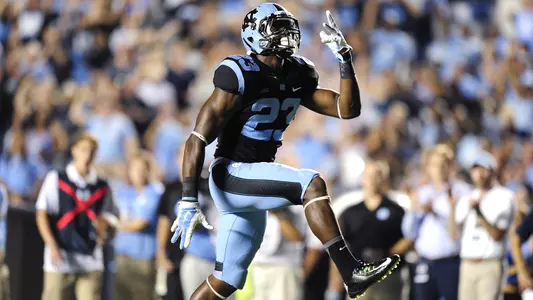
The play that should have done it was a glimpse at the once and future Tar Heels: Sophomore bandit Mikey Bart drove back a Hurricane lineman and got to Miami quarterback Brad Kaaya, for a sack and forced fumble. The ball squirted beneath diving players, unwilling to be corralled until it was finally picked up by Tar Heel freshman linebacker Cayson Collins at the 39-yard line. Collins darted down the sideline. A week after having an apparent fumble recovery called back, Collins was in the end zone.
“I just pride myself on finding the ball. Wherever the ball is, just get to where the ball is and make your plays,” Collins said after the game. “Ethan Farmer not being able to recover it, he kind of popped it out so I just happened to be there at the right time.”
And so even as the offense had moved the ball just 17 yards to that point, even after a high punt snap caused a safety, the Tar Heels found themselves down 9-6 with an extra point to come. Nick Weiler kicked the extra-point try hard left, and so the score remained 9-6.
Yet even after the deflating coda, Collins return could have sparked the Tar Heels. Collins himself was bouncing on the field as he lined up for the ensuing kickoff. Here was an opportunity to swing the game.
The Tar Heels forced a three-and-out on the following possession, and so the offense would get the ball down three.
Alas, after a holding penalty on the punt return, Carolina began a drive at their own four. Even after a first down, they would only reach the 24 when Marquise Williams connected with Ryan Switzer short of the sticks.
That was Carolina's last best chance to win a game they would ultimately lose, 47-20. Miami scored on their next drive when Kaaya connected with tight end Clive Walford. Carolina got one first down and punted. Duke Johnson then rushed 90 yards on the first play of the following drive, setting a record for Tar Heel opponents. Williams threw an interception. Kaaya hit Walford again for a score. In the span of two minutes and 42 seconds, 9-6 became 30-6. All just before halftime.
“For a second, I felt like we had momentum off of it,” Collins said of his touchdown. “But then, Miami made a play, and I guess they kind of drained our energy.”
Miami made a play by being everything Larry Fedora wants to see in his Tar Heels. They were smart in their play-calling and decision-making, exploiting matchups all afternoon. They were fast. Certainly Duke Johnson was. (Collins said he and his high school teammates used to watch YouTube highlights of Johnson. “Actually being on the field when he displays that speed and that power . . . I have respect for him.”) And Miami was physical: on defense, they pressured Williams all afternoon, didn't give him time to throw and shut down running lanes. In fact, the Hurricanes dominated the line of scrimmage on both sides of the ball. Miami defined smart, fast and physical and demonstrated how effective a team can be when it has those three qualities.
Carolina's offense continued its unfortunate pattern of slow starts –they didn't snap the ball on the Miami side of the 50-yard line until the second half– and that ripples out to effect the whole team.
“We were behind so early, and so fast, it was hard to stay in a game plan, so your game plan, you have to adjust with it, and we didn't do a very good job of that,” Fedora said afterward.
For a moment, the Carolina youth movement impacted the game and presented an opportunity to turn things around. It's unfortunate that the Tar Heels were simply unable to capitalize. “Coach Fedora talks about it all the time, feeding off the positive energy, making our own energy,” Collins said. “I felt like my play could build some energy or create some energy, and Miami's play kind of reversed the momentum, I guess.”
Creating energy and building on that energy is a puzzle that North Carolina needs to solve before its final three games. At 4-5, the Tar Heels need to take two of three from Pitt, Duke and NC State to become bowl-eligible. Now, Carolina has a bye week to try and end the plague of slow offensive starts and the missed assignments on defense.
Ideally, the Tar Heels would discern how to spark the energy of a positive play before that positive play happens. Create an environment that enables those plays to happen: be in the right place at the right time, communicate on offense and defense and trust yourself and your teammates to take care of their assignments.
“That just comes from within,” Collins said, “with the leadership and the guys on the team getting everybody going, coming into the game with energy. Just wanting to play, wanting to be out there and wanting to have fun.”
Fedora said he likes that his team fought after halftime, even after allowing 21 straight Hurricanes points. He likes that the young players in particular continued to give their all. That attitude needs to carry through the bye week and into the rest of the season.
“I know what's in these guys,” Fedora said. “I know what's in them. They'll fight and they'll scratch and they're going to claw . . . they're going to play hard. They're not going to give up. They're going to keep playing and we'll overcome.”
The next step is finding out what it takes to be the aggressor, to punch first rather than waiting to get smacked in the mouth. And then, when that punch lands, to keep punching.
Players Mentioned