University of North Carolina Athletics
Blue Dawn Is On
February 26, 2014 | Football
By Lee Pace
There is snow on the ground, it's 28 degrees and the alarm clock beeps at a dastardly 5 a.m. on a Monday morning in the depths of February. There are sleds to push, cones to touch, push-ups to knock out, tackling dummies to leap-all under the razor-sharp gaze of Tar Heel head coach Larry Fedora, strength and conditioning chief Lou Hernandez and their battalion of assistants.
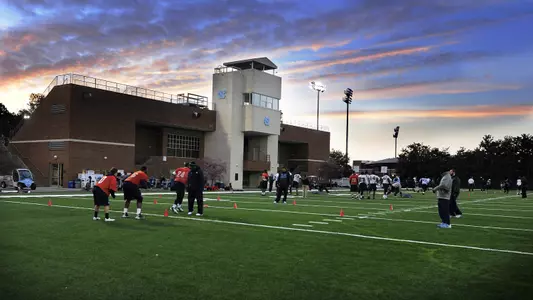
Welcome to Blue Dawn, the Tar Heels' two-week bridge between a winter of strength training for the players and recruiting for the coaches and the onset of spring practice in March-eight days spread over two weeks, an hour at a time with taping beginning at 5:15 a.m. and first whistle at 6 on Navy Field.
"The coaches have us doing it in the cold, at the crack of dawn," says linebacker Jeff Schoettmer. "It's a mental test. The object is to push yourself, prove to yourself you can do it. Who can stand up? Who's the toughest?"
"It's as hard a workout as you'll do in your life," adds bandit Shakeel Rashad. "Just waking up so early makes it so much harder. You're rolling out of bed and the first thing you're doing is running and pushing. It's incredibly tough physically, but that's the point. The coaches talk all the time about getting 'comfortable being uncomfortable.' That's all this is."
Getting up at an insane hour is certainly uncomfortable, particularly for collegians who can sleep as easily as they breathe. Alarm blares, lights on, the ubiquitous motorized scooters so popular on campus today puttering quietly through the dark streets to the Kenan Football Center. Smart players will have hydrated well the night before and consumed nothing more than maybe a banana before the crack of Blue Dawn.
"I would not recommend anyone come out here with food in their stomach," receiver T.J. Thorpe says. A slight chuckle. "I've seen guys do that and leave it on the field."
Winter conditioning programs are nothing new around Tar Heel and college football. Bill Dooley preferred the infamous "mat drills" in the old wrestling rooms in Woollen Gym. John Bunting and Butch Davis ran sessions called at different times "War Days" and the "County Fair"-the latter a cute moniker implying there was a lot of stuff going on at the same time-but they were generally run by the strength and conditioning staff with little to no hands-on involvement from the coaching staff.
When Fedora became head coach at Southern Miss in 2008, he instituted the "Black Dawn" regimen and got his assistant coaches involved in running various stations. He liked that the structure involved the entire team and staff and was a reintroduction of sorts after two to three months of the coaches and players essentially going in their own directions, and he wanted the position coaches to benefit from watching how every player at every position reacted to difficult and stressful situations.
Fedora imported the program to Chapel Hill and in February 2012 introduced the "Blue Dawn" to his new team. The structure essentially consists of one day of players running a gauntlet of eight stations of drills and a second day built around sprints and shuttles. They do four workouts a week over two weeks before the onset of spring practice on March 5.
"We're trying to create as much discomfort as possible," Fedora says. "We're trying to push guys farther than they think they can go. Then we watch and see how they react. If we get the reaction we want, that's great. If not, we try to push them even farther to create that reaction. This is also when your leaders are going to step up-when things are really tough and difficult. You're going to see in February how guys are going to respond under adverse conditions in the fall."
As soon as the team returns to campus in January from semester break, Hernandez, his assistants and the team nutritionists begin reshaping bodies-adding muscle and girth in some places, melting fat in others. The strength training is built around bench presses for the upper body, squats and lunges for legs, power-cleans and Olympic movements for explosive power. The two weeks of Blue Dawn takes the body chiseling a step beyond and adds the mental component.
"Two things that are for sure in football are pain and discomfort," Hernandez says. "How do you handle adversity? How do you manage the pain, can you overcome the discomfort? Our training philosophy is more than benches, squats and cleans. It has to do with discipline and adapting and overcoming. Those are as important as the exercises themselves."
The thermometer hit 28 degrees the morning of Feb. 17 and the six inches of snow from the previous week was piled up around the edges of the turf when the Tar Heels began their 2014 edition of Blue Dawn. Mondays and Thursdays are built around circuits, Tuesdays and Fridays around running.
One of the stations consists of two players pushing sleds loaded with 45-pound weights for 10 yards, turning the sled around and pushing those same 10 yards back, then sprinting in the opposite direction for 10 yards. The loser does pushups.
Another station has a coach signaling groups of three to four players to back-pedal, side-pedal, jump, lunge, roll and flip this way and that. At other stations the players hop and skip blocking dummies, run the edges of large plastic circles and do shuttles back and forth between a maze of cones.
Each station runs for approximately four minutes, with every player visiting each station through the course of the workout. Players deemed by the staff to have given less than total heart and energy the previous day are outfitted in red jerseys-a "badge of dishonor."
"Blue Dawn makes you mentally tough, it teaches you to keep competing when you're tired," Thorpe says. "It translates to the fourth quarter in a game. You can tell the guys you can count on to step up and make plays and be able to fight through being tired. That's the point of Blue Dawn-toughening everyone up and getting them out of their comfort zone. You have to learn to be comfortable under duress. You don't want to have to wear a red jersey. It's a sign to your teammates you took the day off and didn't perform at a level that wins games."
The final chapter each day is the "Tire Drill." Fedora chooses one player from offense and one from defense. They start on a given yard-line, each player wrapping his arms through one side of the tire and facing off against his opponent. On Fedora's whistle, each player attempts to pull the other player a distance of five yards to his rear. The contest is over when one player loses his grip on the tire or gets pulled five yards to his opponent's side. They do three separate contests, and the losing side between offense and defense in the best-of-three has to run penalty sprints.
As the players are clutching and pulling and gnashing and girding, their teammates are in a frenzied circle around them bellowing out a cacophony of jeers and cheers.
"At the end of the workout, guys are exhausted," Fedora says. "You pull one from each side of the ball and you have a fight to the end. It becomes a war of wills-how bad do you really want it for your side of the ball?"
"That drill is like a football game-you fight for five or 10 seconds and you win or lose," Hernandez says. "You're ahead, you're behind, you've gotta keep grinding and pushing and staying in the fight. It tells you a lot about a guy's determination and toughness. It's one of the most physically demanding drills we do."
It's all part of developing a "blue collar mentality," as Fedora terms it, around Tar Heel football.