University of North Carolina Athletics
Turner's Take: Taking Class Outside
April 3, 2014 | Football, Featured Writers, Turner Walston
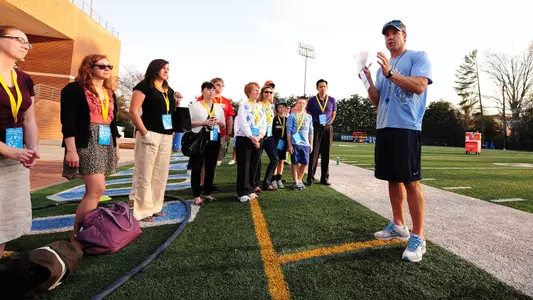
Wednesday's football practice, the 10th of Carolina's spring session, was 'Invite a Professor to Practice Day' at Navy Fields. Carolina football student-athletes were encouraged to extend an invitation to an instructor to attend practice, tour Kenan Football Center and share a conversation over dinner. Nearly 40 Carolina faculty members saw the Tar Heels engage in full-contact drills, including a four-minute scrimmage to close the session.
“I think it's an opportunity for them to step into our classroom, and see how each every day, and what these guys that are in their classes do on a daily basis, and the amount of time and effort that they put into on the field things.” Tar Heel head coach Larry Fedora said after practice. Fedora said the dinner following practice helps both the faculty and the student-athletes see each other on a level beyond simply instructor and student. “The professor gets to find out that, you know what this kid, he may not talk a lot in my class ,or maybe he's quiet or maybe he smiles or whatever, he gets to know him a little bit, and so I always thinks that's a good thing.”
James Seay has been an instructor in the English department at Carolina since 1974, and remembers bringing his young sons to practice under several Tar Heel head coaches. Tar Heel cornerback Malik Simmons invited Seay to his first practice with Fedora in charge. “I had no idea, the complexity of this, and the size,” Seay said. “No idea.” The professor appreciated the opportunity to see his student in a different setting. “It's good. I get to see Malik on his own ground. He's there on my ground (in the classroom) . . . I mean, it's his ground too, but here, he's got authority and experience. So it's a good experience.”
After he addressed the media, Fedora spoke to the gathered faculty members (about 40 attended practice) about sitting in on his instruction. “The thing that we get to do with them that you don't, is we get to do multiple reps over and over and over and over and over, but then we've got 14 tests during the fall that they take on every Saturday in front of thousands and thousands of people,” the coach said. He went on to explain that the Tar Heel coaches attempt to make the players as uncomfortable as possible during practice –playing music as a distraction, for example– so that the team reacts well in hostile environments on Saturdays in the fall. “Every game that they're in, there's going to be adverse conditions,” he said. “There's bad things that happen.”
Fedora stressed that seeing the instructors on the sidelines in practice meant the world to the student-athletes, that they would take an interest in their lives outside of the classroom. He then took questions from the faculty, some of whom who were well-versed in football, and some of whom were not. Those questions included the number of players on the roster (101 as of now, 105 in the fall), how many will make the National Football League (about two percent) the number of practices allowed (15 in the spring), to the hardest part of the job (“If you ask my wife, she would say the hours, but you know, probably the biggest thing is being away from my family.”
The Tar Heel head coach told the gathered faculty that he learns something from the players every day, and has every day of his 27 years of coaching. He is careful to remind himself that the student-athletes are just kids at the end of the day, and that they will make mistakes, but he continues to be impressed with the resilience they have shown just to compete at the collegiate level. “As you get to know them and you find out where some of them come from and what they've overcome in their life to be here today, it is truly amazing,” he said. “It is truly amazing. And I wonder all the time when I hear their stories and I learn their lives, where I would be if those things had happened to me when I was their age? I always wonder. So we've got some pretty special guys.”
Associate professor Barbara Osborne agrees. As a longtime instructor in the Department of Exercise and Sport Science, she has taught many football student-athletes and attended many practices. Wednesday, she was invited by Alex Marrs, who is in her sport law class. She said the thing that has impressed her the most about Fedora's practice is the level of organization. “He plans everything down to the minute, and he calls it organized chaos, but there is nothing from the administrative side that's actually chaos about it,” she said. “The entire thing is scripted so well, and he definitely has goals and objectives, and the players know what the expectations are and they approach it with that same energy that he has.”
Osborne said Fedora has made academics a priority to a level she had not previously seen in 16 years of teaching student-athletes, from recruiting athletes well-prepared to tackle college material in their first semesters on campus to organizing academic teams in summer school. “Academic performance was always a key, and although other coaches in the past had been interested and certainly advocated for their students to go to classes and do well, that competitive element was certainly never there before,” she said.
Tar Heel center Lucas Crowley invited English professor Mark Cohen to practice and said he has always felt support balancing academics and athletics from both sides. Crowley said many of his instructors had been understanding about helping him negotiate the demands of student-athlete life, and he appreciated opportunities like Wednesday to help strengthen those ties. “I think it's important for them to come out here and see what we have to go through on a daily basis, or every other day during spring, because it allows them to see what we go through on top of the work that they're giving us,” Crowley said. “It just lets them see our point of view.”
For the faculty, attending practice is certainly exciting, but for Osborne, the highlight of the event is sitting down to dinner with the student-athletes to help foster relationships off the field and out of the classroom. “I really think that the climate on this campus that was created by the media over the last few years has made all student-athletes a little timid about identifying themselves as athletes to faculty,” she said, “and so learning that faculty aren't mean and don't hate athletes here I think is a good thing, too.”