University of North Carolina Athletics
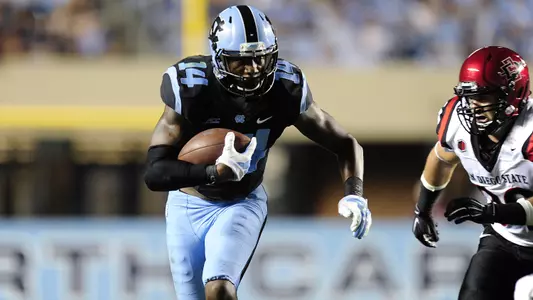
Extra Points: Prognosis Good for Quinshad
January 12, 2015 | Football, Featured Writers
by Lee Pace, GoHeels.com
Imagine your son has just been hurt in a football game and is lying on the far corner of the field away from your seat, a cluster of doctors, athletic trainers and medical technicians around him, his teammates taking their helmets off and their faces lined with worry and strain, one of them even in tears. Imagine you're in a modern NFL stadium like Detroit's Ford Field, its underbelly laden with vast stretches of corridors, elevators and ramps, with stoic and stern security guards at every point.
Imagine the irony of Quinshad Davis's plight here in the waning moments of the Quick Lane Bowl on Dec. 26—a fade route into the corner of the end zone successfully executed would have catapulted him to No. 1 all-time in touchdown receptions at Carolina with 22, one ahead of Hakeem Nicks.
“They sent me to this place and that place, I had no idea where I was going,” Quinzetta Posey, Davis's mother, says of her frantic rush to the field from her seat behind the Tar Heel bench area. “Finally I found a young man, told him my son was hurt on the field and I needed to get down there. He took me to another lady and she took me right on down.”
By the time Quinzetta made her way down the long ramp and tunnel onto the playing field, her son was being carted off the field, his right tibia broken and splinted. They met in the tunnel.
“Momma, I'm all right, take a deep breath, and don't cry,” Quinshad said. “I'm all right.”
She smiles recounting the incident.
“He said he was all right. That's all I needed to hear,” she says.
Kenny Boyd, the head athletic trainer for the Tar Heels, was also struck by Davis's demeanor in the face of what surely was immense pain.
“He had incredible courage through the whole thing,” Boyd says. “One of the things that stuck out to me was him saying he'd be okay. His attitude from the beginning was remarkable.”
Davis was not shocked that he'd broken his leg trying to snare a pass from Mitch Trubisky with just over two minutes left in the game. He played all season with stress fractures [LU1] on both legs and surgery was already planned for Jan. 7 to repair the injuries.
“The doctors told me this could happen, there was a risk playing on my legs,” Davis says. “Dang, I made it all the way through the season and then at the end of the last game, this happens. But I was going to have surgery anyway and miss spring regardless.”
While the medical team was getting a splint and cart in place to carry Davis off, he was surrounded by receivers coach Gunter Brewer and several fellow receivers. Back toward the Carolina bench area, the rest of the squad circled up, many players dropping to one knee and everyone bowing as team chaplain Mitch Mason led a prayer. They all moved to the end zone when the cart carried him off and formed a line as the cart passed by.
“Quinshad was calmer than everybody else,” Brewer says. “He was more worried about his mom. He said, 'I'm okay.' I thought it was a nice showing of respect and how much his teammates look up to him the way they came out and supported him before he was taken off. His mental toughness all year was remarkable. We had to limit him because of his legs, but he still played 605 snaps and caught six touchdowns.”
“It was hard for us to see as a receiving corps,” Ryan Switzer says. “He's one of our brothers. The only good thing was that he was going to have surgery before the injury. I can't wait to see him back out there with us.”
Carolina's medical staff has intricate Emergency Action plans in place to handle injuries both at home and on the road; they regularly conduct rehearsals for moving players from field to locker room to examination stations to transportation vehicles and know the protocol for local hospitals. In the case of the Quick Lane Bowl, bowl administrators had med tech and X-ray tech personnel and equipment available at Ford Field for each of the team's four practices prior to the bowl game.
Davis was deemed by team physicians Dr. Mario Ciocca and Dr. Jeffrey Spang stable enough to travel back to Chapel Hill on the team charter rather than being admitted to Henry Ford Hospital in Detroit. Quinzetta was resolute that she was not leaving her son's side, and fortunately NCAA regulations allow for institutions to provide transportation for immediate family members in such a situation. The seating chart for the team's flight back to Raleigh-Durham International was quickly rearranged to allow Quinshad and his mom to have three seats together, and team officials and the airline executed the procedures to get Quinzetta on the flight manifest.
“I was with my mom, my daughter, Quinshad's girlfriend and one of Quinshad's cousins,” Quinzetta says. “We drove up and got to Detroit Friday mornng. They went back to the hotel, got my things and started the drive home. I got straight on the plane. I wasn't going to leave my baby.”
Dr. Spang made arrangements at UNC Hospitals to have Quinshad admitted immediately upon the team's arrival around midnight. Davis and his mom went from the airport to the hospital by ambulance and he was operated on early the next morning.
Davis came through the surgery in flying colors and was up walking gingerly two days later. His prognosis for being able to begin running by late spring is good. Right now, he just has to let the healing process evolve.
“The immediate concern is the protection phase,” Boyd says. “He can walk around but that's about it. We'll start hydro-therapy in a week or two and continue the process of rehab. There are a few other things he can do in the training room, and he'll start with (strength and conditioning coach) Lou Hernandez and his staff doing some upper body work while the legs are healing.”
Laying on his apartment couch a week after surgery, Davis was in good spirits and resolute that he'd make a full recovery. A friend sent him a photo captured from TV of the moment his leg broke, a clear demarcation of the bone showing in the digital image Davis studies on his cell phone.
“I was just trying to go up and get the ball, I put force on the leg and it broke,” Davis says. “I tried to get up and could not get up. I knew something was bad wrong.
“But I'm all right, I'm good, going to be fine.”
Chapel Hill writer Lee Pace (leepace7@gmail.com) is in his 25th year writing “Extra Points” and 11th reporting from the sidelines for the Tar Heel Sports Network. His unique look at Tar Heel football will appear regularly throughout the fall. Follow him on Twitter @LeePaceTweet.