University of North Carolina Athletics
Extra Points: Gut Punch
October 4, 2015 | Football, Featured Writers, Lee Pace
by Lee Pace
ATLANTA, GA.—This one had the feel and flavor of another win over Georgia Tech, a 26-14 bouncing of the No. 19-ranked Yellow Jackets in Kenan Stadium in late October 1992. Coach Mack Brown had been laboring four and a half years and through the dank and dim forest of 2-20 to build a respectable football program, and with players like Natrone Means flourishing on offense and Tommy Thigpen and Bracey Walker cutting a huge swath on defense, the Tar Heels first bounced Virginia and then upended Tech on successive weekends in Chapel Hill, the latter leading to a goal-post leveling eruption for the benefit of ABC's television cameras.
“I'm proud that big-time football is back in Chapel Hill,” Brown said in the celebratory din afterward.
Saturday the Tar Heels ventured into Bobby Dodd Stadium in Atlanta, and the only thing the media wanted to harangue about was that surely the highly decorated Paul Johnson would never allow his team to lose three straight, especially the next one being at home and coming against the ne'er-do-well Tar Heels. Lose to Notre Dame? Okay. Lose to Duke? Makes sense. But strike three to Carolina, which has been under .500 in football since 1997, coincidentally the last time the Heels won in the ancient confines just off North Ave in downtown Atlanta? Perish the thought.
The first 20 minutes of the game followed the predictable script: Tech efficient and sharp with its flexbone offense, greedy with time of possession and reaping the largesse of a pair of holding penalties on a Tar Heel receiver and lineman that turned an otherwise promising first drive into a bust. The Yellow Jackets were up 21-0 and seemingly on the verge of a blowout. Tar Heel fans on social media had jumped off the proverbial cliff—“Pathetic but familiar,” chirped one, “Who is covering the pitch guy?” wondered another.
The Tar Heels were frustrated, yes. Daunted, no.
“Our team never panicked when we got down 21 points,” Tar Heel coach Larry Fedora said afterward.
As Tech in the second quarter was gobbling up another seven minutes of possession time with its third touchdown drive, the Tar Heel offensive coaches talking with one another from the coaches' booth upstairs and sidelines agreed there was no reason to deviate from the game plan—heavy with called runs for QB Marquise Williams that seem to get him into a good rhythm, hand-offs to workhorse tailback Elijah Hood and a variety of throws the coaches knew would be open if Williams had good protection.
“We said, 'Don't get out of our norm, stay within our offense, let's create some game-changing plays by moving the chains,'” receivers coach Gunter Brewer said. “The big plays come within our offense—we break a bubble screen or bust a run open. We wanted to get Hood involved and create some flow.”
“I told my guys, 'We've just gotta get in the end zone once and the game will change,'” line coach Chris Kapilovic said. “Their heads weren't down, no one was quitting. We were just anxious to get back out there.”
With the Tar Heels down three scores, offensive coordinator Seth Littrell called seven runs on a nine-play drive that quickly and with authority moved 75 yards in three minutes. Hood ran for 38 yards, T.J. Logan for 16, Ryan Switzer connected with Quinshad Davis on a double-pass for 10. Carolina scored, got a defensive stop and in the blink of an eye added a touchdown on a short field to go into halftime down only 21-14.
“We talked on the phones, 'We can't get it all back in one series,'” QB coach Keith Heckendorf said. “Let's go one possession at a time. Let's score this possession. Then score the next. Before long, we're right back in it.”
Defensive coordinator Gene Chizik told his players there was nothing to change, no schematic tweaks necessary to what the defense had practiced all week. He believed his guys were getting acclimated to the speed and precision with which Tech ran its multiple-option attack, but he did think they could more resourceful and resolute in blowing up blockers.
“The first three series, our eyes were kind of all over the place,” linebacker Jeff Schoettmer said. “We were just getting used to the speed of the game. That first drive, we were just trying to get a feel for what they do. We finally settled down. Coach Chizik came in at halftime and said, 'We're not changing a thing. It's up to ya'll to execute it.' At the end of the day, it's all about physicality and beating the block in front of you.”
Added Fedora, “We played with an attitude in the second half. That's all it takes.”
Tech would score only one touchdown the second half, and that came with the benefit of a short field after Fedora aggressively called for an onside kick that went awry after Carolina scored a field goal on its first possession. The defense kept Tech out of the end zone inside the two yard-line on successive snaps to open the fourth quarter, then linebacker Cayson Collins stripped the ball loose and Junior Gnonkonde recovered it to set up the Tar Heels' go-ahead touchdown.
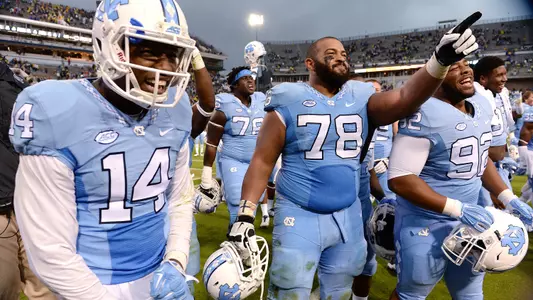
When the finishing touches were applied to the Tar Heels' 38-31 win and they merrily congregated with their fans in the southeast corner of Grant Field, there was much to celebrate: Carolina's biggest comeback in school history; Williams' brilliance after a week in the microscope following his hiccup vs. Delaware; the defense yielding 5.2 yards a snap after coughing up seven yards a snap the last three seasons; receiver Quinshad Davis's fourth career throwing touchdown pass on a gadget play; and the emergence of Collins at the strongside linebacker spot after a month of the Tar Heels juggling four different players there.
The Yellow Jackets and their coach, to say the least, were stunned.
“I feel like I've been gut-punched,” Tech's Johnson said.
Ah, music to a Tar Heel fan's ears after all the misery Tech has dealt Carolina since Johnson arrived in Atlanta in 2008. Don't look now, but that's two straight over Tech and that's how streaks turn in the opposite direction. All that misery in Charlottesville over three decades is now just rumble in the dust of three straight road wins over Virginia and five straight total.
Fedora was asked if the game marked a turning point in his three-plus year tenure at Carolina. He agreed with the premise that the victory was significant, but he played with the nuance of the question.
“I don't know if it's a turning point or us getting over the hump,” Fedora said. “I think we've been going in the right direction, so I don't know if we're turning. I think maybe it gets us over the hump. There is a lot of confidence in that locker room. They feel pretty good about themselves.”
As did the 1992 Tar Heels at mid-season. And we know how that story turned out.
Chapel Hill writer Lee Pace (leepace7@gmail.com) is in his 26th year writing “Extra Points” and 12th reporting from the sidelines for the Tar Heel Sports Network. His unique look at Tar Heel football will appear regularly throughout the year. Follow him on Twitter @LeePaceTweet.