University of North Carolina Athletics
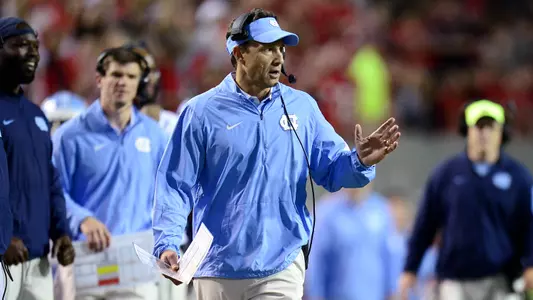
Extra Points: Tar Heel Timeline
December 2, 2015 | Football, Featured Writers, Lee Pace
by Lee Pace
Carolina's football team continues an extraordinary season Saturday night in Charlotte when the Tar Heels collide with Clemson with the ACC championship at stake. Just one year ago, Coach Larry Fedora and his staff were reeling from a pride-smashing loss to N.C. State and were waiting to learn their bowl destination, which would turn out to be the Quick Lane Bowl in Detroit and a 40-21 demolition at the hand of Rutgers.
Twelve months—from six wins to 11, from a tie for third in the ACC Coastal Division to first, from whispers in the locker room about commitment and trust to a giddy love-fest punctuated by senior guard Landon Turner's “Got Your Back” campaign, from a defense made of Swiss cheese a year ago to one that at times has been sculpted of granite and guts.
What happened? Hundreds of things, actually, some big, some little, some dynamic, others subtle. Here's a timeline of the building blocks that fell into the Tar Heels' historical season—the first ever in 125 years of football with 11 regular season wins.
December 2014
Tar Heel coach Larry Fedora admits that whatever coaching skills Vic Koenning has parlayed into successful defensive coordinator stints at Troy, Clemson, Kansas State and Illinois, the stars are not aligned in Chapel Hill. They part ways on Dec. 11 and Fedora begins the courting of Gene Chizik—the Carolina administration having to vet his history at Auburn and Chizik himself having to decide if Chapel Hill is the proper venue to end his two-year coaching hiatus.
Fedora and Chizik are not close friends. “Good coaching acquaintances” might be the proper term, guys who have competed against each other at three different coaching stops, most recently Fedora running Oklahoma State's offense in 2005-06 and Chizik at the defensive controls at the University of Texas.
“Over all those years, I gained a lot of respect for him,” Fedora says. “You start watching him, seeing what he's doing, then competing against him. From a guy with an offensive mind, you gain a healthy measure of respect watching what he's doing. I thought he'd be the perfect guy to come here and help us win a championship.”
As the Tar Heels are flying to Detroit on Dec. 22 for the Quick Lane Bowl set four days later against Rutgers, the player Fedora and his staff consider the best athlete in the state of North Carolina announces he'll enroll at Carolina—cornerback and return specialist Mike Hughes of New Bern. That's a major jolt of recruiting adrenalin and follows the fireworks of having landed defensive lineman Jalen Dalton of Clemmons six weeks earlier. That both fell the Tar Heels' way in the backwash of the Wainstein Report release in mid-October was a major stroke of good fortune.
“The negative recruiting is at an all time high,” Fedora says. “We spend a lot of our time not selling what the University of North Carolina has to offer but defending the accusations and stories that are made up. We spend a lot of time putting fires out.”
January
The New Year dawns with reports being circulated that Chizik will, in fact, become the Tar Heels' new defensive coordinator. The University is following a strict set of protocols and cannot make an official announcement for more than two weeks, but by the first full week of January, Chizik is in his new job, studying tape from last year and evaluating recruits. Linebacker Jeff Schoettmer finds Chizik alone in his office late one afternoon and introduces himself.
“The first thing he said was, 'I came here to win championships,'” Schoettmer says. “I told him I came here to win championships as well. You could definitely tell he meant it.”
“I'm not coming out of retirement without having the chance to win a championship,” Chizik says. “I'm not putting myself in that position. Winning is important to me. That can be done here, or this probably wouldn't have been the right job for me. So I'm all in.”
Fedora welcomes his players back from semester recess with back-to-back meetings on Jan. 6-7 designed to clear the air, bare the soul, cleanse the team's chemistry of any infestations from the previous year. Laziness. Selfishness. Offense vs. defense resentments. Everyone on the team and coaching staff voices an opinion.
“We aired it out,” Fedora says. “It was like a family. We talked about our problems. We owned them and I owned them as the head coach. They were my responsibilities. Then we said let's make sure this doesn't happen again.”
February
Fedora announces a 19-man signing class on Feb. 4, and 10 players who have already enrolled for spring semester gather for a group photo. Meanwhile, Fedora announces two more defensive staff hirings—linebackers coach John Papuchis from Nebraska and secondary coach Charlton Warren from Air Force. Now that the coaching staff is back from its recruiting travels, it's time to get back to work.
First there is Judgment Day—six hours spread over two days Feb. 12-13 of intense physical and mental training under the direction of a former Marine platoon commander. On a cold Thursday afternoon, the players are aligned in rows and run through rapid-fire drills of jumping jacks, push-ups, mountain climbers and flutter-kicks. If the drills aren't performed in perfect unison and cadence and in straight rows and columns, they players start over again.
The team gathers on Friday at 5 a.m. at Bowman Gray Pool and the players swim laps and jump out of the pool to do more push-ups and mountain climbers. They tread water wearing heavy sweatshirts and are made to take the sweatshirts off, pass them to a teammate and put on a different shirt—all the while treading water. Then on Monday is the first of Fedora's annual Blue Dawn regimen—eight sessions over two weeks of early morning conditioning and team-building.
The threads running through everything are to help reveal leaders and burnish everyone's leadership skills; hone each player's competitive edge; and push each player to burst through boundaries he'd never broken before.
“We're trying to create as much discomfort as possible,” Fedora says. “We're trying to push guys farther than they think they can go. Then we watch and see how they react. If we get the reaction we want, that's great. If not, we try to push them even farther to create that reaction. This is also when your leaders are going to step up—when things are really tough and difficult. You're going to see in February how guys are going to respond under adverse conditions in the fall.”
March
Spring practice begins and the fourth new member of the defensive staff arrives in Chapel Hill—Tray Scott will coach the defensive line. Much attention is understandably directed toward Chizik and the new staff and its approach to rebuilding a unit physically and emotionally horsewhipped after allowing 39 points and 489 yards a game in 2014.
Chizik says that a month of meetings, off-season conditioning and one week of practice has been built around instilling a framework of “selflessness, toughness and discipline.” He's drawing no early conclusions, except to say that he's “pleased with the care-factor. These guys care. They want to be good. That's a good place to start.”
The important stuff: Situational defense, red-zone defense, sudden-change transition, an emphasis on re-learning tackling fundamentals and a shift to a 4-3 base alignment. Chizik preaches “win your box”—that is, win your one-on-one battle.
“Inch by inch, that's our motto,” tackle Nazair Jones says. “Coach Chizik talks about that all the time. When he first said it, I didn't really understand what it means. But you hear it every day and it sinks in. You can't work for big goals first. You have to work the small things that will get you to the big goals.”
“Structurally, we're changing everything about the defense,” adds Shakeel Rashad, who's lost 20 pounds over the winter to switch from end to outside linebacker. “Fundamentally, we've started from the ground up. It's like pee-wee football where you do basic tackling drills. We had to go back and work on it because we didn't tackle very well last year. Through doing those things, we're changing the defensive mentally. We're changing the mindset. We're gaining a lot of confidence.”
April
Quarterback Marquise Williams and receiver Quinshad Davis have missed spring ball because of recovery from surgery to repair ailments—a hip with Williams and both legs for Davis—that significantly hampered their speed and mobility as the previous season wore on. Sophomore Mitch Trubisky runs the first-team offense in spring, but Williams doesn't get the month off.
“Quise will be pushed in his mental capacity harder than ever been before,” QB coach Keith Heckendorf says. “He'll miss the physical element, but when you take something away, you can add somewhere else. We're going to challenge his mental endurance this spring. How long can he stay focused? We're going to ask him to lock in mentally on every snap—I.D. coverages pre-snap, verify coverages post-snap. I want him telling me where he's going with the ball every single play. I want him to get as much out of spring ball as anyone. When he walks off the practice field I want him to be exhausted mentally from concentrating on every read and every play on every progression on every defense.”
Because the field at Kenan Stadium has been torn up with construction on a water main underneath, the Tar Heels cannot hold their usual spring game and instead travel to Charlotte on April 11 for a two-hour scrimmage at Rocky River High. That the team will open the 2015 season against South Carolina in the Queen City and then compete to win the ACC Coastal Division and claim a berth in the league title game in Charlotte in December is not lost on the Tar Heels.
“Our motto all year is to play three times in Charlotte,” Schoettmer says.
May
The coaches are on the road recruiting when the majority of the team enrolls in the first session of summer school. The off-season will be crucial for the building and bonding of this team—first through the strength and conditioning program led by Lou Hernandez and second via the “Summer Team Challenge,” an eight-week competition measuring all-around athletic skills and working in off-field components like community service.
Hernandez senses a different mindset from this team as the summer evolves. During one notable heat wave when the team is scheduled to do “perimeter runs”—five 300-yard runs around the edge of the football field—Williams runs with his appointed group at 7 a.m. but comes back in the heat of the day to lend support and encouragement to his teammates in the 1 p.m. and 2:30 groups. When the last group has finished the last run and escapes to the crushed ice and air conditioning in the Kenan Football Center, Williams remains by himself in the center of the field. Hernandez and team chaplain Mitch Mason notice from a distance that Williams appears to be crying. Mason pulls out his phone and takes a photo.
“I was just overcome with emotion,” says Williams. “All the adversity I'd been through here ... all the great people I've met ... I feel blessed. Just standing in Kenan Stadium, it doesn't get any better. That's why I came to this university, I love it so much. I could have gone anywhere in the country, but I chose to come here, play Carolina football and finally put this team back on the map like it was when Mack Brown was here and do things people always thought Carolina could do.”
Hernandez gets a copy of the photo from Mason and posts it on his Twitter account that evening, so powerful is the message.
“That was an emotional day, an important day,” Hernandez says. “You really started to see the chemistry come together, the support, the communication. Guys were taking ownership and leadership. Quise was overcome that day with the power of the team. He saw how hard they worked, how much one guy is standing up for another. It was a great thing to see.”
June
The past, present and future of Tar Heel football is on display the night of June 20 as the fourth annual “Fedora's Freak Show” is held in Kenan Stadium. Some three dozen elite high school prospects are invited to this event conceived by the coaches their first spring at Carolina to present a football camp experience with more energy and cutting-edge structure than typical camps.
Fedora assembles the prospects in the Swofford Auditorium on the second floor of Kenan Football Center shortly after 7 p.m. and introduces them to eight Tar Heels of recent vintage now on NFL rosters who'll be helping coach this night—Jabari Price, Tre Boston, Sly Williams, Jonathan Cooper, Travis Bond, Bryn Renner, Kareem Martin and Kevin Reddick.
“All these guys are living the dream that you have right now,” Fedora tells the recruits, nodding toward the Tar Heel alumni. “Tonight, don't waste the opportunity of them being here. Pick their brains, find out how they got to where they are. What's it going to take for you to get there? How hard do you need to work to get where they are?”
Over two hours the players are quickly ushered through a phalanx of drills and competitions, music being piped through the stadium and current Tar Heels joining the NFL guys and the coaches in motivating and critiquing the recruits.
“I can remember being so psyched, my blood pumping so hard,” freshman offensive tackle William Sweet says of his Freak Show experience a year earlier. “The music and the environment and the energy are so much fun.”
That theme is underlined no more so than during the dodgeball competition around 10 p.m. On the field are two concurrent games with players on opposite teams arrayed 15 to 20 yards apart, hurling eight-inch rubber balls at one another. If you make a visual panorama of the players, coaches, parents and assorted onlookers standing to the side, mostly what you see is a smile on every face.
“I think it's important for these young guys to understand, you can have fun working hard,” Fedora says. “When working hard can become your passion, you can do anything.”
July
The Summer Team Challenge comes to a conclusion in mid-July as summer school ends and the players get a quick break before training camp begins in August. For the second straight year, the “Kamikaze Cheesecake Assassins” captained by Shakeel Rashad claim the title over a field of seven other teams.
The Challenge pits squads of roughly a dozen players each in six weekly competitive events—bowling, dodgeball, volleyball, home run hitting, three-point shooting and paintball. Cumulative point totals are kept. Additional points can be landed through community service; points are deducted for players missing class, workouts, treatments and other obligations. Eight captains are appointed by the coaching staff for their seniority and leadership skills, and they draft players based not only on their overall athletic skills but their proclivity to do the right things off the field and not incur any debit points.
“When we hold the draft, it's a revealing moment when you get to the last couple guys picked on every team,” Fedora says. “If you're left near the end, what's it saying? It's telling you your teammates don't think you're reliable, you're not responsible enough. There is nothing like peer pressure to send a message.”
“It's a good time,” receiver Ryan Switzer says. “Everyone is so competitive. We fight over bowling or Ultimate Frisbee because we all want to win. It's also good because you get a chance to know some guys you don't otherwise see. We've got over a hundred guys on our team. If a guy's not in your position group or your side of the ball, you might never get to know him.”
August
Training camp begins on Aug. 3 and Fedora likes his team's energy and enthusiasm. He also likes what they've accomplished in the off-season.
“Our guys can run with anybody, they're like greyhounds, they can go all day,” he says. “We're starting to get more pieces of the puzzle. Going into today, this is the strongest team we've had since we've been here. Guys have bought in and committed themselves in the weight room and in the summer running program.”
Receiver Mack Hollins says the sting of mediocrity—back-to-back 6-6 regular seasons—with the end of 2014 blemished with resounding losses to N.C. State and Rutgers, were more than enough fuel and fodder to motivate the Tar Heels through Blue Dawn in February, spring practice in March and April and summer school with Hernandez.
“The biggest difference was the complaining,” Hollins says. “Last year, you heard too much of 'Why do we have to do this? Why do we have to do OTAs (organized team activities)? Why the extra reps running?' Now it's, 'Come on guys, we've got to get through this, September third is coming quick, you have to be at the best you can be.' You always have a few guys complain, but this year you've got enough telling them to shut up.”
Changes are visible everywhere. Switzer's body fat is down from 6.1 percent to 4.3, and he bench-presses 300 pounds for the first time. Tailback Elijah Hood is more nimble and flexible after regular hot yoga sessions, the ones that had Williams taking to Twitter and saying, “OMG, I thought Lou's workout was the only thing that would break me. I thought wrong.” Receiver Bug Howard has added enough sinew that he doesn't look as much like the Praying Mantis insect that precipitated his nickname.
“We have a whole different team,” Switzer says. “We're as close a unit as I've ever seen.”
September
Fedora is terse and intense at halftime of the season opener against South Carolina in a neutral-site game at Bank of America Stadium in Charlotte. The Tar Heels hold a 13-10 lead but turn the ball over in the end zone, drop a sure “pick-six” and have two false start penalties. “We ought to be way up right now,” Fedora says. “It's not acceptable for what we have and the returning starters we have on offense.”
Carolina will get stoned offensively on the second-half scoreboard. Two more interceptions thrown by Williams and an assignment breakdown on defense leading to a 48-yard scoring play early in the fourth quarter allow the Gamecocks to escape with a 17-13 win.
Williams is distraught but is consoled by his teammates. Schoettmer in particular sees enough positives in the Tar Heels' ball movement, their revamped defense and the kicking of Nick Weiler to remind his teammates in the quiet of the locker room that there is plenty left to play for.
“Some of the guys' heads were down,” Schoettmer says. “I told them we'd get back to Charlotte in December. We knew how good a team we could be.”
Williams is buoyed the next morning with a phone call from NFL great Peyton Manning and calls or texts from other quarterbacking friends he'd made at Carolina or the summer camp tour—Bryn Renner of the Tar Heels, Dak Prescott of Mississippi State, Cody Kessler of USC among them. Manning tells Williams that he'd thrown more picks as an NFL rookie in 1998 than anyone (28, a record then and now).
“Peyton wanted to tell me he watched the game,” Williams says. “He felt like I wasn't myself, that I wasn't playing the game the way I normally play the game. He told me never stop doing what got me there. It felt good coming from a future Hall of Famer. I was feeling down on myself, but someone like that can always pick you up.”
October
Carolina methodically bounces N.C. A&T, Illinois and Delaware to round out its non-conference schedule and begins October with a trip to Atlanta to face the triple option offense of old nemesis Georgia Tech and coach Paul Johnson. Through 10 minutes left in the first half, it's a disaster—Tech is leading 21-0.
But no one on the Carolina sideline panics. The offensive coaches talking with one another from the booth upstairs and field agree there is no reason to deviate from the game plan—heavy with called runs for Williams that seem to get him into a good rhythm, hand-offs to workhorse tailback Hood and a variety of throws the coaches knew would be open if Williams had good protection.
“We said, 'Don't get out of our norm, stay within our offense, let's create some game-changing plays by moving the chains,'” receivers coach Gunter Brewer says.
“I told my guys, 'We've just gotta get in the end zone once and the game will change,'” line coach Chris Kapilovic said. “Their heads weren't down, no one was quitting. We were just anxious to get back out there.”
Carolina scores twice late in the second quarter to cut Tech's lead to 21-14. Then the Heels use a gadget play with Quinshad Davis throwing to Williams for a 37-yard touchdown to build second half momentum and notch a 38-31 victory—the biggest comeback in school history.
Fedora is asked if the game marks a turning point in his three-plus year tenure at Carolina. He agrees with the premise that the victory is significant, but he plays with the nuance of the question.
“I don't know if it's a turning point or us getting over the hump,” Fedora says. “I think we've been going in the right direction, so I don't know if we're turning. I think maybe it gets us over the hump. There is a lot of confidence in that locker room. They feel pretty good about themselves.”
November
A rock-solid road win on a Thursday night ESPN engagement at Pittsburgh sets the Tar Heels up for a memorable November run against Duke, Miami, Virginia Tech and N.C. State. Duke is seething after Miami's miracle kick-off return to win in Durham that is later acknowledged by the ACC to have been erroneously ruled by officials. The Hurricanes are mercurial but dangerous. Virginia Tech will be honoring Frank Beamer in his last home game after 29 years in Blacksburg. And State will, of course, play with the proverbial chip on its shoulder against the Tar Heels.
Each week, Fedora reminds his team of its two goals—“Coastal Division champion, state champion.”
The Tar Heels explode early against Duke and have blown the Blue Devils out of Kenan Stadium by halftime. Ditto versus Miami—31-0 at intermission. Over two weeks they don't turn the ball over and hit scoring plays of 89, 78 and 49 yards, with a 79-yard punt return by Switzer thrown in for good measure. Then they travel into snake pits at Virginia Tech and Raleigh and polish off an 11-1 regular season, the Tech win secured with a fade route completed from Williams to Davis in overtime.
Fedora addresses his team in a rollicking locker room after the State victory.
“You won 11 straight games, which is the first time in the history of this school that has ever happened,” he says. “You guys are special. You've done something that's never been done, never at this university. Talk about a legacy for you seniors. Wow. Wow. It's everything you ever dreamed about.”
Chapel Hill writer Lee Pace (leepace7@gmail.com) is in his 26th year writing “Extra Points” and 12th reporting from the sidelines for the Tar Heel Sports Network. His unique look at Tar Heel football will appear regularly throughout the fall. Follow him on Twitter @LeePaceTweet.