University of North Carolina Athletics
Extra Points: One Play Short
December 7, 2015 | Football, Featured Writers, Lee Pace
by Lee Pace
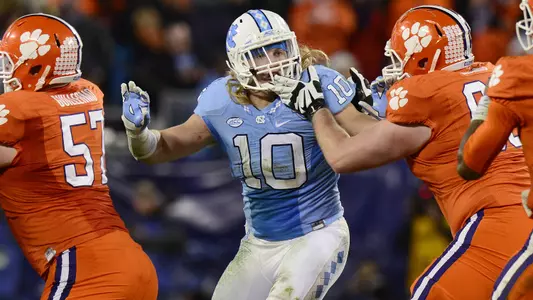
The screen shot taken from ESPN showing the yellow line and no Tar Heels having crossed it on a crucial onside kick had spread like a jolt of electricity through the smart phone universe of the Carolina football team within five minutes of the end of their crushing loss to Clemson Saturday night in the ACC Championship Game.
With the Tar Heels in the middle of a furious fourth-quarter rally and having cut the Tigers' lead to 45-37 with just over one minute to play, Tar Heel coach Larry Fedora called for an onside kick. Kickers Nick Weiler and Freeman Jones jointly addressed the teed-up ball, five players to one side, four to the other. Weiler ran the math as he looked downfield at the Tigers, chose the side with the best odds to recover the kick, communicated that to Jones and signaled his teammates when to take off. Each of the Tar Heels had an assignment—either to block one of the Tigers or hone in on the football.
In this case, Weiler liked the look to the left, which meant he would give way to Jones, who lined up just to the right of the ball, to make the kick. Jones' foot struck the ball just above the mid-point and the ball made its choreographed small hop and then a large hop. It bounced off the chest of a Clemson player, bounded free and was covered by Tar Heel Hunter Crafford, a walk-on sophomore who transferred from Penn State in early 2015.
The fiery celebration on the Tar Heel sideline was short-lived, though, when a yellow flag laying on the grass at Bank of American Stadium signaled an offside infraction. The Tar Heels failed on their next onside kick attempt, and Clemson ran out the clock to secure its win and berth in the College Football Playoff.
But in this high-tech world of images and information spreading at the speed of sound, television replays challenging the legitimacy of the penalty call—one that could not be reviewed in the booth by the review official—were blowing up the social media circuits.
“It was the perfect onside kick, we executed it like we do in practice every week,” Weiler said in the hushed confines of the Tar Heel locker room. “We could see it on the big screen and we've seen the screen shots. No one's offside. Too bad it ended like that.”
”Words can't describe how bad we feel,” added Jones. “It was right there for us. But there's nothing we can do about it. The kick was exactly what I wanted. We got the ball. It was perfect—except they threw a flag.”
“It was the best feeling of my life, the biggest play of my football career, but it got called back,” said Crafford.
Certainly each of the Tar Heels recognize the safe play is to never get into a situation where one random bounce of the ball or one dollop of human decision-making from the striped shirts can tilt the balance. Don't get down 42-23 and need a miracle rally. Don't let Deshawn Watson and Wayne Gallman rush for six yards a clip. Give Marquise Williams a fraction more time to find a receiver, and don't overthrow the ball on the rare times you do have time and have a receiver open. Don't botch a good idea on a fake punt with a muffed assignment. Find a way to get off the field on defense and move it on offense so that you're not dominated nearly 2:1 in time of possession.
“We can't leave it in the ref's hands, we should have capitalized early in the game,” Crafford said. “It's on us.”
“Sometimes we don't click, for whatever reason,” receiver Mack Hollins added. “In the second half, we started clicking like we needed to. That's what makes it hurt so much. If we had gotten the ball back, I think we could go down and score and tie it up.”
Fedora pursed his lips and steeled his jaw afterward when asked about the onside-gone-awry.
“I don't know if we would have gone down and scored, but it was like a minute and eight seconds left on the clock and we should have had the ball at about midfield,” he said. “The way we had moved it the last couple series, I would have felt pretty good. [But the call] isn't going to change. It doesn't matter one way or the other, so I'm going to have to swallow it like a man and just take it, and that's just the way it is. We came up short. We were one play short.”
One play short.
That's not bad facing the consensus No. 1 team in the nation, not bad one year removed from the devastation of the woeful final month of the 2014 season. It's not bad when you've rebuilt your defensive coaching staff, schematic structure and psychological profile in less than a year. It's not bad when a program with little national presence all of a sudden rides a warehouse full of offensive weapons and a vastly improved defense into the Top 10 and the daily discourse on ESPN and other national media outlets. My, how gorgeous it was seeing that Carolina blue all over Sports Center the last seven days.
“We have all the pieces of the puzzle in place,” Fedora said. “I feel really good about where we are and where this program is heading.”
“This year has generated a lot of excitement around the program,” added quarterbacks coach Keith Heckendorf, who one hour before the game Saturday was texting and Tweeting messages and photos to his recruiting targets. “The bus is filling up. We're going to be very selective in who we bring into the program. We lose some good players, but we've got some great ones coming back and others ready to move into their new roles.”
That Carolina Athletic Director Bubba Cunningham on Saturday announced a new deal for Fedora—four additional years to his existing contract, stretching now to 2022—was a smart stroke of initiative in an increasingly competitive coaching marketplace. Fedora essentially has the Carolina program where Mack Brown had it in 1992-93, riding the talents of the early recruiting building blocks (though Fedora had the luxury of five holdovers this year from the Butch Davis era) to some terrific football. Now proven and riding a stable infrastructure, Fedora & Co. can ratchet up the talent procurement machine and tweak and polish the culture.
Watching from the sideline Saturday were former Tar Heels Dre Bly, Julius Peppers and Eric Ebron. Bly was tickled to have seen teammate and quarterback Oscar Davenport for the first time in 17 years. Also in the house were Phil Farris, who caught the winning touchdown pass to beat Michigan in the 1979 Gator Bowl, and Kory Bailey, who snared a touchdown in the Heels' epic 41-9 beatdown of Florida State in 2001.
“I'll be very happy when we can say our 1980 team is not the last one to have won an ACC championship,” said Mike Chatham, a tight end on that squad that finished 11-1 and beat Texas in the Bluebonnet Bowl. “We're all ready for this program to step up and be a consistent contender like our team used to be.”
It's coming—one play at a time.
Chapel Hill writer Lee Pace (leepace7@gmail.com) is in his 26th year writing “Extra Points” and 12th reporting from the sidelines for the Tar Heel Sports Network. His unique look at Tar Heel football will appear regularly throughout the fall. Follow him on Twitter @LeePaceTweet.
Players Mentioned