University of North Carolina Athletics
Extra Points: Hugging Trees In Kenan Woods
May 26, 2015 | Football, Featured Writers
By Lee Pace, GoHeels.com
Name another college football stadium in the nation where you can stand exactly 30 yards from an exterior fence and actually be blocked from viewing the structure by a wooden thicket of oak, pine, hemlock and maple trees.
The Tar Heels' competitive record on the field of Kenan Memorial Stadium could best be charted with a pogo stick—impressive highs and stupefying lows—and its footprint in the center of the Chapel Hill campus limits the laser-beam generation of pre-game energy that the massive parking lots surrounding some stadiums generate.
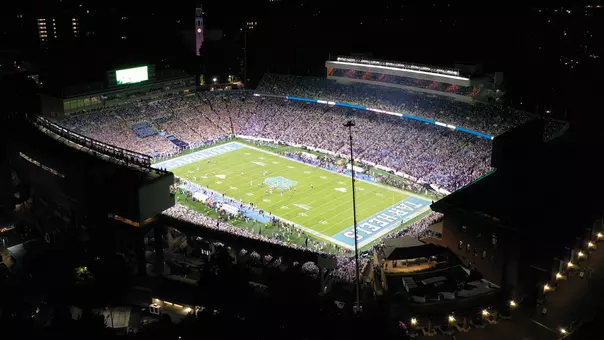
But its wooded setting and the field's placement in the base of a natural ravine meld to give the structure an aesthetic ambiance unrivaled among the major players in college football and those not situated next door to a river (a la Michie Stadium at Army and Neyland Stadium at Tennessee) or a lake (Husky Stadium at the University of Washington).
“The land falls away and the panorama of long, graceful lines and gently sweeping curves spreads out,” noted the Carolina Alumni Review upon the stadium's opening in 1927.
It's the Wrigley Field and the Merion Golf Club of college football.
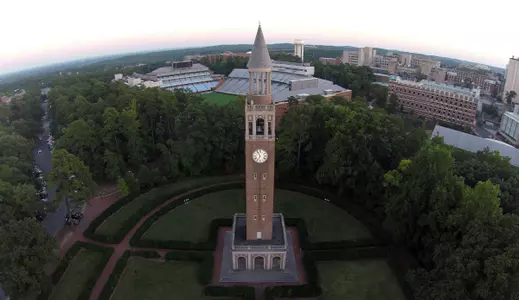
“This is a very unique setting,” says Tom Bythell, UNC's arborist and the man charged with maintaining the Kenan Woods around the structure. “I was told that Mr. Kenan purposely wanted the woods around it. You see the old, old photographs, and the woods were really deep. You'd walk a hundred yards through the woods before getting to the gate. Through the years, the university has grown and slowly encroached on that. It was important to Mr. Kenan that it be wooded all the way around. We're trying to honor that. It's very important and very unique.”
William Rand Kenan Jr. was a 1894 UNC graduate with a degree in chemistry and contributed in 1926 some $330,000 to build the football stadium to memorialize his parents, William R. Kenan Sr. and Mary Hargrave Kenan. The family has remained engaged and generous in its support of the expansion of the facility through nearly a century.
“He personally inspected the campus and looked at the spots they thought of for the new stadium,” says Thomas S. Kenan III, whose grandfather was William Kenan Jr.'s first cousin. “What he loved about the one they eventually selected was that it was in a natural bowl and completely surrounded by trees. It was a beautiful setting and convenient to campus and the town.”
The wooded envelope around the stadium has shrunk the last quarter century with a Campus Health building to the southwest, a parking deck to the west and the UNC Alumni Center and Carolina Club to the northeast. The last major structural addition was the Loudermilk Center to the east in 2011, and the culling of the forest on that end prompted Athletic Department officials and Bythell to take a concerned and close look at preserving and enhancing the remaining acreage known as Kenan Woods.
In the last three years, four sections on the north side of the stadium have been fenced off and new trees and plants established in a fresh eight-inch bed of mulch. No traffic by foot, bicycle or auto is allowed, and Bythell's staff grooms and cultivates the protected woods on a regular basis. The work has been accomplished on a modest amount of some $20,000 allocated through the Loudermilk Center construction budget.
“This is an awesome story,” enthuses Bythell, who's been at Carolina for 17 years. “This idea was to go through and try to make Kenan Woods a little more healthy. It's a win, win, win, win situation. I am so proud of my brothers in athletics for providing the money to make this happen.
“We had a huge problem with flooding and with cars pulling in here to tailgate. It was taking its toll. The natural evolution of the forest was not happening because we were killing off all the little ones. Eventually, it's not sustainable and it will all go away.”
Bythell stands at the boundary of one of the “tree pods,” as the protected sections are called, and lists the elements that are working today that were not five years ago. The strains of James Taylor's Carolina In My Mind waft through the trees on this May Friday as commencement preparations for the weekend proceed inside the stadium.
“We had a real problem with water running through here,” he says, tracking with his hand the flow of rain down into the stadium and its underbelly of drain pipes. “It was all dirt inside this forest. You get a big storm and the water ran in sheets. Now the tree canopy is fuller. The mulch catches the water. There is new tree growth. We've not had the flooding problems like we did before.”
He points from one tiny tree to another amidst the older pines and oaks.
“There's a nice holly, there's a little maple tree growing,” he says. “You can see a little oak tree—that's an acorn that germinated. Now all of a sudden, we've got an opportunity because we're leaving it alone. This piece of the forest will naturally come back. This is really working. It's an interesting thing, it's very cool. All these little trees will be big trees one day.”
Bythell walks to another pod and notes the picnic tables notched into the woods and the challenge of mixing entertainment on fall Saturdays and maintaining ecological health.
“Keeping vehicles out of here is important,” he says. “I can remember coming through here on Sundays after football games to clean up. Parking vehicles and trees do not mix. You get oil leaking from vehicles, you get some toxic waste from the garbage. A forest is virtually indestructible. You just cannot compact all the soil and you can't poison it.
“It's really important for folks to have a great experience on football game days. My job is to maintain this forest and make sure this ambiance is maintained and enhanced. We've accomplished a lot at a reasonable cost. We're getting there. This is so cool.”
Chapel Hill writer Lee Pace (leepace7@gmail.com) in his 25th year writing “Extra Points” and 11th reporting from the sidelines for the Tar Heel Sports Network. His unique look at Tar Heel football appear regularly throughout the year. Follow him on Twitter @LeePaceTweet.