University of North Carolina Athletics
Extra Points: Summer Camping
June 12, 2015 | Football, Featured Writers
By Lee Pace, GoHeels.com
The football year flows with the consistency of an ancient mountain stream: August is training camp, fall is the season, winter is recruiting for coaches and conditioning for players, March and April is spring ball, May is recruiting for the coaches and exams for players.
And June is camp month.
“Eight days in a row,” Larry Fedora said Thursday around noon. “We're ready to go. A lot of time and planning goes into these two weeks, a lot of man-hours by our coaches and support staff. This is a important part of our year.”
Camp season started on June 6 and runs for just over two weeks and across three weekends. Fedora and his staff will operate 14 camps total, including nine one-day camps, a two-day camp and a seven-on-seven team camp called “Beast of the Hill.” One camp is quarterbacks-only and another is devoted to kickers, punters, snappers and holders. No other school in the ACC runs more camps than Carolina.
“I like the fact we have a number of camps and have manageable numbers at each and can put eyes on everyone,” says running backs coach Larry Porter. “That's better than having three or four camps and having three hundred kids at each. You can't coach them all. There is not one kid who comes through here that does not get one-on-one coaching and multiple reps. If I'm a parent or a high school coach, I appreciate that. I know my son has gotten a good evaluation with a strong set of eyes on him.”
After three days of camps over the first weekend of June into Monday and then off-days on Tuesday and Wednesday, the camp operation was in full-scale operation by late Thursday morning in the Eddie Smith Fieldhouse, next to the Navy Field practice facility where camps are held.
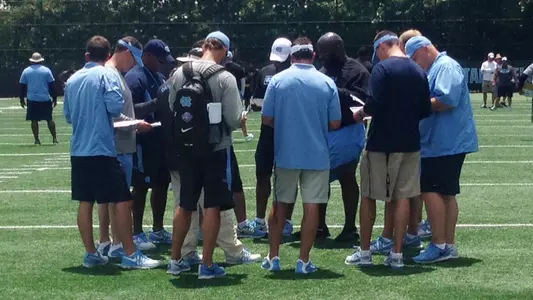
Campers are checked in, pay their $45 camp fee, receive their black dry-fit sleeveless shirt with the Carolina blue argyle pattern and have their photos made beside mannequins outfitted in the Tar Heels' three new uniform combinations they'll wear this season. There's plenty of Gatorade and sunscreen available. The entire Tar Heel coaching staff works every camp, supplemented by graduate assistants, a handful of Tar Heel players, the strength and conditioning staff and extra help from area high school coaches.
“We're going to be very organized, really efficient with our time, they're going to get coached the same way we coach our kids, get drills the same we do with our team,” Fedora says. “We don't want four hundred kids at camp and them getting 10 reps. When they leave here and walk off the field, we want them to be tired and have gotten a bunch of reps and gotten coached hard.”
Fedora starts Thursday's camp shortly before 1 p.m. by welcoming some 60 players of all shapes and sizes from grades nine through 12 in high school (weekend camps draw upwards of 150 players). Each wears his black shirt and has an ID number written on his upper arm with magic marker.
“If you can walk off this field in three hours and say you're a better football player, then it's been a successful day,” Fedora tells them. “I want you to leave with at least one thing that will help you this fall.”
Football camps today are not at all the profit-generating machines that several other sport camps have been for many years. The sport doesn't lend itself to bringing players together and staging a scrimmage—contact, injuries and equipment are different elements than basketball. Liability costs have skyrocketed in recent years. Football camps have become more about recruiting—for players looking for offers and coaches wanting to see players and their skill sets on the practice field.
“The camp business has changed so much the last 10 years,” receivers coach Gunter Brewer says. “Years ago you had overnight camps, three-day camps, team camps. Usually you went to a camp close to home. Now kids are traveling all over and they just want a quick visit. The internet and social media has completely changed the business of recruiting. Kids are shopping—they might go to five or six camps in a summer.”
“It's a two-way interview,” adds defensive coordinator Gene Chizik. “If we've offered a kid or are thinking of offering, I want to know how he is to coach. Sometimes a guy will come in with all these offers, you see him play and say, 'I don't want to coach this guy.' And vice versa, it works both ways. They may come in and say, 'I don't want to be coached by these guys.' For the ones who are borderline or real young, a camp is a great evaluation tool.”
After strength and conditioning coach Lou Hernandez leads the campers through a 10-minute stretching and warm-up session, he gathers the players around and begins to talk about speed technique.
“If you're being recruited, there are two numbers these coaches are going to look at,” he said, nodding toward the Tar Heel staff. “Who can guess the most important number?”
“GPA?” someone threw out.
“Exactly,” Hernandez said. “You're pretty smart if you've figured that out. Now, what's the second most important number?”
“Forty time,” someone piped up.
“Right,” Lou answered. “I can't help you with your GPA. But I can help you with your 40 time.”
Which he did by then talking about “force and frequency,” about take-off technique, about proper use of the arms in sprinting and assorted other fine points. The players then ran 40s and were timed and then moved to the broad jump and drill work. By 1:45 everyone had worked up a good sweat and knew this 88-degree, sunny day would be a challenge.
Quarterbacks threw off one knee to improve their wrist snap.
Receivers ran routes, breaking down over orange discs to show their braking and explosion abilities.
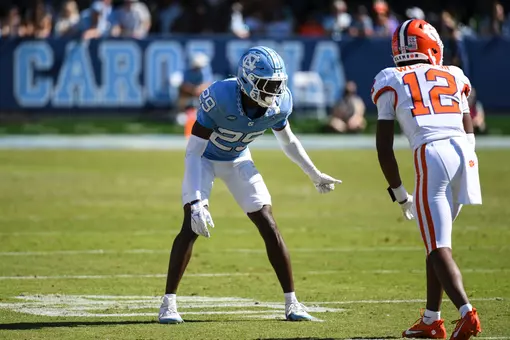
Defensive backs back-pedaled and broke to snag an interception.
And so it went until nearly 4 o'clock.
“The players and their coaches appreciate that we run an efficient camp and all of our coaches are hands-on,” says camp director Jason Tudryn “At some places you never see the staff. All our guys are in the trenches with every position group.
“Our camps are a great way for high school kids to learn some football and get to see our campus and develop a relationship with our staff and program. A lot of these kids are just chasing the dream. They want to get better and want to get noticed.”
Chapel Hill writer Lee Pace (leepace7@gmail.com) is in his 25th year writing “Extra Points” and 11th reporting from the sidelines for the Tar Heel Sports Network. His unique look at Tar Heel football will appear regularly throughout the fall. Follow him on Twitter @LeePaceTweet.