University of North Carolina Athletics
Extra Points: Trench Mob
August 6, 2015 | Football, Featured Writers
By Lee Pace
Within the 450 square feet of meeting room space assigned to the defensive ends and tackles on the second floor of Kenan Football Center is a little history, some psychology, some Xs-and-Os, some motivation and, perhaps most of all, a lot of structure and framework.
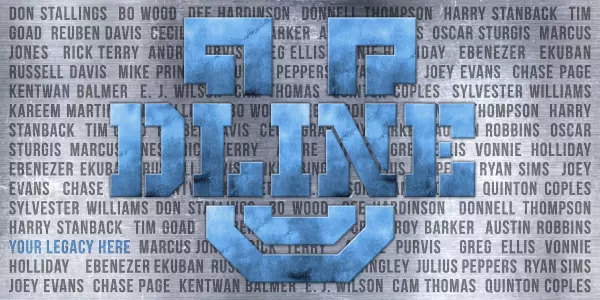
On one wall is a huge “Fathead” cutout of Julius Peppers, a Tar Heel from 1998-2000, pursuing a quarterback as a Chicago Bear. On another is a collage of images of Tar Heel defensive linemen like Peppers, Sly Williams, Kareem Martin, Greg Ellis and Quinton Coples who've gone on to success in the NFL with the tagline “Showtime” emblazoned across the bottom. Yet another assemblage of images displays the players' figures wrapped around an “NC” logo with the words “D-Line U” and “This Can Be You!” superimposed toward the bottom.
“Usually my seat's besides the Julius Peppers picture, he's my favorite player ever,” says sophomore tackle Nazair Jones. “Definitely the pictures are motivation. They define us. It's why we're 'D-Line U.' We've had so many first-rounders sit in the same chairs, in the same room that we have. It's happened before, and we're the next ones to carry on the tradition.”
On another wall is a poster extolling the theme of first-year coach Tray Scott—the words “Trench Mob” in large letters surrounded by images of a chain. Within many of the players' notebooks on the desks is an individual link from a steel chain that Scott bought at a hardware store and disassembled, giving every player one link to remind them their unit is only as strong as its bond and can be snapped by one weak link. Some players keep their link in their notebooks, some have made a keychain of their's. Scott wears his link around his neck, as he's accountable as well.
“The chain is a big thing to me,” sophomore end Dajaun Drennon says. “You do not want to be the weak link. To be a strong link, you have to do everything expected of you—in practice, in the meeting room, in study hall. I'm reminded of that every day when I sit down and open my notebook.”
“There can be no weak links,” adds Scott, in his first year with the Tar Heels after coming from UT-Martin. “If one guy is a weak link, it's up to everyone else to help bring him along, strengthen him, whether it's in the classroom or on the field.”
And yet another poster lists the elements of the “Defensive Lineman Creed,” exhorting its members to take pride in “playing the toughest, most physically demanding position” in the game and that its adherents be mentally tough and ready to endure pain and discomfort daily.
“We will be physical and relentless, we will be playmakers, we will be coachable,” the sign reads.
The structure and culture instilled by Scott is all part of a massive rebuilding effort of a position group that sent 20 draft picks into the NFL over the last two decades, 10 of them first-rounders. The Tar Heels have been so good at times they've had a starting lineup that included four future pros at once with Ellis, Vonnie Holliday, Russell Davis and Michael Pringley in 1997. Then they've gotten so thin that in 2012 they sent paper mache-thin freshman Jessie Rogers at 220 pounds and Justin Thomason at 230 to do battle the second half of the ACC season.
Thomason and Rogers have matured physically and evolved into solid players and will be important cogs in the D-line machine this year. But they're the only seniors, and they're joined as upperclassmen by three juniors in Junior Gnonkonde, Mikey Bart and Ian Dibble.
The unit is bottom heavy with younger players who form the ballast of a group that head coach Larry Fedora and his staff realize has to be significantly bolstered in order for the Tar Heels to climb out of their defensive doldrums. The unit has four sophomores in Jones, Drennon, Tyler Powell and Jonathan Sugg; three redshirt freshmen in Robert Dinkins, Jeremiah Clarke and Malik Carney; and three first-year guys in Jalen Dalton, Aaron Crawford and Jason Strowbridge. The coaches have sold with every breath in their bodies and every thumb-strike on their PDAs to recruits across the East that no school has done it better in the defensive trenches over time than the Tar Heels. Come join the party, the water's warm.
“This is 'D-line U,'” Fedora says. “You've got an unbelievable run of guys the last 20 years. Julius Peppers is still playing. And we've got (graduate assistant coach) Ryan Sims on our practice field. What these guys are getting from Ryan is unbelievable. He was in their shoes and not long ago. There can't be any more impressive place anywhere in the country. That kind of tradition is unbelievable. Every D-lineman out there sees what we've done and knows he can come to the University of North Carolina and reach every dream and goal he has.”
“We make sure these kids can't get away from the history of this program,” Scott says. “The pictures in our room remind them of how much of a privilege it is to play here. The guys before them set such a standard. When I got here I had forgotten that some of the guys I followed as a kid had played here. But I knew them all—Ebenezer Ekuban, J-Pep, Ryan, Marcus Jones, the list goes on. That room is like a Hall of Fame. That's why we tune in to how important the standard is. If our standard is really high, we might not get there, but we're going to be extremely productive trying.”
Scott plays up the trench angle because that's where games are won or lost. The position demands physical strength but proper technique as well—explosion off the line with legs, hips and the lower back, eye progression, hand technique (“Inside hands win”), taking proper angles. He delineates the word MOB into an acronym for “Mind on Business.” This is not a place for the faint of heart or hand—“You have to want to fight every down,” he says. “We're not running around people, we're running through them and controlling them. That's the mindset. It's down after down after down.”
The Tar Heels are getting enough quality and quantity of player now that their pass pressure and run-stopping ability should improve noticeably over 2013-14.
“Those guys are doing an awesome job,” says linebacker Shakeel Rashad. “Every time I can run a play without a lineman climbing to me, I know it's because we had a D-lineman doing an awesome job up front. I've seen a lot of that this camp.”
Scott is rotating eight and nine guys through two units early in training camp. He's giving the freshmen Dalton and Crawford an audition to show how much they might help. He's testing Tyler Powell's recovery from injury. He's watching closely to see if Gnonkonde, a native of the Ivory Coast and neophyte in football age given his late start to the game, has mastered the nuances of end play. His fingers are crossed that Jeremiah Clarke, penciled as the starter at nose tackle after spring practice, can make a quantum leap into his first year of college ball. Certainly two key pieces of the 2015 puzzle are the sophomores, Jones at tackle and Drennon at quick-end.
“We're just trying to get everyone to buy into the mindset,” Jones says. “By day four, we're seeing that. Coach just told us after practice he sees how we're changing and becoming playmakers.”
“We're definitely getting there,” Drennon adds. “I've seen a lot of improvement and changes since last year. We've all gotten stronger and older. We see the big picture now. We have the talent in our room. Now if we put in the work, we can be those guys on the wall.”
Chapel Hill writer Lee Pace (leepace7@gmail.com) is in his 26th year writing “Extra Points” and 12th reporting from the sidelines for the Tar Heel Sports Network. His unique look at Tar Heel football will appear regularly throughout the fall. Follow him on Twitter @LeePaceTweet.