University of North Carolina Athletics
UNC Looks To Continue Past NCAA Success
November 16, 2016 | Men's Soccer
UNC has participated in 17 of the last 18 editions of the NCAA postseason, reached the quarterfinals on nine occasions, made five appearances in the College Cups and won national championships in both 2001 and 2011. Overall, the Tar Heel men's soccer team has competed in 24 NCAA tournaments, compiling a 31-19-7 NCAA record.
This Sunday's second round match against either USF or Florida Gulf Coast will extend a streak of hosting at least one NCAA match at Fetzer Field every year since 2000.
Here is a look back at the outstanding history of Carolina men's soccer in NCAA competition.
The Tar Heels made their first NCAA Tournament appearance in 1968 in a game played on a wet and muddy Fetzer Field. Unfortunately, the defending national co-champions from Michigan State spoiled the debut. The Spartans outshot the Tar Heels, 37-6, and won 5-0 on three goals by Tony Keyes and two from Tom Kreft.
The next time Carolina returned to the tournament was 1987. It wound up the most successful run prior to capturing the 2001 national title. Coached by Anson Dorrance, the Tar Heels entered the NCAA Tournament as the eighth-ranked team in the nation after winning the ACC Tournament. In the first round, Carolina defeated archrival and defending national-champion Duke, 2-0. The Tar Heels then battled South Carolina through two overtimes and a shootout before winning, 2-1, on a penalty kick by Derek Missimo.
In the quarterfinal against Loyola (Md.), Missimo scored on a header to give the Tar Heels a 1-0 victory, making Carolina only the fourth team in ACC history to achieve 20 wins in a season. Carolina then went to the Final Four but fell 4-1 to eventual champion Clemson on the Tigers' home field. The Tar Heels were ranked sixth in the final Soccer America rankings and placed sweeper David Smyth on the All-America team.
In 1988, Anson Dorrance's final year as the men's coach, the Tar Heels defeated Wake Forest, 2-0, in the first round of the tournament. Both Tar Heel goals came in the first half as Adam Tinkham scored on a breakaway and Marc Buffin kicked one in from 25 yards out. For Carolina, it was the 10th win in 11 games, the only loss coming to Virginia in the ACC Tournament championship game. The Tar Heels then advanced to the South Region championship, where they lost 3-1 to South Carolina.
Under coach Elmar Bolowich, Carolina again defeated Wake Forest in the first round of the 1990 tournament. Freshmen Chris Lyn and Brent Walker scored to give Carolina a 2-1 win and improve the series record against the Demon Deacons to 9-1-2. In the second round, the Tar Heels were defeated, 3-1, by Virginia at Charlottesville.
In the first round of the 1991 tournament, the Tar Heels defeated UNC Charlotte, 1-0, at Fetzer Field. Todd Haskins scored the winning goal on an assist by David Moore in the first overtime period. The Tar Heels then travelled to St. Louis, falling 4-0 to the hometown Billikens.
In 1993, the Tar Heels were once again victorious in the first round, holding on for a 3-2 victory over Duke. Gregg Berhalter scored a pair of goals off free kicks, and then Chapel Hill native Greg Caiola came off the bench to score the game-winner in the 69th minute. In the second round, the Tar Heels were upset, 2-1, by Air Force after ACC Rookie of the Year Temoc Suarez suffered a broken ankle midway through the first half.
Carolina returned to NCAA Tournament action in 1994 for the sixth time in eight seasons. Despite possessing the home-field advantage, Carolina was beaten by James Madison, 3-0, in the first round.
The Tar Heels made an NCAA Tournament appearance in 1999 after a four-year absence. UNC played at No. 3 Furman and gave the Paladins, who eventually reached the NCAA Quarterfinals, all they could handle before losing, 2-1, in overtime.
In 2000, Carolina was the top overall seed in the tournament after winning the ACC championship. UNC hosted three games at Fetzer Field, coming back from a 2-0 deficit in the first round to defeat William & Mary, 3-2, in an overtime game played in a driving snowstorm. The Heels downed Rhode Island, 3-1, in the second round before losing to two-time defending NCAA champion Indiana in the quarterfinals.
The 2001 Tar Heels notched the men's first national title in their first-ever appearance in a national title game. After a rousing, late-game comeback win over Stanford to reach the finals, the Tar Heels faced and defeated five-time champion Indiana, who entered the tournament having given up just six goals all season.
The Tar Heels used an early goal 12 minutes in off a header by junior Ryan Kneipper to grab an early 1-0 lead. Kneipper beat an Indiana defender and goalkeeper Colin Rogers to a long cross from Matt Crawford and headed a shot from six yards out just inside the right post.
The Tar Heels then turned to their defense, led by senior captains Danny Jackson and Chris Leitch, senior goalkeeper Michael Ueltschey and sophomore David Stokes, who was assigned to Indiana all-everything player Pat Noonan for most of the game. Indiana put pressure on the Heels, but could not find a way to even the score against the stalwart Carolina defense.
At the 75 minute mark freshman Marcus Storey was fouled in the box, leading to a penalty kick by Jackson into the top left of the net, giving Carolina a 2-0 lead and its first-ever national title.
The Tar Heels made their fourth-consecutive tourney appearance in 2002. Carolina opened its title defense with a 6-0 win over Winthrop in Chapel Hill, paced by Kneipper's school-record tying five goals. In the second round, UNC fell on the road to Penn State, 1-0, in double overtime.
In 2003, UNC earned the No. 4 national seed and a first-round bye but lost to the nation's highest-scoring team, Coastal Carolina, 3-0, at Fetzer Field in the second round of the tourney.
The Tar Heels hosted a postseason match for the fifth straight year in 2004, but fell to George Washington, 1-0, in the first round.
Carolina was the tournament's No. 4 overall seed once again in 2005 and advanced to the quarterfinals for the fourth time in school history and third time over the last six seasons. The Tar Heels opened with wins over Providence (2-0) and Virginia (2-1) behind four goals from Ben Hunter. UNC was eliminated in the round of eight by SMU, 3-2 in double overtime.
UNC hosted once again - as the No. 14 seed - in 2006 but suffered a 1-0 loss to Old Dominion in its first match.
After missing the 2007 tourney, the Tar Heels returned as the No. 13 seed in the 2008 and made a run to the national title game with four straight one-goal victories and a stout defense. After opening the tourney with a second round win over Jacksonville, Carolina posted a 3-2 rain-soaked, overtime win over UIC to reach the quarterfinal round. All-America Michael Callahan tied the match with a 12-yard rocket in the 87th minute. In overtime, Brian Shriver sent a cross from the left flank to Garry Lewis at the far post for the game-winning header in the 95th minute.
The Tar Heels punched their ticket to the College Cup with a 1-0 win over Northwestern at Fetzer Field on freshman Kirk Urso's game-winner in the 61st minute.
UNC met No. 1 Wake Forest in the semifinals and jumped in front with a Brian Shriver header in the fourth minute. Zach Loyd made a run up the right side and found Shriver in the box for what proved to be the game-winner.
The Demon Deacons pressured the Tar Heels for the rest of the match, but goalkeeper Brooks Haggerty, who made a career-best seven saves, and the back four withstood the pressure and advanced to their second national title match with their third shutout of the 2008 NCAA Tournament. In the final, Carolina suffered a 1-0 loss to Maryland, ending their memorable run through the postseason.
Carolina made a return trip to the College Cup in 2009 where the Tar Heels squared off against undefeated and untied No. 1 Akron in the semifinals. The Tar Heels held the Zips scoreless for the first time on the season before falling, 5-4, in penalties. The Tar Heels opened the NCAA Tournament with a first round bye before dispatching No. 25 Brown by a 2-0 margin. Indiana came to Chapel Hill next and left in similar fashion as Alex Dixon tallied the lone goal in UNC's 1-0 win. Next on the docket was No. 24 Drake who was the lone team to tally against Carolina during the 2009 NCAA Tournament en route to falling 2-1. Kirk Urso and Dixon scored in the win, as Dixon became the first player in school history to score in three consecutive NCAA Tournament games.
North Carolina advanced to its third consecutive NCAA College Cup in 2010 in remarkable fashion as the Tar Heels became the first team in NCAA history to advance in three consecutive rounds via penalty shootout. The Tar Heels opened with a 0-0 draw against Georgetown before advancing 5-4 on penalties. In the second round, sophomore All-America Enzo Martinez delivered the goal of the tournament by scoring with nine seconds remaining in regulation to tie Michigan State before UNC advanced 5-4 on penalties once again. Another 1-1 draw in the quarterfinal round against SMU resulted in a 4-2 penalty win to send Carolina to Santa Barbara, Calif.
In the semifinal Carolina went up against undefeated and No. 1 overall seed Louisville. The Cardinals took a 1-0 lead early in the second half before Stephen McCarthy headed home a cross from Alex Dixon four minutes later to knot the score at 1-1. In another match looking to head to penalties, the Cardinals scored a last-minute goal to drop the Heels in heartbreaking fashion.
The 2011 season saw Carlos Somoano take hold of the program as the new head coach of the Tar Heels. It was more of the same as the club would reach the College Cup for a fourth-straight year and finally knock down the door to claim the second national championship in school history. Carolina claimed a 3-2 win over Coastal Carolina in the second round before Billy Schuler sent the Tar Heels through with an overtime winner against Indiana.
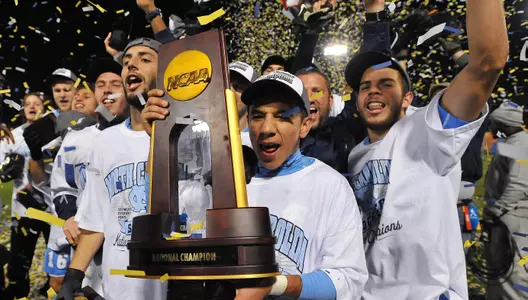
The Tar Heels downed Saint Mary's 2-0 in the quarterfinals to earn a trip to Hoover, Ala., where Carolina locked up with UCLA. The Tar Heels fell in an early 1-0 hole but netted a pair of goals in the second half to force overtime and an eventual penalty shootout that the Tar Heels claimed, 3-1. Ben Speas was the only person to tally in the championship as Carolina downed Charlotte to claim the 2011 National Championship.
Carolina reached the quarterfinal round for the fifth-straight season in 2012 after picking up wins over UMBC (3-2 in penalty kicks) and Fairleigh Dickinson (1-0 in overtime) in Chapel Hill, before falling 1-0 at home to eventual national champion Indiana.
After a rare second round exit in 2013, UNC quickly regained its footing on the national scene with its sixth quarterfinal appearance in the last seven seasons in 2014. A 6-0 home win over James Madison was followed by a pair of 2-1 road wins over national seeds Charlotte and Clemson. A cross-country trek ensued in the quarters at No. 2 UCLA in what turned out to be a match for the ages. Despite playing more than 90 minutes with 10 men, Carolina rallied from a 3-1 deficit on goals by Tyler Engel and Andy Craven to force penalties, but the Bruins ultimately advanced to the College Cup with a 7-6 shootout victory over the Tar Heels.
Carolina earned the No. 5 national seed in 2015, and promptly took down Coastal Carolina, 2-1, in the second round, setting up a matchup with former Tar Heel head coach Elmar Bolowich and the Creighton Blue Jays. UNC ultimately lost in the third round with a 1-0 setback.