University of North Carolina Athletics
Extra Points: Why Not Us?
April 17, 2016 | Football, Featured Writers
By Lee Pace
Throughout Kenan Football Center and Navy Field this spring have been the little clues that the 2016 Carolina football team is hardly resting on its 11-win laurels from last year. An ACC Coastal Division title and historic win streak were sublime, of course, but reality hammered the door flat when the Tar Heels ran into the speed and depth of Clemson and Baylor. And those defensive fronts in orange and green? The Berlin Wall was never so onerous in its day.
Receiver Mack Hollins, for example, insists on starting on all four core special-team units when, as a senior, in many programs he'd be given a pass to rest on those snaps when the ball is kicked. But Hollins walked onto the squad in 2013 and found his niche on special teams and doesn't want to forget his roots.
“The main thing for me and the other seniors is, nothing is given to us,” Hollins says. “We can't assume we're going to get 11 wins this year just because we did last year. Stay hungry. Work harder than we did last year in the offseason and summer, make sure we come out for the first game and have a 'blow-out-every-team' mentality, not start slow like we did against South Carolina and end up losing.”
Another senior receiver, Ryan Switzer, has taken considerable snaps this spring as a flanker on the outside to complement his customary position as a slot receiver. He says with a smile it's nice on the outside to not run into as many linebackers and safeties as you do over the middle, but more than anything, the experience has given him a better understanding of how the route-tree concepts for the Z, Y and A-Backs on the Tar Heel offense fit together.
“We just have to continue to build on what we built last year,” says Switzer. “We're really not missing a beat from last year at quarterback. We've got most of our O-line, running backs and receivers back. We have to make sure we pick up where left off and make sure there's no drop off from last year. And I don't think there will be.”
Chad Scott, the newcomer to Larry Fedora's staff as the tight end/hybrids coach, arrives at 4 a.m. to get his workout in before the day starts and, to facilitate learning a new offensive playbook, copied by hand every word, every page, every diagram.
“That's the way I learned as a student,” says Scott, a Tar Heel running back in 2003-04 and '04 UNC grad. “You commit something to memory much better not only reading it but writing it down as well. It's been interesting learning this system. It's fast-paced, it has a lot of elements and a lot of weapons. I can't wait to be a part of it.”
This time last year, the Tar Heel defense had two base calls in its playbook as first-year coordinator Gene Chizik and three other first-year assistant coaches assimilated themselves into the program. After a year of preaching the habits of winners and building a framework of technique and fundamentals, Chizik is amping up the schematic volume.
“We were pretty vanilla last year,” linebacker Cayson Collins says. “The coaches were trying to get everyone to understand what we were doing conceptually. Now we have all the base stuff installed, we have 13 different pressures in, a third-down package, a goal-line package. Last year we were probably at 20 percent of what we have in now. Coach Chizik wants us to be more aggressive this year.”
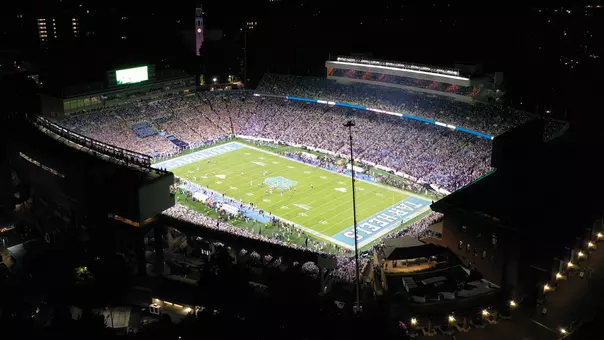
It all adds up to a team that concluded its spring practice regimen with a 90-minute scrimmage Saturday in Kenan Stadium that is as hungry to build off an 11-3 year as that squad was to avenge the bitterness of a 6-7 mark in 2014.
“Why not us?” defensive tackle Robert Dinkins asks. “Why can't we go to the national championship, why can't we bring a national championship home to Carolina? We have our eyes on the prize, we're not satisfied with making it to the ACC Championship Game. We want to win it. It was good what we did last year, but it wasn't enough.”
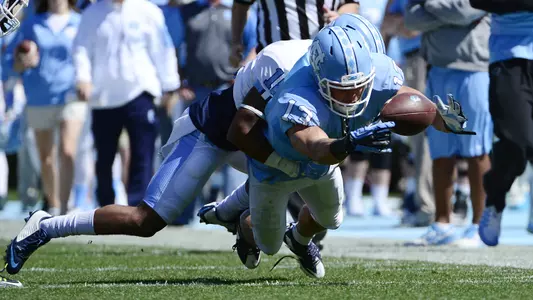
The Tar Heels staged an intra-squad scrimmage Saturday and tallied points in a system they drew from the Seattle Seahawks that measures offensive vs. defensive success throughout an entire practice session by such criteria as gaining four or more yards on first down (points for the offense) or holding on third-and-short (points for the defense). Fedora and his staff were handcuffed in presenting a true Blue-White Game by the fact that five key defensive linemen and starters at linebacker, safety, tailback, tight end and wide receiver were sidelined by injury or, in one case, academic suspension. The plan and hope is that everyone who couldn't play Saturday will be in uniform Sept. 3 when the Tar Heel face Georgia in Atlanta.
That the offense notched a few more points than the defense is of no real surprise given the stability of that unit and its returning talent—though the fact that the defense snared four passes from Tar Heel quarterbacks was noteworthy in the opposite direction.
“It was nice to see the defense create those turnovers,” Fedora said. “But at the same time, I hate to see our offense throw those picks.”
Which is why the only way to parse these events is to pick out the highlights and wait until August for the answers to any lingering questions.
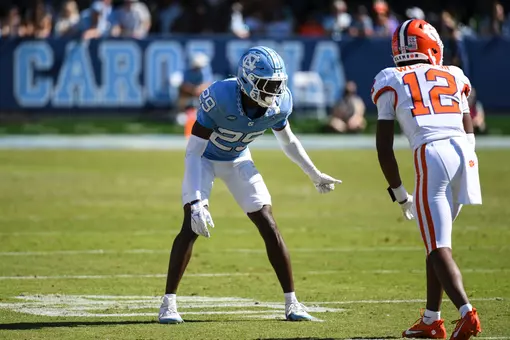
Certainly quarterback Mitch Trubisky showed his throwing acumen as he connected with Hollins seven times for 111 yards and one touchdown. Veteran offensive lineman John Ferranto has found a new home at right guard, having been beat out last year by Bentley Spain at left tackle. Senior kicker Nick Weiler bounced a 52-yarder off the crossbar for a field goal. Des Lawrence and M.J. Stewart remain a formidable tandem at cornerback for the defense. Malik Carney was the only scholarship defensive end to play, and Chizik says now that Carney has “bought in” to moving to the quick-end spot from linebacker, he has “made tremendous strides.”
Eight freshmen enrolled at Carolina in January and went through spring ball, and three on defense and one on offense were particularly active on Saturday. Tailback Jordan Brown led all ball-carriers with 85 yards on 11 carries, and linebacker Jonathan Smith and backs Myles Dorn and Myles Wolfolk all played at times with the No. 1 defense. Linebacker J.B. Copeland, a junior college transfer, had a good spring learning a new system but missed Saturday's scrimmage with an injury.
“It was impressive to see what the young guys could handle,” Fedora said. “You could tell when they were getting overloaded mentally and smoke was coming from their ears and they would make more mistakes, then you pull back and let them relax. They all did a nice job this spring and we're going to need every one of them next fall.”
The mood this time one year ago was a mix of anger, embarrassment and resolve to prove that 6-7 debacle of 2014 wasn't the reality of the program. It's different today. The losses to Clemson and Baylor serve as proof that the Tar Heels haven't “arrived.” But an 11-win season that included blowout wins over Duke and N.C. State and impressive road wins in Atlanta, Blacksburg and Pittsburgh provides a swagger and jolt of confidence necessary to make the next leap forward.
“You look at tape from last year and the mistakes we made—wow, we can be so much better,” Hollins says.
“It's our time to step up,” defensive tackle Naz Jones says from the opposite side of the ball. “If the opponent doesn't score, they can't win.”
Tasty food for thought over the barren four-plus months to come until kick-off in Atlanta.
Chapel Hill writer Lee Pace has covered Tar Heel football for 25 years through “Extra Points” and a dozen as the Tar Heel Sports Network's sideline reporter. His stories appear throughout the year on Goheels.com. Follow him at @LeePaceTweet.