University of North Carolina Athletics
How Dooley Rebuilt A Program
August 12, 2016 | Football, Featured Writers
by Rick Brewer, Sports Information Director Emeritus
Many of the stories that will be told about Bill Dooley this weekend are true. Others will be exaggerations. But, all have been told so many times that it's hard to tell which are which.
Reflections of former players, assistant coaches and friends have been constant since the former Carolina football coach passed away on Tuesday. His funeral will be Saturday in Wilmington.
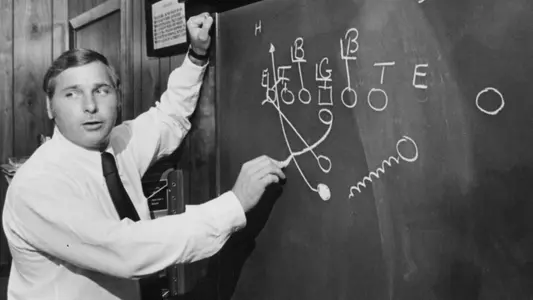
Dooley came to Chapel Hill in 1967 and rebuilt a football program that had sputtered since the Charlie Justice teams of the late 1940s. The Tar Heels had been to only one bowl game since 1949 when Dooley arrived on campus.
He knew the program was in bad shape when he took the job and he started making changes in a hurry.
The stories of his first year here are generally true. Off-season workouts and spring practice were brutal. Many players gave up the sport.
But, Dooley wanted to find out as soon as possible who would be his best and toughest players. He knew his first couple of seasons were going to be difficult and he needed to know whom he could count on when things weren't going well.
One of his first moves was to shift his best athlete, safety Gayle Bomar, to quarterback. He planned to run the I-formation, but didn't have an established tailback. So he needed a quarterback who could shoulder a good deal of the running game as well as direct the offense.
His philosophy for winning was simple-- be able to run the ball, stop the other team from running it and have a solid kicking game.
That may now sound unsophisticated with today's wide-open offenses and multi-look defenses. But, in reality, the running game and run defense are still the keys to being a consistent winner.
Away from outsiders in those early days, he was even more succinct. “You're nothing as a football team if you can't run the ball on an opponent,” he told players.
His early teams operated out of a 4-4 defense with just three players in the secondary. That left Carolina susceptible to the pass. But, Dooley felt it was more important to shut down the ground game by placing eight men up front.
He didn't want opponents controlling the football with a running attack. He wanted his team to be the one wearing down defenses.
That meant putting together a powerful offensive line. But, that is the toughest part of a team to develop. To run the I-formation, his linemen had to be tough, smart and durable enough to handle defenses stacked up to stop the run.
It took four seasons before he had the talent and depth he wanted at the five interior positions. He would have stars there throughout the rest of his time at Carolina.
He didn't have enough players like that when he got started. He knew his early teams would struggle.
But, even he was disappointed when the 1967 and 1968 teams went 2-8 and 3-7. The 1969 season seemed promising. The sophomores and juniors were players he had recruited and the seniors had now been in the program for three years.
A 1-4 start left fans wondering. The fifth game in that opening stretch was a 52-2 blowout at Florida.
The following week Don McCauley scored on a 97-yard kickoff return and rushed for a school-record 188 yards as the Tar Heels topped Wake Forest, 23-3. Carolina went on to finish 5-5.
The Tar Heels posted an 8-3 regular-season record the following year and went to their first bowl game since 1963.
McCauley was the tailback Dooley had been waiting to play. Dooley knew he was a special player when he made him part of his first recruiting class. After a year on the freshman team, he was a part-time starter in 1968. Then came a breakout season in 1969 with 1,092 rushing yards and an NCAA-record 1,720 yards in 1970.
McCauley was not a typical recruit for Dooley in those early years. He was from Garden City, N.Y. and one of a handful of players brought here from outside North Carolina or Virginia.
Dooley put together a recruiting plan even as he was interviewing for the job. He wanted to blanket this state. He realized Carolina wouldn't get every top player, but he knew the school would attract many of them.
Plus, he treated Virginia as part of Carolina's recruiting base. He was able to sign plenty of players from the talent-rich Tidewater area and from the northern Virginia suburbs.
Those were the days before there were scholarship limitations and Dooley brought in over 40 recruits a year. He had more players than lockers and jersey numbers. It just took time to develop them.
The Carolina staff made a point to build relationships with high school coaches across North Carolina and Virginia. That included schools that didn't have a prospect. They would probably have one in the future and knowing the coaches would be helpful.
This type of recruiting was not being done in the ACC. No one else was going everywhere and stockpiling players like Carolina.
Other schools had to change their recruiting philosophies and that led to improvement throughout the league. That's what people mean when they say Dooley turned around ACC football.
He had come to Carolina as the youngest head coach in the country. At the time people didn't realize he already had done the planning that would make him one of the best.