University of North Carolina Athletics
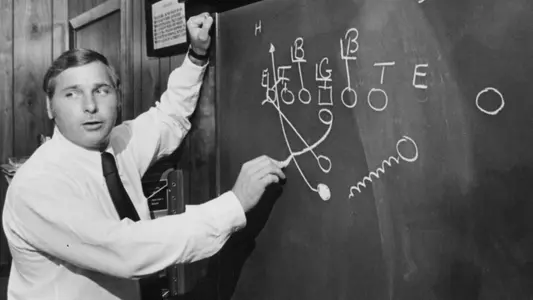
Extra Points: The Dooley Chorus
August 9, 2016 | Football, Featured Writers, Lee Pace
Football training camp had broken that August day in 1976 and a sizeable number of players had spent Saturday evening carousing at the Franklin Street watering holes of the day: Town Hall, Kirkpatrick's, the Bacchae. It was very late that night when the quiet on South Campus was interrupted by a chorus of football players clustered in the courtyard behind Ehringhaus Dormitory, singing in hearty unison their knockoff of a popular Top 40 song of the era by Bobby Sherman.
“Dooley, Dooley, Dooley do ya love me?” they chortled. “Dooley, Dooley, Dooley do ya care?”
That was a popular refrain among players from the 1967-77 Bill Dooley era of Carolina football—even the most outstanding player was always a little insecure of his spot in a program that ran on structure, discipline and old-school values.
“Coach Dooley was a demanding coach,” says Paul Hoolahan, a starting guard on the 1970 team. “It was not a program for the faint of heart.”
“Coach Dooley was a very imposing figure,” remembers Paul Miller, a quarterback of that vintage. “He was like Methuselah to a kid like me.”
Carolina football was floundering in the mid-1960s after Coach Jim Hickey's program enjoyed its one modicum of success, a 9-2 squad that throttled Air Force in the 1963 Gator Bowl, 35-0.
“We were struggling to find ourselves in those days,” Bud Carson, an assistant coach from the Hickey era, remembered years later. “We were just an average football team, trying to get over the hump. It was difficult building a program at that time.”
When Hickey was dismissed after the 1966 season, Carolina AD Chuck Erickson turned to the Southeastern Conference for help. A program that won on the road at Michigan and Ohio State under Hickey but lost all too often to Duke, Virginia and Wake Forest needed an infusion of Deep South masculinity.
And they found it in Dooley, a 32-year-old Alabama native, former Mississippi State guard and at the time an assistant coach at Georgia. The squad was first introduced to its new coach during a meeting in Woollen Gym at the beginning of spring semester in January 1967.
“When I was at Georgia, we always loved to play the University of North Carolina,” Dooley told his new charges.
Some players exchanged glances. They could remember three straight losses over the previous three seasons to the Bulldogs—24-8 in 1964, 47-35 in '65 and 28-3 in '66.
“We knew if we got to the third and fourth quarters and it was a close game,” Dooley continued, “we'd win the football game. We knew we were mentally and physically tougher than North Carolina.”
Privately, Dooley said it was a “country club atmosphere.” He'd been told you can't win at Carolina—the school had had three winning seasons in 17 years, and two of those were 6-4—because the town and campus were too liberal, there were too many social distractions, that it all led to a soft football player.
“We intend to do something about that,” Dooley said.
The winter workouts began in a few weeks. There was no weightlifting. It was all running, sprinting and wrestling. The intensity was a shock.
“I still have nightmares about it,” says Gayle Bomar, a safety under Hickey who would move to quarterback for Dooley. “None of us had been through anything quite like it in our lives. A lot of guys decided to hang it up. I think we had 90-some players in the winter, and about 30 dropped out before we made it to spring.”
Spring practice was another ordeal. It lasted for almost two months—early March through the end of classes.
“More nightmares,” Bomar says. “It was long, it was grueling, it was a tremendous amount of contact every day. I remember one scrimmage on a Saturday in Kenan Stadium. We started about noon, and we could hear the Bell Tower ring every hour. Before it was over, the Bell Tower rang five or six times. It was a long day, a very intense experience.
“Later, I went into the service and went to boot camp. It was a picnic compared to that first spring practice.”
Not only did Dooley introduce a rigorous offseason conditioning program, but he organized his coaching staff as a CEO would a staff of salesmen. He ordered them to wear a shirt and tie and visit every high school in the state of North Carolina that first year. He hired the school's first full-time academic counselor and strength and conditioning coach.
“The ACC was lagging what they were doing in the SEC at the time,” long-time assistant coach Sandy Kinney remembered years later. “Coach Dooley set the new standard. Soon after, every school in the league was doing what we were doing at Carolina.”
“I hate to admit it, but Bill Dooley changed the face of ACC football,” former Virginia Coach Don Lawrence added.
Dooley's results spoke for themselves. He won ACC titles in 1971 and '72 and his team shared the league title with Clemson in 1977. He won with defense, a sound kicking game and a run-oriented ground attack that used just enough play-action passing to keep a defense honest. He loosened up in later years, delighting in the mid-1980s when, as the coach at Wake Forest, a newspaper headline proclaimed the Deacons' offense “Air Dooley” under the prolific arm of QB Mike Elkins.
Dooley made his last public appearance in July when the 14th-annual Triangle Pigskin Preview luncheon was held at a Cary hotel. Dooley had conceived and organized the event as a means to generate interest during the summer lull and raise scholarship funds for area youths, and though he was feeling the effects of several years of declining heath, he still had a twinkle in his eye as he accepted the handshakes of old friends and well-wishers.
Dooley's highest compliment that day came from Scottie Montgomery, a former Duke player and current ECU head coach, who noted during his remarks that everyone in the state who cared about college football should pay homage to Dooley.
“He did so much for football in this state,” Montgomery said. “We all owe him a debt of gratitude.”
Certainly those same players who crooned Bill Dooley's name in song so playfully four decades ago will bow for a moment of silence today.
Lee Pace (UNC '79) has covered Tar Heel football since 1990 with his “Extra Points” column, found today regularly throughout the year on Goheels.com.