University of North Carolina Athletics
Turner's Take: The Payoff
September 25, 2016 | Football, Featured Writers, Turner Walston
By Turner Walston
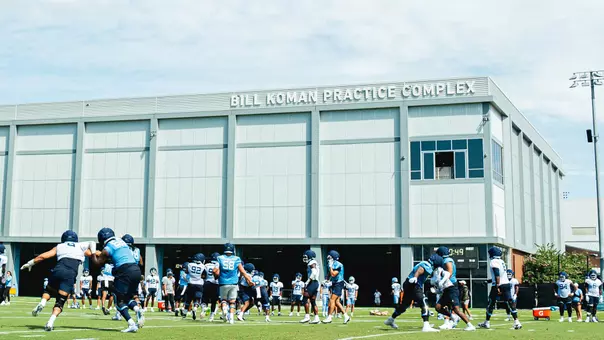
It started on Wednesday at Navy Fields. After the warm-up period and stretches, the Tar Heel offense and defense spend most of their allotted practice time apart, with the offense on the grass field, the defense on the turf field. They work in their position groups or against their scout teams, often not bothering to think of one another until the close of practice. Every Tar Heel football practice culminates with a two-minute drill. Offense vs. defense. Ones vs. ones. Neither unit wants to give an inch. The offense wants to score; the defense wants to stop them. There's plenty of jawing back and forth as they work from opposite sidelines, plenty of banter, some friendly, some not so friendly, as each unit works to make themselves –and the other– better.
Sometimes, the offense wins. A wide receiver gets behind the defensive secondary and scores a touchdown, then carps about it. Sometimes, the defense wins, the offense seeing a drive stall at midfield when they can't convert on fourth down. Sometimes, it's a field goal.
At Carolina's Wednesday practice this week, the defense won. They were fired up, too. Quarterback Mitch Trubisky wears the 'no-touch' green jersey, and the defense got to him on a fourth-and-long attempt. The play was blown dead, the quarterback ruled sacked. Trubisky threw the ball anyway, and it was . . . intercepted. "We'll take the pick, too!" a defensive back yelled toward his offensive counterparts. Trubisky and his offensive line, his backs and receivers hadn't gotten it done.
"Coach (Gene) Chizik is one of the best defensive coaches in the country," receiver Austin Proehl said. "Going against them every week definitely helps us, and makes us better on a week-to-week basis."
It helped on Saturday.
Three days after that two-minute drill, the Tar Heels found themselves down thirteen points. They'd had an awful start, giving away points via an early safety and a missed two-point conversion, finding themselves behind the chains and behind on the scoreboard.
The clock loomed. Time was ticking down, and things got dangerous when the Tar Heel offense went three-and-out early in the fourth quarter. They punted to Pitt, down two touchdowns with 9:10 remaining. Given the Heels' struggles on offense and defense to that point, things looked grim.
But finally, a good stop. Pitt got four yards on the ground on the first two downs, but Nathan Peterman's pass toward Tre Tipton fell incomplete. Life. A Ryan Switzer punt return gave the Heels the ball near midfield. Still, they needed him to make a fourth-down grab to keep the drive alive.
Trubisky hit Austin Proehl for 20 to get to the three, then lofted a ball up to Bug Howard for a score. 36-30, Pitt. 5:24 remaining.
Another stop for the defense. Pitt picked up three yards, then lost one, and Desmond Lawrence and Dominique Ross caught James Conner for no gain on a third-down screen pass. Pitt would have to punt. "There were no missed tackles in that last couple of series," head coach Larry Fedora said later. "We made the plays when we had to make them."
Switzer fair-caught Ryan Winslow's punt at the Tar Heel 37 yard-line. Remember that safety from the opening series? That was two points. Remember that failed two-point conversion attempt, that was a third point left on the field. And so Pitt's lead was six rather than three. A field goal would do no good. With two timeouts, Carolina would have three minutes and 35 seconds to go 63 yards, score a touchdown and win with the extra point. All without Mack Hollins, the team's best deep threat who'd been sidelined by an injury on special teams.
What followed was an incredible example of clock and field awareness, of poise from a first-year starting quarterback, of trust in backs and receivers, of an offensive line that gave their playmakers time to make plays. What followed was one of the most improbable finishes in Kenan Stadium history.
"We found out a lot," Proehl would say later. "We found out who we were as a team."
This is the kind of late-game situation that the Tar Heels drill to end every practice. Sometimes, they need three. Need six. Need seven. Saturday, they needed six at least, needed a win to stay in the Coastal Division race.
It didn't look good. First and ten at the 37 quickly became third and 16 at the 31 after an illegal block. But Trubisky stayed poised, finding Proehl, perhaps the team's cleanest route-runner for 10. He then connected with Switzer for 15 on fourth and six.
Fourth and six again, after a couple of misses toward Proehl and Howard. This time it was Proehl who made the must-have grab on the sideline for 13.
Trubisky then took an untimely sack, and Carolina was forced to take their final timeout with 110 seconds on the clock. They'd need 21 yards and would have just three downs to do it. But there's that poise. Switzer for five. Sixteen to go. Switzer for seven. Nine to go. Switzer for . . . nine, and only just. The 5'10 spark plug got up high to grab one over his head and extend the game.
"It's not about reach," Trubisky said later. "It's not about height. It's all about heart. He found the hole, and I threw it to him."
"I knew both calls were coming to me, and I wasn't about to let Mitch down or let my guys down, no matter how tired I was," Switzer said. "The last one . . . that was just a product of just quarterback-wide receiver connection. I got bumped off my route. I ended up running the opposite way of where I was supposed to, and Mitch just stuck with me and put it where it needed to be."
The last one was also the school-record-tying 16th reception of the game for Switzer, the kid from West Virginia who was a freshman wonder on the punt return three years ago and is one of the most versatile offensive weapons in college football as a senior.
Three fourth-down conversions on a single drive, and the Tar Heels got a fresh set of downs at the Pitt 17. After an incompletion toward Proehl, Trubisky hit Howard on the sideline for 13. First and goal, but no timeouts and just 31 seconds on the clock.
Every play in the Tar Heel offensive playbook is a run/pass option. On every play, the quarterback can choose to hand the ball off to his capable tailback or pull it out and find a wide receiver.
With 31 seconds to play, the play call was made. '235 Fade.' "It's a run, play-action," Howard explained. "If we go to the run, Elijah just bulls his way through there. If not, just throw it up one- on-one."
Trubisky looked for Howard, but with Pitt's Ryan Lewis draped across the wideout, the ball fell to the ground. The play call was made. Again, '235 Fade.' This time, it went to Hood, with 23 seconds to play. He chewed up two yards, close to the end zone, but not in. Pitt slowed him down, slowed him up, trying to run the Tar Heels out of clock. The whistles blew with 18 seconds to play. "They ate up as much time as they probably could," Fedora said. "I think there was about 13 seconds left on the clock when we finally got a play off, something like that."
Coach, there were five. Trubisky could have spiked the ball to stop the clock, could have brought up fourth down but an opportunity to huddle. Then again, an opportunity for both teams to huddle. No. '235 Fade.' Again.
"We were in the huddle (before), like, 'We're going to have time for three plays, and we're going to run the same play three times, and we better make it happen,'" Howard said. "So Fedora was putting the pressure on, like 'I'm not changing the play, so just get it done.' The first one didn't work. Second one didn't work, and third one, we had to make it work."
Howard was so confident in his length and Trubisky's accuracy that he told Lewis that the play was coming. "After the first one, I just told him, 'We're coming right back.' I told him the fade was coming again. So, the second one, we ran the ball. He was like, 'Where's the ball at?' And I said, 'Just wait.'"
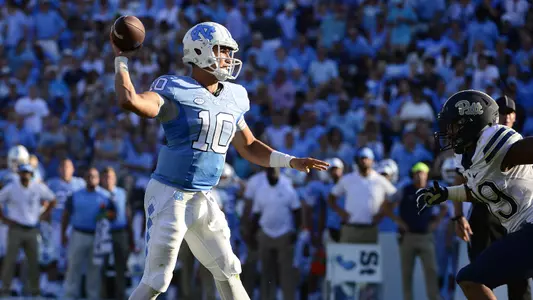
Five seconds. Snap. Trubisky lofted it up to his right, toward Howard again. Howard, who was working against Lewis, again. He turned in the near corner of the end zone, got position on Lewis, who tugged at Howard's jersey. The penalty flag flew. Bug got a hand free, his left. It's all he needed. He hauled in the game-tying score with two seconds remaining.
"Boom. Game winner," Howard said.
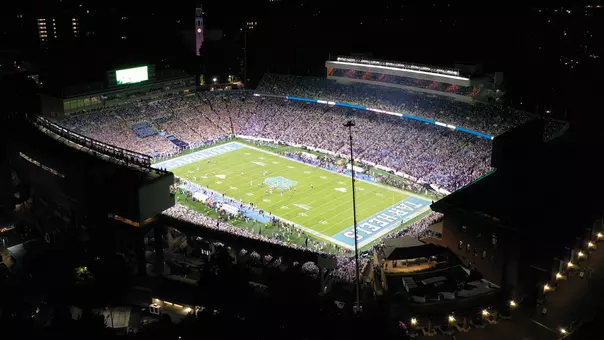
Nick Weiler's extra point gave the Tar Heels their first lead of the game. Quadree Henderson made the kickoff return interesting, bringing the ball back to the Tar Heel 40 before freshman Myles Dorn and sophomore Corey Bell, Jr. ran him down, but that did it. Time expired. Ballgame. Thirty-seven to thirty-six, one of the greatest endings in Kenan Stadium history.
After the teams shook hands and the Tar Heels sang the alma mater with their fellow students, the quarterback calmly walked toward the Tar Pit, shaking hands with fans and thanking them for their support. He calmly walked into the tunnel, overcome by the moment. Trubisky, who'd watched as a redshirting freshman as Bryn Renner led the Tar Heel offense. Trubisky, who saw Marquise Williams set records for two years in Larry Fedora's schemes. Trubisky, who'd led his first game-winning drive.
"I'm proud of Mitch," an emotional Switzer said of his former roommate. "I love him. I told him that on the sideline. Me and him have specifically, have dreamt of moments like this. It was tough for him the first three years being here, not being the guy, I was one of the guys that was seeing when he was in his room or just didn't feel like it, because he wasn't playing, so that's why it hits me a little bit harder than most, because I've seen him, how much he struggled and I'm just so thankful that it's paying off now."
Switzer and Trubisky worked together throughout those three years, throwing late at night and early in the morning when no one was watching. They'd thrown and caught thousands of times with no stakes at all. Saturday, they connected 16 times, with 54,500 people watching.
Trubisky was almost in a daze after the game. He dutifully answered questions, giving credit to his receivers, his offensive line, his defense. But he couldn't really grasp the experience he'd just been through, maybe not quite realizing what he'd just done, engineering such an improbable game-winning drive.
Certainly Trubisky studied the film from that two-minute drill in practice, saw where things broke down and learned from it. Sunday, he'll look at the film from Saturday, the good and the bad. He'll be his harshest critic. He'll find throws he'll want back, decisions he could have made differently. But he'll see himself leading his team, and he'll see a winner.
"I'm just enjoying it," he said moments after the finish. "It was a crazy ride. It was awesome to be out there. We had a great crowd, the team came together great, and we just finished it. It was amazing to be a part of. It was a lot of fun. I enjoyed it."
So did we, Mitch. So did we.