University of North Carolina Athletics
Extra Points: Stone Cold
September 25, 2016 | Football, Featured Writers, Lee Pace
by Lee Pace
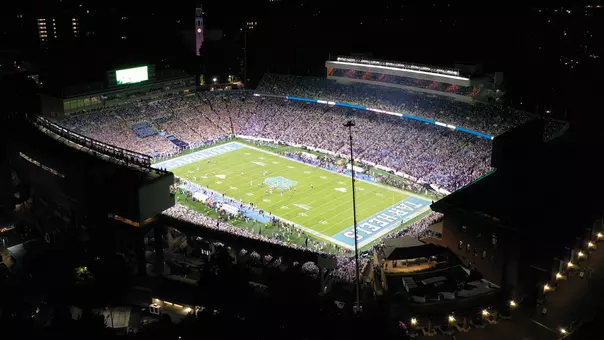
Eighteen seconds: Elijah Hood is churning his massive legs in the thick of a goal-line scrum, half a dozen Pitt Panthers clutching and scraping and clawing to bring him to the ground. Pitt clings to a precarious 36-30 lead as early evening falls in Kenan Stadium, but this beast of a Tar Heel offense is snorting and ripping into high gear just in the nick of time.
Carolina's defense of its 2015 ACC Coastal Division championship officially began on a steamy late-September afternoon against the Panthers, both teams considered among the favorites for the 2016 division title. The game has been Pitt-dominated. The Panthers have hit for an average of five yards a run out of their jet-sweep oriented offense and have used a nullified Tar Heel punt return for a touchdown, a safety and botched Carolina field goal and extra point to forge an early lead and stay ahead all game. The Tar Heel offense had the ball less than six minutes in the first half and laid a three-and-out egg to open the second half.
“The ebb and flow of the game was just ridiculous,” receiver Ryan Switzer said.
“We had the ball 18 minutes and won the football game. That's tough to do,” Coach Larry Fedora marveled later.
Sixteen seconds: Hood finally hits the ground and now it's third-and-goal at the two yard-line. The Tar Heels have moved from their 37 yard-line in 16 plays and just over three minutes, converting three fourth-downs. Neither team has a time out.
It has been a war of attrition for the Tar Heels, particularly at the defensive line position as it's been throughout the first third of the season. Dajaun Drennon was expected to be back for the Pitt game but was still sidelined. Tyler Powell, Nazair Jones and Mikey Bart needed medical attention at varying points. Tight end Brandon Fritts returned from an injury in the Georgia game, played some the first half Saturday but was in street clothes after halftime. Mack Hollins was out the last quarter and his deep-ball threat negated after being stretched out on the trainer's table midway through the second half with a lower-body ailment. Austin Proehl was rubbed down for cramps during timeouts late in the game. Switzer could barely limp to the sideline after his last fourth-down completion, and his right shoulder was iced down when he left the locker room after the game.
“I've never seen anybody that tired,” receiver Bug Howard said of Switzer. “When you hear people say 'you leave it all on the field,' I saw that tonight. He came to the sideline and he dropped to the ground. We had guys like that tonight on both sides of the ball.”
Thirteen seconds: Hood gets untangled from the heaving, sweaty mob and hands the ball to one official, who spots it at the two.
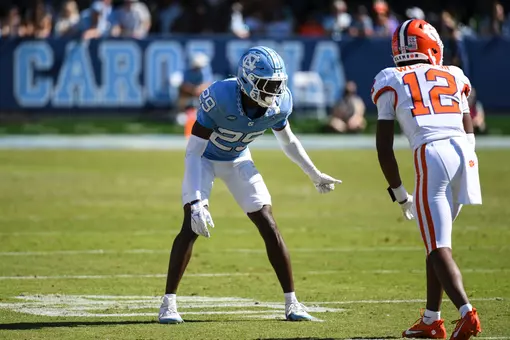
That the Tar Heels are in position to tie and potentially win the game is due in large measure to the fourth-quarter resolve of a much-maligned defense that the last two weeks has had coordinator Gene Chizik smacking it with terms like “soft” and “unacceptable.” Carolina forced three-and-outs on three of Pitt's final four possessions, with senior cornerbacks Des Lawrence and M.J. Stewart making nifty stops on the edge and Nazair Jones and Aaron Crawford plugging up the middle.
“My whole message to the guys was we haven't lost on this field since 2014, and today wasn't going to be the day,” Jones said. “That was the message I was pushing. We have a lot of stuff to fix, but we were able to make the stops when it really counted.”
Nine seconds: Center Lucas Crowley stands over the ball and his fellow linemen take their splits. QB Mitch Trubisky stands seven yards behind him, looking left and then right to make sure everyone's getting in proper position.
Everyone knows the play call, which happens to be exactly the same one used on first and second downs, 235 Fade. There are a myriad of options built into the play—go to the 6-5 Howard in the front right corner of the end zone if he's got one-on-one coverage; go to Switzer on the opposite side angling to the back-left corner; or hand the ball off to Hood. The decision is strictly Trubisky's. He'd gone to Howard on first down but made a low throw, and Pitt cornerback Ryan Lewis knocked the ball down. Sensing Pitt was expecting another throw, Trubisky handed the ball to Hood on the next snap, but linebacker Matt Galambos went unblocked and stopped Hood cold.
One suspected Trubisky would look again to Howard on a fade route they'd practiced literally thousands of times since last season. Fedora and his staff instituted a “One More” mantra last spring, insisting if Carolina is going to improve over 11-3 from 2015, everyone on the squad has to be willing to spend a few more minutes after every film session, conditioning drill and practice session to focus on “one more” of this or “one more” of that.
“We pretty much had the fade all day,” said Howard, who'd scored on that very play on Carolina's previous possession. “Mitch and me can run it in our sleep. It's been our 'one more' play all year. If the DB overplays me, Mitch back-shoulders it to me. If I beat the DB off the line, he throws it to the back pylon and I run under it. We have an answer for whatever they do.”
Eight seconds: Crowley bends over and puts his right hand on the ball. Howard takes care to line up exactly on the line of scrimmage to the right. Anthony Ratliff-Williams, playing the opposite receiver in Hollins' absence, does likewise.
“There was no panic,” said QB Coach Keith Heckendorf, watching from the coaches' booth high above the field. “In some respects that transition was normal speed for us. We teach our guys to hand the ball to the official, get lined up and look to the sideline. I knew we'd get the play off. In fact, if we'd needed a fourth down, we would have had time for that also.”
“LSU lost a game Saturday at Auburn when they couldn't get lined up and make a play,” added receivers coach Gunter Brewer. “Their receivers couldn't get set. We put ourselves in a chance to win the game because we did get lined up. We had time. We got off the ball and had multiple ways to go.”
Six seconds: Hood is set to Trubisky's right for the full second required by the rules for a man who is not “in motion.”
Out on the right flank, Howard tells Lewis what's coming.
“We're running it again,” Howard told him. “We're coming right back.”
Howard signals Trubisky which way he's going to take Lewis, who's five inches shorter.
“The DB knew the one on first down was luck,” Howard said. “It came out of Mitch's hand a little funny. I knew the DB was going to try to overplay it, so all Mitch had to do was throw it up there so only I can get it.”
Five seconds: Crowley snaps the ball to Trubisky.
The first thing Blake Anderson, Carolina's quarterbacks coach in 2012-13, noticed about Trubisky scouting him in the fall of 2012, beyond his obvious physical skills, was his steady pulse in the most harried of all situations. Anderson watched a high school playoff game in Ohio in which Trubisky was a calming presence to his teammates—and to the adults.
“What struck me in the heat of all this was Mitch's poise and demeanor,” Anderson said. “It never got to him. He was calm and never broke stride. He put his hands up, calmed his guys down and told them what they were going to do.”
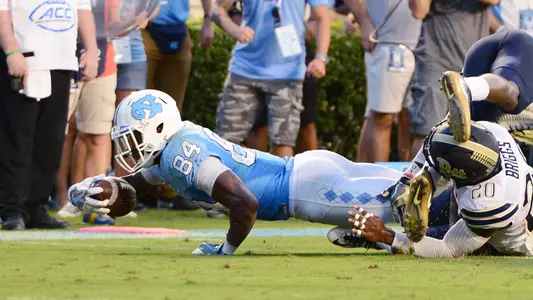
Now, four years later, Trubisky took the snap, turned his shoulders to the right and lofted a high, soft ball toward the outside shoulder of Howard, who jumped for the ball and caught it with his left hand while Lewis pulled Howard's right arm from behind. A flag came out for pass interference, but Howard never lost possession of the ball.
“Mitch is stone cold,” Hood said. “I do not know how Mitch did it, but he stayed focused, relied on his training and trusted his reads.”
“That's who he is,” Fedora added. “When good things happen, you don't see him going crazy. I could probably learn something from him.”
Two seconds: The Tar Heels have tied the game at 36-all and just have to convert the extra point and stop Pitt on the ensuing kick-off to win the game. They do both and escape with a 37-36 victory.
The Fade to Bug will take its spot alongside Gio Bernard's punt return vs. N.C. State in 2012 and Amos Lawrence's draw play vs. Duke in 1978 in the handful of colossal last-minute, game-winning plays for the Tar Heels. In the aftermath there was discussion of the exodus of many fans during the dire straits of the early fourth quarter and comparisons to the Tar Heels' monster rally at Georgia Tech in the ACC opener from last year that set off the dominoes toward the ACC division title.
“There's a lot of grit on this football team, a lot of toughness, and all the intangibles that we need to be successful,” Fedora said.
And all you needed was a microcosm of a dozen seconds to see them all.
Chapel Hill writer Lee Pace has covered Tar Heel football for 26 years through “Extra Points” and a dozen as the Tar Heel Sports Network's sideline reporter. He has just published a book on Kenan Stadium, “Football in a Forest.” Follow him at @LeePaceTweet and contact him at leepace7@gmail.com.