University of North Carolina Athletics
Extra Points: Deja Vu
September 4, 2016 | Football, Featured Writers, Lee Pace
by Lee Pace
Three hours and 48 minutes into the proceedings Saturday night as the Georgia band bleated out the tune of the Battle Hymn of the Republic with its customized lyrics and grown men in red polos barked like dogs, Ryan Switzer sat on a cooler in the Tar Heel bench area, his head buried in his hands and shrugging off encouragement and sympathy from assorted teammates. Nearby, fellow receiver Bug Howard flung a large piece of sign-board used to signal formations into the distance, the frustration of the Tar Heels' 33-24 loss to Georgia and blown 14-karat opportunity boiling over.
“It's my last go-around,” the senior Switzer said later. “When you invest so much into something and it doesn't go your way, it hurts. Obviously, you're going to show some emotion. Take your hat off to Georgia. They did enough things to win the game. That's on us. We've got to find out what we need to do to become a good football team. With the seniors on this team, I think we will.”
As the Carolina players trudged slowly and solemnly to one corner of the field to stand as the Marching Tar Heels played Hark the Sound, former Tar Heel All-America Dré Bly, one of a gaggle of high-profile ex-Tar Heels on the sideline Saturday night, sought out freshman Patrice Rene, who'd just gotten his first taste of college football and done so on a mega-watt stage: ESPN, sold-out Georgia Dome with four-fifths of the 75,405 crowd in red, Tar Heels with their highest pre-season ranking (18th) in six years. Rene, playing with the first team at cornerback during nickel-package situations with M.J. Stewart moving inside, was picked on twice during a key third-quarter Bulldog scoring drive and was flagged for two pass interference calls. Rene's confidence to play press-man coverage, his extra height at 6-2 and his speed to run step-for-step with Bulldog receivers were clearly on display. So was his inexperience. In time he'll learn how to manage the opponent and the airborne football in harmony.
“Great coverage, but you've gotta play the ball,” Bly told Rene, later adding, “I like this kid. He's not afraid.”
So much promise: The Tar Heels led 24-14 midway through the third quarter and had the look and feel along the sideline of a team ready to bare its chest and seize control of the game.
So much heartache: That lead turned out to be fool's gold as Georgia stormed from behind with tailback Nick Chubb showing the skills that ran roughshod over the Southeastern Conference before a season-ending knee injury last October. Chubb ran for almost seven yards a carry, the backbreaker a 55-yarder in the game's final four minutes.
“This game won't make or break our season,” tackle Nazair Jones said.
“We need to keep doing what we're doing, but take it up a notch,” defensive end Mikey Bart added. “A lot of young players played today and some of them made some crucial mistakes. We'll get that fixed.”
The Tar Heels have had high-profile openers in the past—versus South Carolina in a neutral site in Charlotte just last year; at South Carolina and Jadaveon Clowney in 2013; vs. LSU in this same Chick-Fil-A Kickoff Game in 2010 with 13 key Tar Heels suspended for eligibility issues; at Oklahoma in 2001 in John Bunting's debut as head coach; in Kenan Stadium against old-nemesis Clemson in 1996; projected as sacrificial lambs to USC in Anaheim in 1993; and at top-ranked Pittsburgh with QB Dan Marino in 1982.
Two were successful as QB Jason Stanicek ran the option with aplomb and the Heels pounded the Trojans in '93 and as an elite band of defenders shut down the Tigers during a 45-0 route in '96. But in most others there's been one glaring affliction—Marquise Williams' three interceptions last year, a potential game-tying touchdown bounce off a tight end's hands against LSU, the usually prolific running game of the Dick Crum era generating only 58 yards from Kelvin Bryant in 1982.
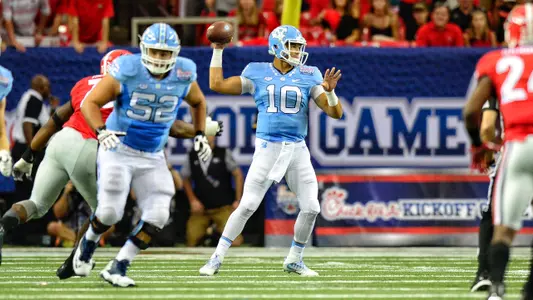
As Saturday's kick-off neared, I pondered what to cite as my “key to the game” on the Tar Heel Sports Network's broadcast. My colleagues Jones Angell, Brian Simmons and Dave Nathan had targeted the play of first-time starting quarterback Mitch Trubisky, the Heels' ability to stop the run and the all-important turnover margin as their keys. I had noted during training camp the Heels' abysmal propensity to draw officials' yellow flags during the 2013 and '14 seasons, Carolina ranking in the bottom 10 percent nationally both years and being nailed for an average of 64 yards a game. But that figure was cut to 46 yards a game last season and catapulted Carolina into the top third in that category, so that topic had fallen into the black hole of disinterest among media covering training camp.
I penciled those figures onto note paper on the sideline and prepared to go with that on the air—it was incumbent on the Heels to continue their improvement from '15 in focus and discipline, particularly pre-snap. But when I looked around the cavernous Georgia Dome and was engulfed in red—save the lower level on one side, where the 15,000 Carolina tickets were located—and heard the roar of Bulldog Nation, I changed my mind and said offensive communication amid the din would be paramount—how well could Trubisky and the linemen communicate calls, blocking assignments and cadences?
Turns out that I should have stuck with the concept of limiting penalties.
Carolina was flagged 13 times for 101 yards. The most painful was an illegal receiver downfield flag on tackle Jon Heck that was the first in a series of dominos that fell in a crucial turning point of the game. Georgia had cut Carolina's lead to 24-21 and the Tar Heel offense needed to generate a return uppercut to the chin. But a nice completion to Austin Prohel was nullified when Heck, who gets a three-yard ribbon to roam downfield before it being deemed illegal, was clearly two to two-and-half yards past the line of scrimmage while engaging a defender when the pass was released. Larry Fedora's vigorous protest of the call resulted in an unsportsmanlike conduct flag from the Big Ten crew.
So the Tar Heels go from first down at the 25 to second-and-18 from the four. Trubisky then makes an ill-advised screen pass from deep in the end zone to Elijah Hood, who's nailed behind the goal for a safety. That cuts the lead to one and the momentum has shifted back to Georgia, which finished the Tar Heels off with 10 fourth-quarter points.
That throw was certainly one of several Trubisky said he'd “like to have back.”
He termed his game “below average” and said he “left some throws out there.” Fedora without the benefit of careful study in the immediate aftermath said Trubisky had played “Okay” and was definitely pleased the Tar Heels didn't commit a single turnover. Everyone agreed it was good Trubisky finally had a full-game as the guy under his belt.
“Now I think he'll settle down and become more relaxed, hang in the pocket a little longer,” QB coach Keith Heckendorf said. “As he plays more, things will become more natural and fluid.”
In the after-burn of a stinging loss, the Tar Heels are in much the position they were one year ago following that debacle to a clearly inferior Gamecock squad. The difference is the Bulldogs are a significantly more talented litmus test.
“We rallied together and picked it up after that loss,” said tailback T.J. Logan, who had a monster game with a 95-yard kickoff return and 13.3 yards a carry on six touches from scrimmage. “A lot of people are going to try to discount us. The season's not over and we'll have our whole body of work to answer them back.”
Would that Georgia be a similar springboard in 2016 as South Carolina was a year ago.
Chapel Hill writer Lee Pace has covered Tar Heel football for 26 years through “Extra Points” and a dozen as the Tar Heel Sports Network's sideline reporter. He has just published a book on Kenan Stadium, “Football in a Forest.” Follow him at @LeePaceTweet and contact him at leepace7@gmail.com.