


University of North Carolina Athletics
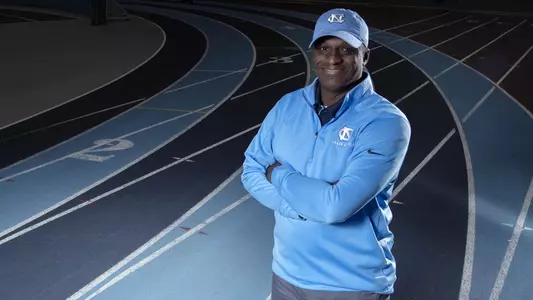
Photo by: Jeffrey A. Camarati
Coached: Adrian Wheatley
December 31, 2019 | Track & Field
With a new decade on the horizon, the Carolina track & field and cross country teams ushered in a new era with the hiring of program director Chris Miltenberg in June. Since then, Miltenberg has assembled one of the most promising coaching staffs in the nation.
Associate head coach and recruiting coordinator Michael Eskind, throws coach Amin Nikfar and distance coach Dylan Sorensen joined Miltenberg on his cross-country journey to Carolina. Sprints and relays coach Adrian Wheatley hopped on the Tar Heel train in August and distance coach Sam Nadel reunited with her former Georgetown teammate in September, this time in Carolina blue.
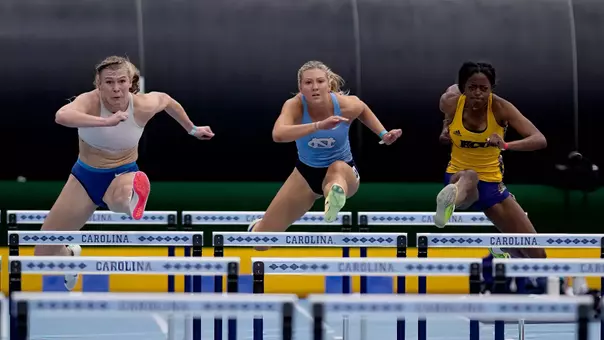
In this series, Tar Heel track & field fans get an inside look this decorated coaching staff. For part two of Coached, GoHeels spoke with assistant coach Adrian Wheatley who oversees the development of student-athletes competing in sprints, hurdles and relay events.
Wheatley, a three-time USTFCCCA Regional Coach of the Year, joined Carolina after eight seasons with the University of Illinois track & field program. Prior to Illinois, Wheatley spent three seasons (2009-11) at the University of Virginia, two at Austin Peay State (2007-08) and two at the College of Charleston (2005-06). As a collegiate student-athlete, Wheatley helped the University of Tennessee men's track & field program capture the 2001 NCAA Outdoor Championship team title and the 2002 NCAA Outdoor runner-up finish before graduating in 2002.
During his eight-year coaching tenure at Illinois, Wheatley built a foundation of success in the men's sprints, hurdles, relays and horizontal jumps. He coached 62 All-America performances, 58 NCAA Championship qualifiers, 93 NCAA Regional qualifiers, 27 individual Big Ten champions, 3 Big Ten relay titles and 36 All-Big Ten finishers. His guidance helped rewrite Illinois history with 44 of his athletes now sitting on the top-10 performance list in their respective events and seven holding school records. Wheatley was named USTFCCCA Midwest Region Men's Assistant Coach of the Year three times (2013 indoors, 2015 indoors and outdoors).
Read below what Wheatley had to say about Carolina, his coaching career and the importance of confidence.
–––––––––––––––––––––––––––––––––––––––––––––––––––––––––––––––––––––––––––
Q: How did you get to Carolina?
A: "The opportunity presented itself when Coach Miltenberg reached out and inquired about my interest in the university, and it was a point in my career where I wanted to continue to grow and learn. One of the lures to come to Carolina was to have the opportunity to work with this great staff we have here now. Coach Milt has obviously had huge success in the coaching world — he's won a national championship and several conference championships. Having been a part of that as a student-athlete, that's something I aspire to do as a coach, so I was excited about the chance to learn under Coach Milt and to continue my personal development as a coach."
Q: How would you describe your coaching style?
A: "I am athlete-centered as a coach. I want kids to understand that this is their experience. I want them to have the confidence to set high expectations and high goals for themselves, but I also want them to know it's my job to walk beside them through the process. We'll work together to reach those goals. In football terms, I like to be a players' coach — I'm not a yeller and screamer. At the end of the day, if you can't motivate yourself to do great things, then this is not a place for you because we're going to be competitive at a high level."
Q: When did you decide to go into coaching?
A: "When I was at Tennessee, I vividly remember going to other sporting events on campus. I'd play soccer in high school, so I enjoyed watching that sport especially, and I remember going to one of the soccer games and thinking, 'What do the coaches do? All they do is coach. You can do that?' That realization kind of inspired me to get into coaching, so I actually I started off at my old middle school as the head cross country coach. From there, I tried to figure out how to make a career out of it –– got into track, worked my way up and the rest is history."
Q: Did you say you started off as a cross country coach?
A: "Funny enough, yes. I was more of a middle-distance guy in college — 400 meters, 400-meter hurdles, 800 meters were kind of my primary events — but that was what was available and I had enough knowledge to understand the sport. I was just excited for the opportunity to try my hand at coaching and to work with one of my best friends. She and I actually ran together at that same middle school when we were young, so that was awesome for us to go back and just kind of get our feet in the door."
Q: Obviously there's a big difference between middle school and collegiate competition as well as between the mentality of sprinters and distance runners, but do you still apply any coaching strategies from your middle school cross country coaching days?
A: "I think the one big thing to remember about coaching is you're really coaching people. It doesn't matter if you're coaching middle school, high school, collegiate or professional. If you treat your athletes like individuals and see them as more than just someone in your program, they're going to give their best for you. Those kids were the ones who ended up having the greatest success in the programs that I've been a part of. Obviously, the technical pieces and the training change as you develop, but from a core standpoint, I've found in every place I've coached that if you treat people right, they're going to respond and want to walk through this process with you."
Q: Speaking of success, you were a member of a couple successful teams in your running days. What makes the difference between good sprinters and great sprinters? Good teams and great teams?
A: "There's an internal motivation within those individuals and those teams who have the most success. When I was an athlete, there was a lot of accountability between teammates. Our coaches put us in a position to compete at a high level, but there was an expectation and understanding that what we did off the track positively or negatively correlated to what happened on the track. The teams were committed to living the lifestyle of a champion. As coaches, we have to really have to put together the foundation for these teams to be successful by creating a culture. It doesn't happen in year one — it takes some time — but if we consistently do things right every day, then we should know what is going to happen when we step out of that track. We shouldn't need to change anything because it's championship week. Put on our spikes just like we did every other day; go out and compete hard; come back and take care of ourselves off the track. I talk a lot about how going to practice is easy. and how it's the stuff nobody else sees that really separates the good from the great. I think that outside stuff can be the hardest part for some people. So here's what I try to emphasize to people — very few people can compete at this high a level and if you're here, you have a chance to do just that. You only have four years of this opportunity and then you're going to have to hang your spikes up. You have plenty of time in your life to be social, eat those midnight pizzas. You're only a college athlete for this small window, so take advantage of the opportunity to be great."
Q: Who is your favorite athlete to watch, active or retired?
A: "It's probably Justin Gatlin. He was one of my college teammates, so to be able to see him compete and see him have his successes has been fun for me. I always find myself following his performances and cheering for him in his competitions."
Q: Which of your student-athletes had the most transformative career from the minute they stepped on campus to the last day they were a member of the team?
A: "During my first four years at Illinois, I had the opportunity to work with a young gentleman who basically laid the foundation for who I am as a coach. My first year, he had a pretty successful indoor season as a true freshman, scoring at the conference meet, and then had an okay outdoor season. Sophomore year, he had a lot of success but then battled some injuries and then his junior seasons were his most successful up to that point. But then we got to his senior year — had another really good indoor season and was moving in the right direction. When we got to the outdoor season though, he really struggled from a performance standpoint. I distinctly remember one meet in Arizona where he underperformed big time. For as talented as this kid way, there was no other way to describe it — just flat out underperformed. We tried to figure out what was going on as he continued to compete without much success, but both of us were getting frustrated. Eventually it got to a point where we were just two weeks out from conference and he still wasn't in a good space, so finally, I just said, 'I don't care where you go or what you do, but you need to get away. When you're ready to come back, let's come back and get it done.' I didn't know if I was doing the right thing — it was his senior year, we had a really good team, but nothing is working. So he took my advice and I didn't see him for a week. He comes back the week before conference and looks okay in our sessions, but he brought it that meet. Ran a season-best in the first round of the 100 meters and goes on to win his first outdoor 100-meter Big Ten title with a lifetime PR; set a season-best in the 200; qualified for the NCAA meet in the 200 or the 4x100. I remember I was coaching one of the triple jumpers next to the pit when the 100 went off, and when he won he just kind of united that group. Our triple jumper was next on the board and ended up hitting a lifetime PR on the next jump. We ended up winning the Big Ten team title that year. The best part about it for me was he just figured out how to get things together. As a coach, I was proud because he had the confidence to tell himself, 'Listen, you've earned this. This is not how you want your season to end. Let's take this time and come back and be ready to go because it's your time.' And he did it. That's a special moment with a special kid. Guys like that, they build programs. Very special and positive experience for me as a coach. so I'm really happy we've been able to stay in contact."
Q: What advice would you give to your future student-athletes?
"My college coach made the statement, 'If you want to soar with the eagles, you can't hoot with the owls.' You want to be really good? You can't be doing what Joe Shmoe is doing, you've got to be doing what the greats are doing. Don't wait for tomorrow to be great because tomorrow's not necessarily guaranteed. Do it now because when the doors are closed and you have to hang your spikes up, you're going to want to be able to say you couldn't have done anything better. No regrets."
Associate head coach and recruiting coordinator Michael Eskind, throws coach Amin Nikfar and distance coach Dylan Sorensen joined Miltenberg on his cross-country journey to Carolina. Sprints and relays coach Adrian Wheatley hopped on the Tar Heel train in August and distance coach Sam Nadel reunited with her former Georgetown teammate in September, this time in Carolina blue.
In this series, Tar Heel track & field fans get an inside look this decorated coaching staff. For part two of Coached, GoHeels spoke with assistant coach Adrian Wheatley who oversees the development of student-athletes competing in sprints, hurdles and relay events.
Wheatley, a three-time USTFCCCA Regional Coach of the Year, joined Carolina after eight seasons with the University of Illinois track & field program. Prior to Illinois, Wheatley spent three seasons (2009-11) at the University of Virginia, two at Austin Peay State (2007-08) and two at the College of Charleston (2005-06). As a collegiate student-athlete, Wheatley helped the University of Tennessee men's track & field program capture the 2001 NCAA Outdoor Championship team title and the 2002 NCAA Outdoor runner-up finish before graduating in 2002.
During his eight-year coaching tenure at Illinois, Wheatley built a foundation of success in the men's sprints, hurdles, relays and horizontal jumps. He coached 62 All-America performances, 58 NCAA Championship qualifiers, 93 NCAA Regional qualifiers, 27 individual Big Ten champions, 3 Big Ten relay titles and 36 All-Big Ten finishers. His guidance helped rewrite Illinois history with 44 of his athletes now sitting on the top-10 performance list in their respective events and seven holding school records. Wheatley was named USTFCCCA Midwest Region Men's Assistant Coach of the Year three times (2013 indoors, 2015 indoors and outdoors).
Read below what Wheatley had to say about Carolina, his coaching career and the importance of confidence.
–––––––––––––––––––––––––––––––––––––––––––––––––––––––––––––––––––––––––––
Q: How did you get to Carolina?
A: "The opportunity presented itself when Coach Miltenberg reached out and inquired about my interest in the university, and it was a point in my career where I wanted to continue to grow and learn. One of the lures to come to Carolina was to have the opportunity to work with this great staff we have here now. Coach Milt has obviously had huge success in the coaching world — he's won a national championship and several conference championships. Having been a part of that as a student-athlete, that's something I aspire to do as a coach, so I was excited about the chance to learn under Coach Milt and to continue my personal development as a coach."
Q: How would you describe your coaching style?
A: "I am athlete-centered as a coach. I want kids to understand that this is their experience. I want them to have the confidence to set high expectations and high goals for themselves, but I also want them to know it's my job to walk beside them through the process. We'll work together to reach those goals. In football terms, I like to be a players' coach — I'm not a yeller and screamer. At the end of the day, if you can't motivate yourself to do great things, then this is not a place for you because we're going to be competitive at a high level."
Q: When did you decide to go into coaching?
A: "When I was at Tennessee, I vividly remember going to other sporting events on campus. I'd play soccer in high school, so I enjoyed watching that sport especially, and I remember going to one of the soccer games and thinking, 'What do the coaches do? All they do is coach. You can do that?' That realization kind of inspired me to get into coaching, so I actually I started off at my old middle school as the head cross country coach. From there, I tried to figure out how to make a career out of it –– got into track, worked my way up and the rest is history."
Q: Did you say you started off as a cross country coach?
A: "Funny enough, yes. I was more of a middle-distance guy in college — 400 meters, 400-meter hurdles, 800 meters were kind of my primary events — but that was what was available and I had enough knowledge to understand the sport. I was just excited for the opportunity to try my hand at coaching and to work with one of my best friends. She and I actually ran together at that same middle school when we were young, so that was awesome for us to go back and just kind of get our feet in the door."
Q: Obviously there's a big difference between middle school and collegiate competition as well as between the mentality of sprinters and distance runners, but do you still apply any coaching strategies from your middle school cross country coaching days?
A: "I think the one big thing to remember about coaching is you're really coaching people. It doesn't matter if you're coaching middle school, high school, collegiate or professional. If you treat your athletes like individuals and see them as more than just someone in your program, they're going to give their best for you. Those kids were the ones who ended up having the greatest success in the programs that I've been a part of. Obviously, the technical pieces and the training change as you develop, but from a core standpoint, I've found in every place I've coached that if you treat people right, they're going to respond and want to walk through this process with you."
Q: Speaking of success, you were a member of a couple successful teams in your running days. What makes the difference between good sprinters and great sprinters? Good teams and great teams?
A: "There's an internal motivation within those individuals and those teams who have the most success. When I was an athlete, there was a lot of accountability between teammates. Our coaches put us in a position to compete at a high level, but there was an expectation and understanding that what we did off the track positively or negatively correlated to what happened on the track. The teams were committed to living the lifestyle of a champion. As coaches, we have to really have to put together the foundation for these teams to be successful by creating a culture. It doesn't happen in year one — it takes some time — but if we consistently do things right every day, then we should know what is going to happen when we step out of that track. We shouldn't need to change anything because it's championship week. Put on our spikes just like we did every other day; go out and compete hard; come back and take care of ourselves off the track. I talk a lot about how going to practice is easy. and how it's the stuff nobody else sees that really separates the good from the great. I think that outside stuff can be the hardest part for some people. So here's what I try to emphasize to people — very few people can compete at this high a level and if you're here, you have a chance to do just that. You only have four years of this opportunity and then you're going to have to hang your spikes up. You have plenty of time in your life to be social, eat those midnight pizzas. You're only a college athlete for this small window, so take advantage of the opportunity to be great."
Q: Who is your favorite athlete to watch, active or retired?
A: "It's probably Justin Gatlin. He was one of my college teammates, so to be able to see him compete and see him have his successes has been fun for me. I always find myself following his performances and cheering for him in his competitions."
Q: Which of your student-athletes had the most transformative career from the minute they stepped on campus to the last day they were a member of the team?
A: "During my first four years at Illinois, I had the opportunity to work with a young gentleman who basically laid the foundation for who I am as a coach. My first year, he had a pretty successful indoor season as a true freshman, scoring at the conference meet, and then had an okay outdoor season. Sophomore year, he had a lot of success but then battled some injuries and then his junior seasons were his most successful up to that point. But then we got to his senior year — had another really good indoor season and was moving in the right direction. When we got to the outdoor season though, he really struggled from a performance standpoint. I distinctly remember one meet in Arizona where he underperformed big time. For as talented as this kid way, there was no other way to describe it — just flat out underperformed. We tried to figure out what was going on as he continued to compete without much success, but both of us were getting frustrated. Eventually it got to a point where we were just two weeks out from conference and he still wasn't in a good space, so finally, I just said, 'I don't care where you go or what you do, but you need to get away. When you're ready to come back, let's come back and get it done.' I didn't know if I was doing the right thing — it was his senior year, we had a really good team, but nothing is working. So he took my advice and I didn't see him for a week. He comes back the week before conference and looks okay in our sessions, but he brought it that meet. Ran a season-best in the first round of the 100 meters and goes on to win his first outdoor 100-meter Big Ten title with a lifetime PR; set a season-best in the 200; qualified for the NCAA meet in the 200 or the 4x100. I remember I was coaching one of the triple jumpers next to the pit when the 100 went off, and when he won he just kind of united that group. Our triple jumper was next on the board and ended up hitting a lifetime PR on the next jump. We ended up winning the Big Ten team title that year. The best part about it for me was he just figured out how to get things together. As a coach, I was proud because he had the confidence to tell himself, 'Listen, you've earned this. This is not how you want your season to end. Let's take this time and come back and be ready to go because it's your time.' And he did it. That's a special moment with a special kid. Guys like that, they build programs. Very special and positive experience for me as a coach. so I'm really happy we've been able to stay in contact."
Q: What advice would you give to your future student-athletes?
"My college coach made the statement, 'If you want to soar with the eagles, you can't hoot with the owls.' You want to be really good? You can't be doing what Joe Shmoe is doing, you've got to be doing what the greats are doing. Don't wait for tomorrow to be great because tomorrow's not necessarily guaranteed. Do it now because when the doors are closed and you have to hang your spikes up, you're going to want to be able to say you couldn't have done anything better. No regrets."
Carolina Women's Basketball 2025-26 | In Pursuit: Episode 4 - "It's Us"
Sunday, February 01
UNC Men's Basketball: Tar Heels Roll Past Yellow Jackets, 91-75
Saturday, January 31
MBB: Hubert Davis Pre-Georgia Tech Press Conference
Friday, January 30
Carolina Insider - Interview with Megan Streicher (Full Segment) - January 30, 2026
Friday, January 30