


University of North Carolina Athletics
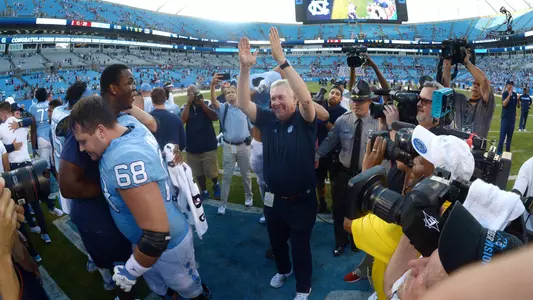
Photo by: UNC Athletic Communications
Extra Points: Full Circle
September 2, 2019 | Football, Featured Writers, Extra Points
By Lee Pace
Kevin Guskiewicz was at Carolina in the 1990s.
The University's chancellor told a gathering of Tar Heel alumni and friends Friday evening in Charlotte of meeting Coach Mack Brown in 1995 when Guskiewicz came to Chapel Hill as a professor of Exercise and Sports Science. He wanted to use the football program as a laboratory of sorts for cutting-edge research into concussions in the sport of football, a request that Brown green-lighted. That program has since become the template for equipment, rules and technique changes from the NFL down to Pop Warner.
"There was a not another coach in the country who would have said, 'Yes,'" said Guskiewicz. "He said if it will help us become a leader and help create a safer environment for our student-athletes, let's go for it. I'm thrilled to see him back."
The chancellor went on to tell of one of his regular text-message exchanges with Brown.
"Chancellor, you are going to have to manage the expectations. I don't think we're going undefeated," Brown wrote.
That was before Saturday night, when the Tar Heels in the Mack Is Back Debut rallied in the fourth quarter for a 24-20 win over South Carolina. So you just never know.
Tim Brewster was also at Carolina in the 1990s.
Brewster was the Tar Heels' tight ends coach under Brown from 1989-97 and coaches the same position now and is also associate head coach. He was proud Saturday of seeing the Carolina blocking front in control enough against an outstanding Gamecock line that the Tar Heels had a nicely balanced mix of 238 yards on the ground and 245 through the air. He noted the physicality that tailbacks Michael Carter, Antonio Williams and Javonte Williams displayed. He couldn't remember in 30 years of coaching a team having two 90-yard-plus touchdown drives in one game like the Tar Heels pounded out in the fourth quarter.
But he also was delighted in watching the other side of the ball—the Carolina defense that missed a few tackles early but held South Carolina to 101 total yards in the second half and just seven points and wrapped a bow around the win with two pass interceptions. The Tar Heels played a true freshman at one cornerback nearly all of the first half, Storm Duck subbing for an injured Trey Morrison. Both linebackers, Jeremiah Gemmel and Chazz Surratt, were new. But coordinator Jay Bateman unveiled his "everyone is a blitzer" package and got more and more pressure on Gamecock QB Jake Bentley as the game evolved. Carolina had three sacks, seven tackles-for-loss and four QB hurries.
"Defensively it reminded me a little bit of when we were here the first time and got really good on defense," Brewster said of the 1995-97 period when Carolina averaged yielding 14 points a game. "The confidence that playing great defense gives you is amazing. There is nothing like playing great defense."
Brewster said to defensive coordinator Jay Bateman walking out of the tunnel for the second half, "You got a bead on them now, don't you?"
Bateman smiled in acknowledgement.
"Jay had a good read on them," Brewster said. "Whether it's offense or defense, play-callers get into a good rhythm, a good flow. You're seeing the game, you're seeing the field clearly. I could see that was how Jay was thinking."
In a steamy and jubilant Tar Heel locker room afterward, Brown presented game balls to Sparky Woods, one of his senior consultants, and Robert Gillespie, the running backs coach, both of whom had coached at South Carolina previously. Then Brewster and the Tar Heel seniors presented Brown with a game ball, the entire room bursting out in a chant of "Mack Mack Mack Mack Mack …."
"The best thing is, these players have truly bonded," Brewster said. "It becomes a brotherhood. Love is the reason for the fight. That is the only reason. That was never more clear than Saturday—how those kids hung together, zero flinch, zero panic on the boundary."
"The guys chanting 'Mack Mack Mack' was awesome," added former Tar Heel running back A.J. Blue, now on the strength and conditioning staff. "They didn't know how much love they have for Coach Mack and each other until today. They understand the authenticity now. Not one single person doesn't believe. That's the starter in the car, the believing."
And Dré Bly was certainly at Carolina in the 1990s.
Bly was a starting cornerback for Brown and the Tar Heels from 1996-97 (and played his last year under Carl Torbush in '98) and picked off 20 career passes, second best in ACC history, before graduating to a lengthy and successful NFL career. Bly had coached youth baseball and 7-on-7 football in Charlotte after retirement from the NFL but had never held a full-time coaching gig until Brown took the Carolina post last November and immediately pegged Bly as an assistant coach. He's now on Brown's staff as cornerbacks coach and joins him as well in the College Football Hall of Fame.
In the fourth quarter Saturday, a juncture where the 2018 team lost four games in which it led or tied in the final period, the Tar Heels' strength, stamina and practice protocols came to bear. Strength and conditioning coach Brian Hess promised the players starting in January that "South Carolina won't recognize" the opponent it studied on tape from 2018. And Brown learned coaching 16 training camps in the searing Texas sun how to blend enough outside work with indoor periods—achieving a fine line being conditioned but not dead-legged by opening kickoff.
Brown is vigilant watching players' body language for fatigue or frustration and saw none of it Saturday. Blue said he heard freshman offensive lineman Ed Montilus saying at one point the Gamecocks were wilting and the Tar Heels needed to ratchet up the tempo. No players seemed to need attention for cramps.
"These guys are trusting Coach Brown just like we trusted him back in the day," Bly said. "Everything he stands for in emphasizing family and running an organization and having high accountability and work ethic—all that played out in the second half. A lack of trust loses games. Coach Brown has done everything he's said he'd do. Guys thought he was too hard at first. But now they see the benefits. They see the results, the kick-back."
Bly had 43 interceptions over 11 NFL seasons to go with his 20 as a Tar Heel (13 as a freshman in '96) and knows how debilitating stealing the ball mid-air is to an opponent. He's been obsessive in introducing more ball drills into practice with his players and the Tar Heel safeties—"If a DB practices catching every day in practice, he won't panic when he sees the ball in a game," Bly says. With approval from Brown and Bateman, he had a belt the ilk of those used in boxing and professional wrestling manufactured to award to players forcing turnovers. He unveiled it to the defense Friday night.
"I said, 'How can we increase our turnovers?'" Bly said. "We've not made many the last few years. We were not getting it done. Turnovers drive success. We needed to make more plays. When I picked off 13 balls, it became contagious. I held up the belt and told the guys, 'We need a new turnover king.' They embraced it. They're having fun with it."
On cue Saturday, safety Myles Wolfolk intercepted balls on the Gamecocks' final two possessions. Freshman QB Sam Howell lost one fumble but didn't throw any interceptions. That 2-1 turnover advantage was a far cry from the opener four years ago against these same Gamecocks, when the Tar Heels threw three interceptions and suffered their only regular-season loss in compiling an 11-1 record.
"I think it's a turning point for this team," safety Myles Dorn said. "We changed the narrative of Tar Heel football, just in one game."
"We knew that our stigma last year was, if we get hit in the mouth, that we'd lay down," Carter added. "Today, I feel like we got hit in the mouth, and we got back up and we kept fighting. And I'm really proud of my teammates for that."
The storylines of a person or play or circumstance going around in the 1990s and coming back around today were further amplified by the fact that Carolina had not won a season opener against a member of a Power 5 conference since 1997. That year the Tar Heels christened their newly built west end zone stands and Kenan Football Center with a 23-6 win over Indiana.
The coach? Mack Brown. Since then, they've dropped openers to Oklahoma (2001), Rutgers (2006), LSU (2010), South Carolina (2015), Georgia (2016) and California (2017 and '18).
"This is a huge win for us, we were a huge underdog," Brown said. "No one thought we would win the game. They thought, 'We'll fight, we'll hang in there,' but no one thought we'd win. We've had 10 great months here, now it was time to win a game. You can win the off-season, but that doesn't continue unless you win the games."
Brown said he was "saddened a little bit" at the ACC Kickoff in Charlotte in July when Charlie Heck and Dorn were asked by ESPN what traditions around the Carolina athletic experience they enjoyed most. Both had to think really hard. There was nothing obvious like the Rock at Clemson or Enter Sandman at Virginia Tech. Heck finally said, "Rushing Franklin Street after a big basketball win."
"We've got to create some fun traditions here around football," Brown said.
One will be an arrival walk before home games around the Bell Tower, a shorter stroll than the "Old Well Walk" of the John Bunting and Butch Davis eras but one with more aesthetic value than the Larry Fedora era arrival in the west end amphitheater.
Brown and his co-idea generator, wife Sally, proposed in the 1990s bathing the Bell Tower in Carolina blue light after victories, an idea they admit was borrowed from the University of Texas's long-standing tradition of lighting its tower in orange. But the Browns, ironically enough, moved to Austin before they could make that happen and that idea has now come full circle to Chapel Hill.
By the time the Tar Heels were leaving Charlotte Saturday night in their caravan of five busses, social media posts were appearing showing the Bell Tower resplendent in blue light.
"For away games, we'll hope to have the pilot buzz the tower on the way in to the airport so the kids can see it," Brown says. "We'll announce our time of arrival, so hopefully we can get a bunch of kids on campus to meet us when we get in."
Unfortunately on Saturday, a massive traffic snarl on I-85 an hour outside of Charlotte put the team in interminable stop-and-roll traffic, delaying its arrival until around 11:30 on a holiday weekend, and there were only a few scattered souls waiting to greet the Tar Heels.
No worries, though. There's plenty of evidence that what is past is prelude around Tar Heel football. Celebrations have room to run.
Chapel Hill writer Lee Pace (UNC '79) is in his 30th year writing "Extra Points" and 16th reporting from the sidelines for the Tar Heel Sports Network. Follow him @LeePaceTweet and email him at leepace7@gmail.com.
Kevin Guskiewicz was at Carolina in the 1990s.
The University's chancellor told a gathering of Tar Heel alumni and friends Friday evening in Charlotte of meeting Coach Mack Brown in 1995 when Guskiewicz came to Chapel Hill as a professor of Exercise and Sports Science. He wanted to use the football program as a laboratory of sorts for cutting-edge research into concussions in the sport of football, a request that Brown green-lighted. That program has since become the template for equipment, rules and technique changes from the NFL down to Pop Warner.
"There was a not another coach in the country who would have said, 'Yes,'" said Guskiewicz. "He said if it will help us become a leader and help create a safer environment for our student-athletes, let's go for it. I'm thrilled to see him back."
The chancellor went on to tell of one of his regular text-message exchanges with Brown.
"Chancellor, you are going to have to manage the expectations. I don't think we're going undefeated," Brown wrote.
That was before Saturday night, when the Tar Heels in the Mack Is Back Debut rallied in the fourth quarter for a 24-20 win over South Carolina. So you just never know.
Tim Brewster was also at Carolina in the 1990s.
Brewster was the Tar Heels' tight ends coach under Brown from 1989-97 and coaches the same position now and is also associate head coach. He was proud Saturday of seeing the Carolina blocking front in control enough against an outstanding Gamecock line that the Tar Heels had a nicely balanced mix of 238 yards on the ground and 245 through the air. He noted the physicality that tailbacks Michael Carter, Antonio Williams and Javonte Williams displayed. He couldn't remember in 30 years of coaching a team having two 90-yard-plus touchdown drives in one game like the Tar Heels pounded out in the fourth quarter.
But he also was delighted in watching the other side of the ball—the Carolina defense that missed a few tackles early but held South Carolina to 101 total yards in the second half and just seven points and wrapped a bow around the win with two pass interceptions. The Tar Heels played a true freshman at one cornerback nearly all of the first half, Storm Duck subbing for an injured Trey Morrison. Both linebackers, Jeremiah Gemmel and Chazz Surratt, were new. But coordinator Jay Bateman unveiled his "everyone is a blitzer" package and got more and more pressure on Gamecock QB Jake Bentley as the game evolved. Carolina had three sacks, seven tackles-for-loss and four QB hurries.
"Defensively it reminded me a little bit of when we were here the first time and got really good on defense," Brewster said of the 1995-97 period when Carolina averaged yielding 14 points a game. "The confidence that playing great defense gives you is amazing. There is nothing like playing great defense."
Brewster said to defensive coordinator Jay Bateman walking out of the tunnel for the second half, "You got a bead on them now, don't you?"
Bateman smiled in acknowledgement.
"Jay had a good read on them," Brewster said. "Whether it's offense or defense, play-callers get into a good rhythm, a good flow. You're seeing the game, you're seeing the field clearly. I could see that was how Jay was thinking."
In a steamy and jubilant Tar Heel locker room afterward, Brown presented game balls to Sparky Woods, one of his senior consultants, and Robert Gillespie, the running backs coach, both of whom had coached at South Carolina previously. Then Brewster and the Tar Heel seniors presented Brown with a game ball, the entire room bursting out in a chant of "Mack Mack Mack Mack Mack …."
"The best thing is, these players have truly bonded," Brewster said. "It becomes a brotherhood. Love is the reason for the fight. That is the only reason. That was never more clear than Saturday—how those kids hung together, zero flinch, zero panic on the boundary."
"The guys chanting 'Mack Mack Mack' was awesome," added former Tar Heel running back A.J. Blue, now on the strength and conditioning staff. "They didn't know how much love they have for Coach Mack and each other until today. They understand the authenticity now. Not one single person doesn't believe. That's the starter in the car, the believing."
And Dré Bly was certainly at Carolina in the 1990s.
Bly was a starting cornerback for Brown and the Tar Heels from 1996-97 (and played his last year under Carl Torbush in '98) and picked off 20 career passes, second best in ACC history, before graduating to a lengthy and successful NFL career. Bly had coached youth baseball and 7-on-7 football in Charlotte after retirement from the NFL but had never held a full-time coaching gig until Brown took the Carolina post last November and immediately pegged Bly as an assistant coach. He's now on Brown's staff as cornerbacks coach and joins him as well in the College Football Hall of Fame.
In the fourth quarter Saturday, a juncture where the 2018 team lost four games in which it led or tied in the final period, the Tar Heels' strength, stamina and practice protocols came to bear. Strength and conditioning coach Brian Hess promised the players starting in January that "South Carolina won't recognize" the opponent it studied on tape from 2018. And Brown learned coaching 16 training camps in the searing Texas sun how to blend enough outside work with indoor periods—achieving a fine line being conditioned but not dead-legged by opening kickoff.
Brown is vigilant watching players' body language for fatigue or frustration and saw none of it Saturday. Blue said he heard freshman offensive lineman Ed Montilus saying at one point the Gamecocks were wilting and the Tar Heels needed to ratchet up the tempo. No players seemed to need attention for cramps.
"These guys are trusting Coach Brown just like we trusted him back in the day," Bly said. "Everything he stands for in emphasizing family and running an organization and having high accountability and work ethic—all that played out in the second half. A lack of trust loses games. Coach Brown has done everything he's said he'd do. Guys thought he was too hard at first. But now they see the benefits. They see the results, the kick-back."
Bly had 43 interceptions over 11 NFL seasons to go with his 20 as a Tar Heel (13 as a freshman in '96) and knows how debilitating stealing the ball mid-air is to an opponent. He's been obsessive in introducing more ball drills into practice with his players and the Tar Heel safeties—"If a DB practices catching every day in practice, he won't panic when he sees the ball in a game," Bly says. With approval from Brown and Bateman, he had a belt the ilk of those used in boxing and professional wrestling manufactured to award to players forcing turnovers. He unveiled it to the defense Friday night.
"I said, 'How can we increase our turnovers?'" Bly said. "We've not made many the last few years. We were not getting it done. Turnovers drive success. We needed to make more plays. When I picked off 13 balls, it became contagious. I held up the belt and told the guys, 'We need a new turnover king.' They embraced it. They're having fun with it."
On cue Saturday, safety Myles Wolfolk intercepted balls on the Gamecocks' final two possessions. Freshman QB Sam Howell lost one fumble but didn't throw any interceptions. That 2-1 turnover advantage was a far cry from the opener four years ago against these same Gamecocks, when the Tar Heels threw three interceptions and suffered their only regular-season loss in compiling an 11-1 record.
"I think it's a turning point for this team," safety Myles Dorn said. "We changed the narrative of Tar Heel football, just in one game."
"We knew that our stigma last year was, if we get hit in the mouth, that we'd lay down," Carter added. "Today, I feel like we got hit in the mouth, and we got back up and we kept fighting. And I'm really proud of my teammates for that."
The storylines of a person or play or circumstance going around in the 1990s and coming back around today were further amplified by the fact that Carolina had not won a season opener against a member of a Power 5 conference since 1997. That year the Tar Heels christened their newly built west end zone stands and Kenan Football Center with a 23-6 win over Indiana.
The coach? Mack Brown. Since then, they've dropped openers to Oklahoma (2001), Rutgers (2006), LSU (2010), South Carolina (2015), Georgia (2016) and California (2017 and '18).
"This is a huge win for us, we were a huge underdog," Brown said. "No one thought we would win the game. They thought, 'We'll fight, we'll hang in there,' but no one thought we'd win. We've had 10 great months here, now it was time to win a game. You can win the off-season, but that doesn't continue unless you win the games."
Brown said he was "saddened a little bit" at the ACC Kickoff in Charlotte in July when Charlie Heck and Dorn were asked by ESPN what traditions around the Carolina athletic experience they enjoyed most. Both had to think really hard. There was nothing obvious like the Rock at Clemson or Enter Sandman at Virginia Tech. Heck finally said, "Rushing Franklin Street after a big basketball win."
"We've got to create some fun traditions here around football," Brown said.
One will be an arrival walk before home games around the Bell Tower, a shorter stroll than the "Old Well Walk" of the John Bunting and Butch Davis eras but one with more aesthetic value than the Larry Fedora era arrival in the west end amphitheater.
Brown and his co-idea generator, wife Sally, proposed in the 1990s bathing the Bell Tower in Carolina blue light after victories, an idea they admit was borrowed from the University of Texas's long-standing tradition of lighting its tower in orange. But the Browns, ironically enough, moved to Austin before they could make that happen and that idea has now come full circle to Chapel Hill.
By the time the Tar Heels were leaving Charlotte Saturday night in their caravan of five busses, social media posts were appearing showing the Bell Tower resplendent in blue light.
"For away games, we'll hope to have the pilot buzz the tower on the way in to the airport so the kids can see it," Brown says. "We'll announce our time of arrival, so hopefully we can get a bunch of kids on campus to meet us when we get in."
Unfortunately on Saturday, a massive traffic snarl on I-85 an hour outside of Charlotte put the team in interminable stop-and-roll traffic, delaying its arrival until around 11:30 on a holiday weekend, and there were only a few scattered souls waiting to greet the Tar Heels.
No worries, though. There's plenty of evidence that what is past is prelude around Tar Heel football. Celebrations have room to run.
Chapel Hill writer Lee Pace (UNC '79) is in his 30th year writing "Extra Points" and 16th reporting from the sidelines for the Tar Heel Sports Network. Follow him @LeePaceTweet and email him at leepace7@gmail.com.

Players Mentioned
Running Back
/ Football
Defensive Back
/ Football
Linebacker
/ Football
Offensive Line
/ Football
Offensive Line
/ Football
Defensive Back
/ Football
Linebacker
/ Football
Running Back
/ Football
Running Back
/ Football
Defensive Back
/ FootballSaturday, July 18
Saturday, July 18
Saturday, July 18
Tuesday, June 23