


University of North Carolina Athletics
Extra Points: Seeing Double
December 7, 2020 | Football, Featured Writers, Extra Points
Carolina's football program has been blessed with a handful of terrific one-two backfield punches over the years—among them Mike Voight and James Betterson in 1974-75, Kelvin Bryant and Amos Lawrence in 1980, Tyrone Anthony and Ethan Horton in 1983, Leon and Curtis Johnson in 1993-94 and Elijah Hood and T.J. Logan in 2015.
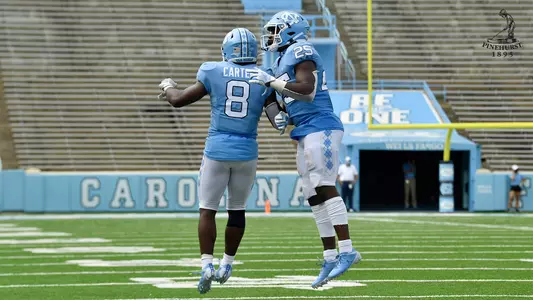
On Saturday we witnessed together for the final time on the turf in Kenan Stadium another prodigious tandem—Michael Carter and Javonte Williams. Carter, a senior from Navarre, Fla., has certainly played his last game in Chapel Hill as the Tar Heels wind their way to a season finale at Miami and a potential bowl berth. Williams, a junior from Wallace, N.C., will have a decision to make in early 2021 on remaining a Tar Heel or graduating to the NFL.
The Tar Heels made quick work as expected of Western Carolina on Senior Day, rolling to a 49-9 victory that featured the Carolina offense scoring touchdowns on six of seven first-half possessions and Coach Mack Brown and his staff opening the second half by pulling a handful of first-team players. The defense surrendered no touchdowns, the Catamounts' lone score coming on a fourth quarter scoop-and-score fumble recovery, and at times played a front line featuring four freshmen—Desmond Evans, Myles Murphy, Kevin Hester Jr. and Kaimon Rucker—an inviting nod toward the future.
Brown said the coaches made a point to play everyone dressed out, and the final moments included walk-on defensive back Christopher Holliday, son of former Tar Heel receiver Corey Holliday, leveling a resounding hit on a Catamount receiver in front of the Carolina bench with a minute to play.
"It was perfect, it started a little soft on defense, we were playing too high, but the guys woke up, started playing with lower pads and we stopped the run," Brown said. "We dominated the first half like we should have. In my coaching career, I have never started the third quarter without the first team in there.
"It's the way these games when you have better players are supposed to go, it's the way our Mercer game went last year. It's what you're supposed to do. I'm proud we did the things we needed to do."
Carter and Williams did their parts. Carter appropriately got the spotlight along with 15 other seniors being recognized pre-game with messages from their parents running on the video board in lieu of the traditional on-field recognition ceremonies. He carried the ball eight times for 73 yards with three touchdowns and in the process moved up to No. 5 all-time on the Carolina career rushing list with 3,096 yards. Williams gave Carter a breather on one second-quarter possession, gaining 32 yards on a screen pass and making a diving catch inside the 10 before finishing it off with a three-yard touchdown run.
Through nine games this year, they had combined for 252.1 yards from scrimmage a game, and one quarter of their carries have gone for 10 yards or more. The Pro Football Focus analytics service notes that Carter is "easily the best change of pace back in college football," and its gives Williams the highest overall grade for running, catching and blocking among all running backs in FBS. Williams led the nation through November in avoided tackles with 64, and PFF further lists Williams as the No. 2 prospect among running backs for the 2021 NFL Draft and Carter at No. 7.
And to think: Neither were megawatt, high-profile, Twitter-centric recruiting prospects coming out of high school, Carter with the class of 2017 and Williams in 2018. Carter was assigned three stars by recruiting services as a senior at Navarre High in Florida while Najee Harris (Alabama), D'Andre Swift (Georgia) and Travis Etienne (Clemson) drew the spotlight. Williams likewise was a three-star afterthought dwarfed within the state of North Carolina by Zamir White of Scotland County and Ricky Person of Heritage High in Wake Forest.
Carter leaned on his father Tony's connections to the Carolinas and UNC's prestigious academic heritage to sift through offers that included Cincinnati, Vanderbilt, Southern Miss and Louisville. Tony was an outstanding running back at Chester High in South Carolina in the late-1980s and was actually offered by the Tar Heels during Brown's first tenure at Carolina, but he wound up playing football at South Carolina State, had a 20-year-career in the Air Force and now is a teacher and coach at Navarre High in the Florida Panhandle.
"Michael missed a year with an injury and started looking more at the big picture," Tony said after his son cast his lot with the Tar Heels in February 2017. "He asked, 'Where will I be in five years, 10 years?' That was the allure of North Carolina—a great football program and an outstanding education."
Carter has become universally respected by his coaches and teammates for his contributions on the field and beyond. Brown says Carter was his "go-to guy" in feeling the pulse of the locker room in the two years since Brown re-took the program's reins in November 2018, and that Carter's counsel has been particularly valuable during the turmoil of Covid-19 and social unrest of the last nine months. Offensive coordinator Phil Longo remembers being mentally disheveled one day after his diabetic daughter had a medical emergency, and it was a chance encounter with Carter outside the locker room before practice that pulled Longo from his hang-dog state.
"Since that day, I've made a point to find Michael every day before practice," Longo says. "He sets you right. His personality is infectious."
Williams, meanwhile, had three goals as a kid growing up in Wallace—play for the Wallace-Rose Hill High Bulldogs, win a state championship and play for the Tar Heels (his bed had a Carolina logo on it). But he played linebacker for the Bulldogs through his junior year, and at 5-foot-10 was undersized in the eyes of college defensive coaches. Kevin Motsinger, the Wallace-Rose Hill coach beginning in 2017, remembers Tar Heel linebacker coach Mike Eckler loving Williams' potential but admitting his size might be a problem. Jason Tudryn, the Tar Heels' head of high school relations during Larry Fedora's tenure, remembers Williams playing defense during the Tar Heels' summer camp in 2017.
"In a camp setting, you get a feel for a kid's measurables," says Tudryn, now the secondary coach at the University of Massachusetts. "Javonte's strengths were his intangibles when he puts the pads on—how physical he is, his toughness, his heart and competitive grit. You don't find that in a camp."
Motsinger told Williams he could be a Division I tailback and moved him to offense for his senior year. Still, his college prospects were slow to take hold. Motsinger remembers Yale offering Williams (he was class valedictorian) and Coastal Carolina finally extending an offer but only after the Chanticleers hired a former NFL scout to run their personnel operation and him telling the coaches that Williams was better than anyone currently on the Chanticleers' roster. But that was too little, too late, as the Tar Heels after missing on some other tailback prospects finally circled back and offered Williams after Fedora and Tudryn watched him in the state 2-A championship game in Kenan Stadium in early December 2017.
"Society today is caught up in technology and 'right now,'" says Motsinger. "We want the sure thing instead of looking at the important things. What's his heart like? What kind of person is he?"
Motsinger says that had "Pookie" Williams, as he was commonly known around Wallace, walked out the front door of the high school with the keys to the principal's truck, the only question anyone would have asked would be was he going to fill it with gas or get it washed? He remembers another time he was worried about the team's mental state before a game until he saw Williams in the corner of the locker room, reading the Bible.
"If Pookie's ready, we're okay," Motsinger thought.
And the amazing thing? Carter and Williams are each other's biggest fans. Running backs coach Robert Gillespie harkens to the team motto "Be the One" and that both tailbacks exemplify its tenets.
"How can I be the one,'" Gillespie says. "Both these guys have the attitude that, 'I want to work so hard that I can do my job at a high level, but I also want to help someone else get to my level.' They are the ultimate teammates."
The combination of Michael Carter and Javonte Williams have come and gone as far as Kenan Stadium is concerned. Best enjoy them together these last two games—at Miami and wherever else the Tar Heels go.
Chapel Hill based writer Lee Pace (Carolina '79) has written "Extra Points" since 1990, is the author of "Football in a Forest" and has been part of the Tar Heel Sports Network broadcast crew since 2004. Write him at leepace7@gmail.com.
On Saturday we witnessed together for the final time on the turf in Kenan Stadium another prodigious tandem—Michael Carter and Javonte Williams. Carter, a senior from Navarre, Fla., has certainly played his last game in Chapel Hill as the Tar Heels wind their way to a season finale at Miami and a potential bowl berth. Williams, a junior from Wallace, N.C., will have a decision to make in early 2021 on remaining a Tar Heel or graduating to the NFL.
The Tar Heels made quick work as expected of Western Carolina on Senior Day, rolling to a 49-9 victory that featured the Carolina offense scoring touchdowns on six of seven first-half possessions and Coach Mack Brown and his staff opening the second half by pulling a handful of first-team players. The defense surrendered no touchdowns, the Catamounts' lone score coming on a fourth quarter scoop-and-score fumble recovery, and at times played a front line featuring four freshmen—Desmond Evans, Myles Murphy, Kevin Hester Jr. and Kaimon Rucker—an inviting nod toward the future.
Brown said the coaches made a point to play everyone dressed out, and the final moments included walk-on defensive back Christopher Holliday, son of former Tar Heel receiver Corey Holliday, leveling a resounding hit on a Catamount receiver in front of the Carolina bench with a minute to play.
"It was perfect, it started a little soft on defense, we were playing too high, but the guys woke up, started playing with lower pads and we stopped the run," Brown said. "We dominated the first half like we should have. In my coaching career, I have never started the third quarter without the first team in there.
"It's the way these games when you have better players are supposed to go, it's the way our Mercer game went last year. It's what you're supposed to do. I'm proud we did the things we needed to do."
Carter and Williams did their parts. Carter appropriately got the spotlight along with 15 other seniors being recognized pre-game with messages from their parents running on the video board in lieu of the traditional on-field recognition ceremonies. He carried the ball eight times for 73 yards with three touchdowns and in the process moved up to No. 5 all-time on the Carolina career rushing list with 3,096 yards. Williams gave Carter a breather on one second-quarter possession, gaining 32 yards on a screen pass and making a diving catch inside the 10 before finishing it off with a three-yard touchdown run.
Through nine games this year, they had combined for 252.1 yards from scrimmage a game, and one quarter of their carries have gone for 10 yards or more. The Pro Football Focus analytics service notes that Carter is "easily the best change of pace back in college football," and its gives Williams the highest overall grade for running, catching and blocking among all running backs in FBS. Williams led the nation through November in avoided tackles with 64, and PFF further lists Williams as the No. 2 prospect among running backs for the 2021 NFL Draft and Carter at No. 7.
And to think: Neither were megawatt, high-profile, Twitter-centric recruiting prospects coming out of high school, Carter with the class of 2017 and Williams in 2018. Carter was assigned three stars by recruiting services as a senior at Navarre High in Florida while Najee Harris (Alabama), D'Andre Swift (Georgia) and Travis Etienne (Clemson) drew the spotlight. Williams likewise was a three-star afterthought dwarfed within the state of North Carolina by Zamir White of Scotland County and Ricky Person of Heritage High in Wake Forest.
Carter leaned on his father Tony's connections to the Carolinas and UNC's prestigious academic heritage to sift through offers that included Cincinnati, Vanderbilt, Southern Miss and Louisville. Tony was an outstanding running back at Chester High in South Carolina in the late-1980s and was actually offered by the Tar Heels during Brown's first tenure at Carolina, but he wound up playing football at South Carolina State, had a 20-year-career in the Air Force and now is a teacher and coach at Navarre High in the Florida Panhandle.
"Michael missed a year with an injury and started looking more at the big picture," Tony said after his son cast his lot with the Tar Heels in February 2017. "He asked, 'Where will I be in five years, 10 years?' That was the allure of North Carolina—a great football program and an outstanding education."
Carter has become universally respected by his coaches and teammates for his contributions on the field and beyond. Brown says Carter was his "go-to guy" in feeling the pulse of the locker room in the two years since Brown re-took the program's reins in November 2018, and that Carter's counsel has been particularly valuable during the turmoil of Covid-19 and social unrest of the last nine months. Offensive coordinator Phil Longo remembers being mentally disheveled one day after his diabetic daughter had a medical emergency, and it was a chance encounter with Carter outside the locker room before practice that pulled Longo from his hang-dog state.
"Since that day, I've made a point to find Michael every day before practice," Longo says. "He sets you right. His personality is infectious."
Williams, meanwhile, had three goals as a kid growing up in Wallace—play for the Wallace-Rose Hill High Bulldogs, win a state championship and play for the Tar Heels (his bed had a Carolina logo on it). But he played linebacker for the Bulldogs through his junior year, and at 5-foot-10 was undersized in the eyes of college defensive coaches. Kevin Motsinger, the Wallace-Rose Hill coach beginning in 2017, remembers Tar Heel linebacker coach Mike Eckler loving Williams' potential but admitting his size might be a problem. Jason Tudryn, the Tar Heels' head of high school relations during Larry Fedora's tenure, remembers Williams playing defense during the Tar Heels' summer camp in 2017.
"In a camp setting, you get a feel for a kid's measurables," says Tudryn, now the secondary coach at the University of Massachusetts. "Javonte's strengths were his intangibles when he puts the pads on—how physical he is, his toughness, his heart and competitive grit. You don't find that in a camp."
Motsinger told Williams he could be a Division I tailback and moved him to offense for his senior year. Still, his college prospects were slow to take hold. Motsinger remembers Yale offering Williams (he was class valedictorian) and Coastal Carolina finally extending an offer but only after the Chanticleers hired a former NFL scout to run their personnel operation and him telling the coaches that Williams was better than anyone currently on the Chanticleers' roster. But that was too little, too late, as the Tar Heels after missing on some other tailback prospects finally circled back and offered Williams after Fedora and Tudryn watched him in the state 2-A championship game in Kenan Stadium in early December 2017.
"Society today is caught up in technology and 'right now,'" says Motsinger. "We want the sure thing instead of looking at the important things. What's his heart like? What kind of person is he?"
Motsinger says that had "Pookie" Williams, as he was commonly known around Wallace, walked out the front door of the high school with the keys to the principal's truck, the only question anyone would have asked would be was he going to fill it with gas or get it washed? He remembers another time he was worried about the team's mental state before a game until he saw Williams in the corner of the locker room, reading the Bible.
"If Pookie's ready, we're okay," Motsinger thought.
And the amazing thing? Carter and Williams are each other's biggest fans. Running backs coach Robert Gillespie harkens to the team motto "Be the One" and that both tailbacks exemplify its tenets.
"How can I be the one,'" Gillespie says. "Both these guys have the attitude that, 'I want to work so hard that I can do my job at a high level, but I also want to help someone else get to my level.' They are the ultimate teammates."
The combination of Michael Carter and Javonte Williams have come and gone as far as Kenan Stadium is concerned. Best enjoy them together these last two games—at Miami and wherever else the Tar Heels go.
Chapel Hill based writer Lee Pace (Carolina '79) has written "Extra Points" since 1990, is the author of "Football in a Forest" and has been part of the Tar Heel Sports Network broadcast crew since 2004. Write him at leepace7@gmail.com.
Players Mentioned
Running Back
/ Football
Linebacker
/ Football
Defensive Line
/ Football
Defensive Back
/ Football
Defensive Line
/ Football
Linebacker
/ Football
Running Back
/ FootballMonday, September 21
Sunday, September 20
Friday, September 18
Friday, September 18