


University of North Carolina Athletics
Lucas: April 5 Flashback
April 5, 2020 | Men's Basketball, Featured Writers, Adam Lucas
Looking back at key Tar Heel moments from this day in NCAA Tournament history.
By Adam Lucas
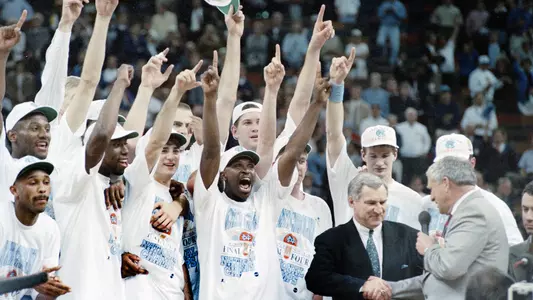
In the history of Carolina Basketball, there has only been one game played on April 5: the 1993 national championship victory over Michigan.
In many ways, this game was the reverse of the 2005 title game matchup with Illinois. In 1993, Carolina was a very good team, but it was Michigan that was seen as having more raw talent. The Wolverines were in their second straight championship game with the Fab Five recruiting class that included Chris Webber, Jalen Rose and Juwan Howard. And although that year's Tar Heels would not produce as many big NBA names, they were an excellent college team, featuring overwhelming strength in the paint--led by Eric Montross, who was backed up by another pair of seven-footers, Kevin Salvadori and Matt Wenstrom--veteran leadership at power forward from senior George Lynch, athleticism from Brian Reese, one of the best defensive point guards in UNC history with Derrick Phelps, and perimeter shooting from Donald Williams.
Oh, and the variable that some of those talent vs. team arguments in 1993 didn't take into account: the Tar Heels were coached by Dean Smith. As usual, the Carolina head coach was masterful with his variety of defenses and deployment of the bench. Smith's usage of a couple key substitutes during the second half drew nationally televised criticism from Billy Packer, but it turned out to be a terrific way to keep the starters fresh for the final stretch.
Williams poured in 25 points, matching his semifinal output on the way to Most Outstanding Player honors. Montross had 16 points, while George Lynch had a double-double with 12 points and ten rebounds.
The uneducated will tell you this game turned on Chris Webber's fateful timeout when his team didn't have one. More astute fans will realize two lesser-known factors: first, Webber traveled in the backcourt. He had already committed a pseudo-turnover before he ever tried to signal for a stoppage, a situation that was created by Lynch's defensive savvy in jumping an attempted pass from Webber to Rose. When Carolina played Michigan in Hawaii, Lynch had noticed the Wolverines sometimes left Webber alone in the backcourt to bring the ball up the court. He told his teammates he might apply some pressure in a similar situation in the championship game, and it turned out to be a key play.
Second, even if the travel had been ignored, and even if he was allowed to advance the ball into the frontcourt, Carolina had him in a double-team with the squad's two best defenders--Lynch and Phelps. Carolina also had fouls to give and the players on the floor were well aware of it.
Casual history sometimes doesn't accurately reflect the quality of the 1993 Tar Heels. Remember that this group had a pair of wins over a Florida State team that was ranked in the top ten, a pair of wins over a Georgia Tech team that likewise spent time in the top ten, a split with a top-ten Duke team, three victories over a top-25 Virginia club, a nonconference win over top-ten Seton Hall, and four straight wins in the NCAA Tournament over top-12 opponents. Overall, they were 12-2 against ranked opponents and won a very good Atlantic Coast Conference regular season (six of the nine teams spent at least a week in the national top ten and the All-ACC first team was a stellar mix of Grant Hill, Rodney Rogers, Lynch, Montross and Bobby Hurley) by two full games.
If you have any sort of interest in the 1993 team, it's well worth listening to the recent Carolina Insider podcast that focused on the comeback that season against Florida State. While the game against the 'Noles was the focus, it's got some great insight from Derrick Phelps, George Lynch and Eric Montross about the dynamics of the national champions.
In the history of Carolina Basketball, there has only been one game played on April 5: the 1993 national championship victory over Michigan.
In many ways, this game was the reverse of the 2005 title game matchup with Illinois. In 1993, Carolina was a very good team, but it was Michigan that was seen as having more raw talent. The Wolverines were in their second straight championship game with the Fab Five recruiting class that included Chris Webber, Jalen Rose and Juwan Howard. And although that year's Tar Heels would not produce as many big NBA names, they were an excellent college team, featuring overwhelming strength in the paint--led by Eric Montross, who was backed up by another pair of seven-footers, Kevin Salvadori and Matt Wenstrom--veteran leadership at power forward from senior George Lynch, athleticism from Brian Reese, one of the best defensive point guards in UNC history with Derrick Phelps, and perimeter shooting from Donald Williams.
Oh, and the variable that some of those talent vs. team arguments in 1993 didn't take into account: the Tar Heels were coached by Dean Smith. As usual, the Carolina head coach was masterful with his variety of defenses and deployment of the bench. Smith's usage of a couple key substitutes during the second half drew nationally televised criticism from Billy Packer, but it turned out to be a terrific way to keep the starters fresh for the final stretch.
Williams poured in 25 points, matching his semifinal output on the way to Most Outstanding Player honors. Montross had 16 points, while George Lynch had a double-double with 12 points and ten rebounds.
The uneducated will tell you this game turned on Chris Webber's fateful timeout when his team didn't have one. More astute fans will realize two lesser-known factors: first, Webber traveled in the backcourt. He had already committed a pseudo-turnover before he ever tried to signal for a stoppage, a situation that was created by Lynch's defensive savvy in jumping an attempted pass from Webber to Rose. When Carolina played Michigan in Hawaii, Lynch had noticed the Wolverines sometimes left Webber alone in the backcourt to bring the ball up the court. He told his teammates he might apply some pressure in a similar situation in the championship game, and it turned out to be a key play.
Second, even if the travel had been ignored, and even if he was allowed to advance the ball into the frontcourt, Carolina had him in a double-team with the squad's two best defenders--Lynch and Phelps. Carolina also had fouls to give and the players on the floor were well aware of it.
Casual history sometimes doesn't accurately reflect the quality of the 1993 Tar Heels. Remember that this group had a pair of wins over a Florida State team that was ranked in the top ten, a pair of wins over a Georgia Tech team that likewise spent time in the top ten, a split with a top-ten Duke team, three victories over a top-25 Virginia club, a nonconference win over top-ten Seton Hall, and four straight wins in the NCAA Tournament over top-12 opponents. Overall, they were 12-2 against ranked opponents and won a very good Atlantic Coast Conference regular season (six of the nine teams spent at least a week in the national top ten and the All-ACC first team was a stellar mix of Grant Hill, Rodney Rogers, Lynch, Montross and Bobby Hurley) by two full games.
If you have any sort of interest in the 1993 team, it's well worth listening to the recent Carolina Insider podcast that focused on the comeback that season against Florida State. While the game against the 'Noles was the focus, it's got some great insight from Derrick Phelps, George Lynch and Eric Montross about the dynamics of the national champions.
Tuesday, June 23
Sunday, June 21
Sunday, June 21
Saturday, June 20