


University of North Carolina Athletics
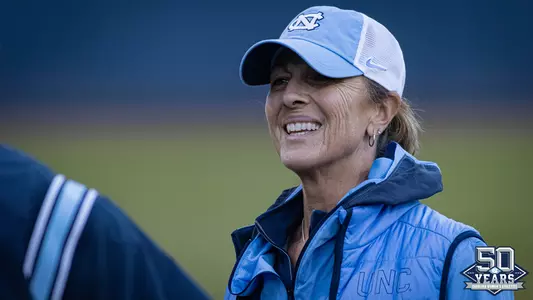
Donna J. Papa
50 Years: From The Ground Up
March 2, 2022 | Softball
Coach Donna J. Papa and Carolina Softball
A consistent part of the past 50 years of Carolina Women's Athletics has been the steady leadership of Softball Coach Donna J. Papa. This year, she marks 37 years as a head coach in Chapel Hill.
"Donna has been a fixture on the Carolina sidelines—building Carolina Softball into what it is today," said Executive Associate Athletic Director and longtime administrator, Larry Gallo. "She represents the quality of leadership and longevity of our head coaches at Carolina—a true Hall of Famer who has positively influenced the lives of so many of our student-athletes."
Building her program from the ground up is exactly what Papa has done. Carolina's softball program was born in the spring of 1977 as a slow pitch program, as North Carolina high school programs were not yet in the era of fast pitch softball.
Dolly Hunter, the then-softball coach who also doubled as Carolina's field hockey coach, led the Tar Heels for two years. Hunter was followed by Dr. Beth Miller, also the Tar Heels' volleyball head coach, for a season.
For six years, from 1980 until 1985, Susan Clark led the transition of the program from slow pitch softball to the modern fast pitch variety for her final two seasons, changing the strategy of the team and recruiting.
Clark had great success at Carolina and, in 1981, produced a team which reached the national championship game of the Association for Intercollegiate for Athletics for Women (AIAW) against Florida State.
When Clark retired in 1985, UNC held a nationwide search leading to the hire of Papa, a graduate of the University of Connecticut who was coaching softball and volleyball at Susquehanna University in Pennsylvania when she applied for the UNC job. Her interviews consisted of discussions with legendary leaders such as Dr. Frances Hogan, Miller and, of then-athletic director, John Swofford.
A jack-of-all-trades at her previous job, Papa also ran intramurals and coached cheerleaders at Susquehanna, and was well positioned for the challenges she would face at the next level of coaching.
With her initial assistant coach Robin Payne, Papa built on the foundation Clark had left and she hit the recruiting trail to find out-of-state student-athletes to fill the pitching and catching positions, the main differences in the transition from slow pitch to fast pitch.
Papa's teams were successful from the get-go, and she never wavered from her belief that Tar Heel softball players had to be student-athletes first and foremost.
"I have always wanted to put championship level teams on the field," said Papa in a recent interview with Carolina Athletics. "But the softball part and the academic part must mix successfully. The bottom line is there are limited opportunities in professional softball so I have to make sure we are recruiting students who can get degrees. We put the teeth in that statement—it's not just talk. This past fall we had a 3.2 cumulative grade point average as a team, had 10 players on the Dean's List and had 20 players with GPAs above 3.0."
Papa has come a long way since she arrived at Carolina and shared an office in Woollen Gymnasium with three other head coaches: Jennifer Alley from women's basketball, Karen Shelton from field hockey and Peggy Bradley-Doppes from volleyball.
Papa's desk was housed in the reception area of the office, and she remembers the days when road trips for the team involved driving airport-rental-car style vans to places as far flung as Louisiana, Florida and Georgia.
She laughed, recalling that the team's equipment room was basically the trunk of her car.
For the first 15 years of her tenure, Carolina had a very successful program despite having just a bare bones facility at Finley Field on Old Mason Farm Road—just off U.S. 15-501. For years Carolina looked on campus to build a more permanent facility and then-Educational Foundation Vice President Sue Walsh worked with Papa to head up fundraising and to help Carolina find a new home.
The new stadium was built on Raleigh Road behind the UNC General Administration building. It opened in 2001, and by 2006 was ready for a formal dedication once extra bells and whistles were added. Papa credits Gene Anderson, Susie Prevette and Ken and Cheryl Williams for being the main benefactors, and Anderson Softball Stadium is now in its third decade of use.
One of the consistencies of Papa's program has been the great student-athletes representing the program, one of whom is Meleata Smalls (now, Pinto) who played at Carolina from 1992-94.
Smalls, an outfielder from Springfield, Va., remembers her recruiting trip to Chapel Hill with much fondness, and recalled that she immediately knew it was the place she wanted to go to school.
In 1998, she married fellow Tar Heel student-athlete, soccer player Hassan Pinto. They now have three children who went on to be NCAA Division I athletes, including daughter Brianna, who led UNC women's soccer to three straight NCAA College Cups from 2018-20.
"Donna Papa is ageless," said Smalls Pinto. "I love her energy and her passion for the game. One of her most endearing qualities is her ability to laugh at herself. Every alumnae is so impressed with what she has done with the program because it's a part of all of us. And she still has great aspirations to take Carolina to another level of greatness."
Papa began the 2022 season with over 1,290 wins and collegiate softball Hall of Fame recognition, and went on to win four-straight to open the 2022 season. Her goal is to accomplish even more.
"I want to be a role model for the women who play here," Papa said. "It is important to show that, as a staff, we care about our student-athletes as people and show love and concern for their welfare."
From slow pitch to fast pitch, Carolina softball has done just that under Papa's leadership —acting as a pillar of class, competency and consistency for each softball student-athlete.
"We are so very proud of the teams we have put on the field over the past four decades," she said. "I believe in building a program from the ground up and running it the right way. There is no need for short cuts."
"Donna has been a fixture on the Carolina sidelines—building Carolina Softball into what it is today," said Executive Associate Athletic Director and longtime administrator, Larry Gallo. "She represents the quality of leadership and longevity of our head coaches at Carolina—a true Hall of Famer who has positively influenced the lives of so many of our student-athletes."
Building her program from the ground up is exactly what Papa has done. Carolina's softball program was born in the spring of 1977 as a slow pitch program, as North Carolina high school programs were not yet in the era of fast pitch softball.
Dolly Hunter, the then-softball coach who also doubled as Carolina's field hockey coach, led the Tar Heels for two years. Hunter was followed by Dr. Beth Miller, also the Tar Heels' volleyball head coach, for a season.
For six years, from 1980 until 1985, Susan Clark led the transition of the program from slow pitch softball to the modern fast pitch variety for her final two seasons, changing the strategy of the team and recruiting.
Clark had great success at Carolina and, in 1981, produced a team which reached the national championship game of the Association for Intercollegiate for Athletics for Women (AIAW) against Florida State.
When Clark retired in 1985, UNC held a nationwide search leading to the hire of Papa, a graduate of the University of Connecticut who was coaching softball and volleyball at Susquehanna University in Pennsylvania when she applied for the UNC job. Her interviews consisted of discussions with legendary leaders such as Dr. Frances Hogan, Miller and, of then-athletic director, John Swofford.
A jack-of-all-trades at her previous job, Papa also ran intramurals and coached cheerleaders at Susquehanna, and was well positioned for the challenges she would face at the next level of coaching.
With her initial assistant coach Robin Payne, Papa built on the foundation Clark had left and she hit the recruiting trail to find out-of-state student-athletes to fill the pitching and catching positions, the main differences in the transition from slow pitch to fast pitch.
Papa's teams were successful from the get-go, and she never wavered from her belief that Tar Heel softball players had to be student-athletes first and foremost.
"I have always wanted to put championship level teams on the field," said Papa in a recent interview with Carolina Athletics. "But the softball part and the academic part must mix successfully. The bottom line is there are limited opportunities in professional softball so I have to make sure we are recruiting students who can get degrees. We put the teeth in that statement—it's not just talk. This past fall we had a 3.2 cumulative grade point average as a team, had 10 players on the Dean's List and had 20 players with GPAs above 3.0."
Papa has come a long way since she arrived at Carolina and shared an office in Woollen Gymnasium with three other head coaches: Jennifer Alley from women's basketball, Karen Shelton from field hockey and Peggy Bradley-Doppes from volleyball.
Papa's desk was housed in the reception area of the office, and she remembers the days when road trips for the team involved driving airport-rental-car style vans to places as far flung as Louisiana, Florida and Georgia.
She laughed, recalling that the team's equipment room was basically the trunk of her car.
For the first 15 years of her tenure, Carolina had a very successful program despite having just a bare bones facility at Finley Field on Old Mason Farm Road—just off U.S. 15-501. For years Carolina looked on campus to build a more permanent facility and then-Educational Foundation Vice President Sue Walsh worked with Papa to head up fundraising and to help Carolina find a new home.
The new stadium was built on Raleigh Road behind the UNC General Administration building. It opened in 2001, and by 2006 was ready for a formal dedication once extra bells and whistles were added. Papa credits Gene Anderson, Susie Prevette and Ken and Cheryl Williams for being the main benefactors, and Anderson Softball Stadium is now in its third decade of use.
One of the consistencies of Papa's program has been the great student-athletes representing the program, one of whom is Meleata Smalls (now, Pinto) who played at Carolina from 1992-94.
Smalls, an outfielder from Springfield, Va., remembers her recruiting trip to Chapel Hill with much fondness, and recalled that she immediately knew it was the place she wanted to go to school.
In 1998, she married fellow Tar Heel student-athlete, soccer player Hassan Pinto. They now have three children who went on to be NCAA Division I athletes, including daughter Brianna, who led UNC women's soccer to three straight NCAA College Cups from 2018-20.
"Donna Papa is ageless," said Smalls Pinto. "I love her energy and her passion for the game. One of her most endearing qualities is her ability to laugh at herself. Every alumnae is so impressed with what she has done with the program because it's a part of all of us. And she still has great aspirations to take Carolina to another level of greatness."
Papa began the 2022 season with over 1,290 wins and collegiate softball Hall of Fame recognition, and went on to win four-straight to open the 2022 season. Her goal is to accomplish even more.
"I want to be a role model for the women who play here," Papa said. "It is important to show that, as a staff, we care about our student-athletes as people and show love and concern for their welfare."
From slow pitch to fast pitch, Carolina softball has done just that under Papa's leadership —acting as a pillar of class, competency and consistency for each softball student-athlete.
"We are so very proud of the teams we have put on the field over the past four decades," she said. "I believe in building a program from the ground up and running it the right way. There is no need for short cuts."
Monday, September 28
Sunday, September 27
Sunday, September 27
Saturday, September 26