


University of North Carolina Athletics
Extra Points: Hot Peppers
October 3, 2024 | Football
By Lee Pace
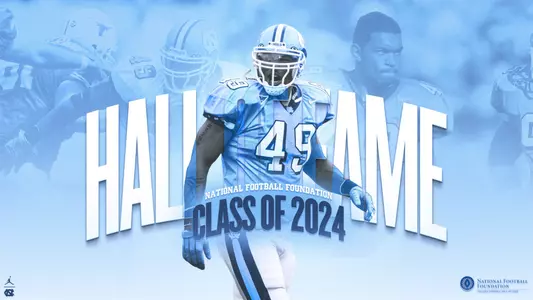
It's a big year for Julius Peppers—in July he was inducted into the Pro Football Hall of Fame in Canton, Ohio, and in December he'll be feted in Las Vegas as he enters the College Football Hall of Fame.
In his induction speech three months ago in Canton, Ohio, Peppers thanked coaches Mack Brown and Donnie Thompson "for coming to Bailey, North Carolina, and making me realize that Chapel Hill was where I needed to be" when they got his commitment to the Tar Heels in 1997. He also thanked his head coaches in football and basketball, Carl Torbush and Bill Guthridge, respectively, for giving him the opportunity to become one of the most decorated two-sports stars in intercollegiate history. And, he paid tribute to another Tar Heel.
"I ain't going to sit up here and act like my idol and one of the reasons that I went to Chapel Hill is not in the building," Peppers said. "The GOAT, his Airness, Michael Jordan. MJ, I want to thank you for the inspiration and memories. Love you, big bro."
Pep, MJ and the Tar Heels. That's quite the trifecta.
Be sure to be in your seat in Kenan Stadium Saturday when Peppers is honored with his College Football Hall of Fame On-Campus Salute during the first quarter break and his Pro Football Hall of Fame induction during the first TV timeout of the second quarter. And we can all reflect back on the greatest Julius Peppers moments while wearing the Carolina blue and traipsing across the grass or hardwood. Which were the biggest?
Was it Peppers plucking a tipped ball out of the air at Duke in 2000, galloping 27 yards to a touchdown and diving across the goal-line with a flourish? Was it big No. 49 shucking two blockers at Clemson in 2001, leaping to deflect a Woodrow Dantzler pass and then cradling the ball as he fell to the ground? Was it any number of times he spun a left tackle like a top en route to the quarterback or even pushed the tackle into the quarterback while knocking both to the turf?
In the wintertime was it Peppers in his third basketball game as a Tar Heel early in the 1999 season at Buffalo with an acrobatic dunk that was featured on ESPN's Sports Center and had the entire team guffawing watching the snippet later on the team bus? Or at Georgia Tech, when he took off from the corner, caught a lob thrown behind him, arched his back, caught the ball and threw down a thunderdunk? Or that six-point, two-blocks, great-defense game against an athletic Tennessee team in the 2000 Sweet 16 en route to the Final Four?
Tough choice, for sure.
Basketball was his first love.
Football was his business decision.
It all turned out quite well for Peppers, who dazzled Tar Heel fans and the ACC with his exploits in the football and basketball arenas from 1999-2001 and then went on to a lengthy career in the NFL.
"He really liked basketball the most," says Brown, who recruited Peppers out of Southern Nash High in the mid-1990s and got a commitment before he left for Texas after the 1997 season. "I told him football was his future, it was his best sport. I said, 'We'll let you play basketball, go enjoy it, but here's where you'll make your money.'"
Brown pauses and smiles, knowing that Peppers banked some $160 million in career earnings.
"He owes me," he says.
Peppers grew up in Bailey, a town located halfway between Zebulon and Wilson in Nash County. He was a three-sport star and drew national recruiting interest over his eye-popping numbers and freakish athletic ability that allowed him do backflips the entire length of a football field for 100 yards in full pads and helmet. Young Julius was nicknamed "Big Head" by his buddies because of the XXX-size hats and caps he wore, and he stuffed his feet into track shoes two sizes too small because the 18s that fit him were not available (he was second in the triple jump in the state track meet anyway).
Peppers committed to Carolina during the summer of 1997 leading into his senior season, but he continued to draw recruiting pitches from Tennessee, Nebraska, Penn State, Virginia and Florida State, among others, as he wrapped up a career that saw him rush for 3,500 yards and 46 touchdowns while playing end on defense.
"When we went to see him play, he was so much bigger than everybody, he just ran through everybody," Brown remembers. "He could be a running back. Then he wanted to be either a defensive end or a tight end. We thought he could be a freak on defense."
"He's hard to tackle," Southern Nash coach Ray Davis said. "It looks like ants crawling on his back sometimes."
Peppers waivered momentarily after Brown departed for Texas in early December 1997, but after Torbush was appointed Brown's successor, Torbush's first phone call after the introductory press conference was to Peppers. Torbush reiterated that Peppers could play basketball for the Tar Heels and that he would retain Thompson, who led Peppers' recruiting and was the defensive ends coach.
"I just realized one of my dreams," Torbush said. "Julius, I hope you'll still come to Carolina and pursue yours."
Part of the reason Peppers liked Carolina was the fact that both coaching staffs were willing to give him a shot at both sports.
"My passion was basketball," Peppers said. "Part of the story is that I had to be somewhat convinced to try out for the football team in high school. So, when I had the opportunity to come take the football scholarship and try out for the basketball team, it was something that I couldn't pass up."
As a redshirt freshman in 1999, Peppers started 11 games at end and led the team in tackles-for-losses with 10 and sacks with six. As a sophomore, he earned first-team All-ACC honors and led the nation with 15 sacks, one short of Lawrence Taylor's record set in 1980.
Kenny Browning, the Tar Heels' defensive coordinator in 2000, remembers how important Peppers and his defensive line teammates, tackle Ryan Sims and noseguard Anthony Perkins, were to a unit that was playing three first-year players in the secondary.
"Julius had had five sacks at Virginia that year," Browning says. "We dominated Pitt upfront and knocked out two of their quarterbacks. I game-planned for him. We were so young in the back end, if we didn't put a lot of pressure on the quarterback, it would have been disastrous. Julius was always gifted physically, but he was sharp, too. People tried to disparage his intelligence, but that was the furthest thing from the truth. He was one smart football player. You gave him something one time and that was it."
Throughout his first year at Carolina, Peppers joined other football players in pick-up basketball games in Woollen Gym, sometimes joined by basketball players like Ed Cota. Cota raved to Guthridge about Peppers' prospects as a basketball player.
"Ed really sold Coach Guthridge on what a good basketball player Julius could be," says Pat Sullivan, a young assistant coach at the time who's now on Hubert Davis' staff. "I'm not sure how sold Coach Guthridge was on the idea. But he trusted Ed. Ed was persistent. He recognized the talent."
As soon as the 1999 football season ended, Peppers moved to the Smith Center and joined a team led by Cota and 7-footer Brendan Haywood. Sullivan remembers an early practice when Peppers wrenched his ankle, gritted his teeth and waved off a suggestion he take a break.
"I was thinking this is the kind of toughness we need," Sullivan says. "He brought a different element, some football mentality. During that 2000 run to the Final Four, we beat Missouri and Stanford, two rough and tumble teams. We became sort of that rough and tumble team, not just that typical free flowing Carolina team. We got down in the mud a little, and I credit Julius with helping with that."
Peppers was a key part of the rotation on the team that went to the Final Four. As the sixth man, he averaged 5.8 points and 4.6 rebounds.
"Julius was a godsend, the missing piece for us," Guthridge said. "I hate to think how that season might have ended without him."
Ronald Curry, another two-sport phenomenon who played quarterback on the football team, joined the basketball squad the next year, and the Tar Heels won 15 games in a row early and were No. 1. But they lost to Penn State in the second round of the 2001 NCAA Tournament with Peppers hitting 21 points and 10 rebounds.
"I'll tell you this, I do believe if Pep would've just focused on basketball, he could've played in the NBA," said Matt Doherty, who replaced Guthridge as the Carolina head coach for the 2000-01 season. "He had a feel for the game. He wasn't just a rebounder or banger. He could pass the ball, make the 15-18 foot shot and had soft hands."
After the 2000-01 basketball season, Peppers made the decision to spend his junior season—which would be his fourth and last as a Tar Heel—concentrating on football.
"I'll miss basketball, but I think I'll be a much better football player now that I'm training for it like a normal player," he said. "I still believe that if I committed to basketball, I could make an impact in the NBA. But my coaches say that in football I could be another Lawrence Taylor or Jevon Kearse. I now see football as my job and my greatest challenge."
Peppers had an outstanding senior year in 2001. He was first on the team in interceptions with three, in tackles-for-loss with 19 and sacks with 9.5 sacks. His only blemish was being essentially a non-factor in Carolina's game at Texas—just one deflected pass in the stat line for Peppers as the Longhorns whipped the Tar Heels, 44-14.
That's because Brown, then in his fourth season leading the Longhorns, and offensive coordinator Greg Davis refused to let the opponent's best player beat them. They schemed their offense so that on every play, Peppers was blocked by the tackle opposite him as well as one more player, sometimes two.
"We double-teamed him every play," Brown says. "It took two players, but we kept him out of it. Sometimes with the great ones, if you discourage them early, they get frustrated. They're used to making plays, and they lose their edge if you take them out of it. If you let them get started, you've got yourself a mess."
Peppers certainly created a lot of messes for opponents throughout the ACC and the NFL for two decades.
"I always hated it when someone new came in and people wanted to say, 'This kid's another Julius Peppers,'" says Browning, who was on the Carolina staff from 1994-2011. "I said no way. That guy was a generational talent. That doesn't mean the new guy can't be a heck of a player. But to compare him to Julius? That's not fair. No one can be another Julius Peppers."
Chapel Hill writer Lee Pace (Carolina '79) has been writing about Tar Heel football under the "Extra Points" banner since 1990 and reporting from the sidelines on radio broadcasts since 2004. Write him at leepace7@gmail.com and follow him @LeePaceTweet.
It's a big year for Julius Peppers—in July he was inducted into the Pro Football Hall of Fame in Canton, Ohio, and in December he'll be feted in Las Vegas as he enters the College Football Hall of Fame.
In his induction speech three months ago in Canton, Ohio, Peppers thanked coaches Mack Brown and Donnie Thompson "for coming to Bailey, North Carolina, and making me realize that Chapel Hill was where I needed to be" when they got his commitment to the Tar Heels in 1997. He also thanked his head coaches in football and basketball, Carl Torbush and Bill Guthridge, respectively, for giving him the opportunity to become one of the most decorated two-sports stars in intercollegiate history. And, he paid tribute to another Tar Heel.
"I ain't going to sit up here and act like my idol and one of the reasons that I went to Chapel Hill is not in the building," Peppers said. "The GOAT, his Airness, Michael Jordan. MJ, I want to thank you for the inspiration and memories. Love you, big bro."
Pep, MJ and the Tar Heels. That's quite the trifecta.
Be sure to be in your seat in Kenan Stadium Saturday when Peppers is honored with his College Football Hall of Fame On-Campus Salute during the first quarter break and his Pro Football Hall of Fame induction during the first TV timeout of the second quarter. And we can all reflect back on the greatest Julius Peppers moments while wearing the Carolina blue and traipsing across the grass or hardwood. Which were the biggest?
Was it Peppers plucking a tipped ball out of the air at Duke in 2000, galloping 27 yards to a touchdown and diving across the goal-line with a flourish? Was it big No. 49 shucking two blockers at Clemson in 2001, leaping to deflect a Woodrow Dantzler pass and then cradling the ball as he fell to the ground? Was it any number of times he spun a left tackle like a top en route to the quarterback or even pushed the tackle into the quarterback while knocking both to the turf?
In the wintertime was it Peppers in his third basketball game as a Tar Heel early in the 1999 season at Buffalo with an acrobatic dunk that was featured on ESPN's Sports Center and had the entire team guffawing watching the snippet later on the team bus? Or at Georgia Tech, when he took off from the corner, caught a lob thrown behind him, arched his back, caught the ball and threw down a thunderdunk? Or that six-point, two-blocks, great-defense game against an athletic Tennessee team in the 2000 Sweet 16 en route to the Final Four?
Tough choice, for sure.
Basketball was his first love.
Football was his business decision.
It all turned out quite well for Peppers, who dazzled Tar Heel fans and the ACC with his exploits in the football and basketball arenas from 1999-2001 and then went on to a lengthy career in the NFL.
"He really liked basketball the most," says Brown, who recruited Peppers out of Southern Nash High in the mid-1990s and got a commitment before he left for Texas after the 1997 season. "I told him football was his future, it was his best sport. I said, 'We'll let you play basketball, go enjoy it, but here's where you'll make your money.'"
Brown pauses and smiles, knowing that Peppers banked some $160 million in career earnings.
"He owes me," he says.
Peppers grew up in Bailey, a town located halfway between Zebulon and Wilson in Nash County. He was a three-sport star and drew national recruiting interest over his eye-popping numbers and freakish athletic ability that allowed him do backflips the entire length of a football field for 100 yards in full pads and helmet. Young Julius was nicknamed "Big Head" by his buddies because of the XXX-size hats and caps he wore, and he stuffed his feet into track shoes two sizes too small because the 18s that fit him were not available (he was second in the triple jump in the state track meet anyway).
Peppers committed to Carolina during the summer of 1997 leading into his senior season, but he continued to draw recruiting pitches from Tennessee, Nebraska, Penn State, Virginia and Florida State, among others, as he wrapped up a career that saw him rush for 3,500 yards and 46 touchdowns while playing end on defense.
"When we went to see him play, he was so much bigger than everybody, he just ran through everybody," Brown remembers. "He could be a running back. Then he wanted to be either a defensive end or a tight end. We thought he could be a freak on defense."
"He's hard to tackle," Southern Nash coach Ray Davis said. "It looks like ants crawling on his back sometimes."
Peppers waivered momentarily after Brown departed for Texas in early December 1997, but after Torbush was appointed Brown's successor, Torbush's first phone call after the introductory press conference was to Peppers. Torbush reiterated that Peppers could play basketball for the Tar Heels and that he would retain Thompson, who led Peppers' recruiting and was the defensive ends coach.
"I just realized one of my dreams," Torbush said. "Julius, I hope you'll still come to Carolina and pursue yours."
Part of the reason Peppers liked Carolina was the fact that both coaching staffs were willing to give him a shot at both sports.
"My passion was basketball," Peppers said. "Part of the story is that I had to be somewhat convinced to try out for the football team in high school. So, when I had the opportunity to come take the football scholarship and try out for the basketball team, it was something that I couldn't pass up."
As a redshirt freshman in 1999, Peppers started 11 games at end and led the team in tackles-for-losses with 10 and sacks with six. As a sophomore, he earned first-team All-ACC honors and led the nation with 15 sacks, one short of Lawrence Taylor's record set in 1980.
Kenny Browning, the Tar Heels' defensive coordinator in 2000, remembers how important Peppers and his defensive line teammates, tackle Ryan Sims and noseguard Anthony Perkins, were to a unit that was playing three first-year players in the secondary.
"Julius had had five sacks at Virginia that year," Browning says. "We dominated Pitt upfront and knocked out two of their quarterbacks. I game-planned for him. We were so young in the back end, if we didn't put a lot of pressure on the quarterback, it would have been disastrous. Julius was always gifted physically, but he was sharp, too. People tried to disparage his intelligence, but that was the furthest thing from the truth. He was one smart football player. You gave him something one time and that was it."
Throughout his first year at Carolina, Peppers joined other football players in pick-up basketball games in Woollen Gym, sometimes joined by basketball players like Ed Cota. Cota raved to Guthridge about Peppers' prospects as a basketball player.
"Ed really sold Coach Guthridge on what a good basketball player Julius could be," says Pat Sullivan, a young assistant coach at the time who's now on Hubert Davis' staff. "I'm not sure how sold Coach Guthridge was on the idea. But he trusted Ed. Ed was persistent. He recognized the talent."
As soon as the 1999 football season ended, Peppers moved to the Smith Center and joined a team led by Cota and 7-footer Brendan Haywood. Sullivan remembers an early practice when Peppers wrenched his ankle, gritted his teeth and waved off a suggestion he take a break.
"I was thinking this is the kind of toughness we need," Sullivan says. "He brought a different element, some football mentality. During that 2000 run to the Final Four, we beat Missouri and Stanford, two rough and tumble teams. We became sort of that rough and tumble team, not just that typical free flowing Carolina team. We got down in the mud a little, and I credit Julius with helping with that."
Peppers was a key part of the rotation on the team that went to the Final Four. As the sixth man, he averaged 5.8 points and 4.6 rebounds.
"Julius was a godsend, the missing piece for us," Guthridge said. "I hate to think how that season might have ended without him."
Ronald Curry, another two-sport phenomenon who played quarterback on the football team, joined the basketball squad the next year, and the Tar Heels won 15 games in a row early and were No. 1. But they lost to Penn State in the second round of the 2001 NCAA Tournament with Peppers hitting 21 points and 10 rebounds.
"I'll tell you this, I do believe if Pep would've just focused on basketball, he could've played in the NBA," said Matt Doherty, who replaced Guthridge as the Carolina head coach for the 2000-01 season. "He had a feel for the game. He wasn't just a rebounder or banger. He could pass the ball, make the 15-18 foot shot and had soft hands."
After the 2000-01 basketball season, Peppers made the decision to spend his junior season—which would be his fourth and last as a Tar Heel—concentrating on football.
"I'll miss basketball, but I think I'll be a much better football player now that I'm training for it like a normal player," he said. "I still believe that if I committed to basketball, I could make an impact in the NBA. But my coaches say that in football I could be another Lawrence Taylor or Jevon Kearse. I now see football as my job and my greatest challenge."
Peppers had an outstanding senior year in 2001. He was first on the team in interceptions with three, in tackles-for-loss with 19 and sacks with 9.5 sacks. His only blemish was being essentially a non-factor in Carolina's game at Texas—just one deflected pass in the stat line for Peppers as the Longhorns whipped the Tar Heels, 44-14.
That's because Brown, then in his fourth season leading the Longhorns, and offensive coordinator Greg Davis refused to let the opponent's best player beat them. They schemed their offense so that on every play, Peppers was blocked by the tackle opposite him as well as one more player, sometimes two.
"We double-teamed him every play," Brown says. "It took two players, but we kept him out of it. Sometimes with the great ones, if you discourage them early, they get frustrated. They're used to making plays, and they lose their edge if you take them out of it. If you let them get started, you've got yourself a mess."
Peppers certainly created a lot of messes for opponents throughout the ACC and the NFL for two decades.
"I always hated it when someone new came in and people wanted to say, 'This kid's another Julius Peppers,'" says Browning, who was on the Carolina staff from 1994-2011. "I said no way. That guy was a generational talent. That doesn't mean the new guy can't be a heck of a player. But to compare him to Julius? That's not fair. No one can be another Julius Peppers."
Chapel Hill writer Lee Pace (Carolina '79) has been writing about Tar Heel football under the "Extra Points" banner since 1990 and reporting from the sidelines on radio broadcasts since 2004. Write him at leepace7@gmail.com and follow him @LeePaceTweet.

Carolina Football: The Process - Episode 1
Wednesday, May 13
UNC Baseball: Long Ball Sends Heels Over UNCW, 13-7
Wednesday, May 13
UNC Baseball: Tar Heels Complete Home Sweep of Pitt, 7-3
Sunday, May 10
UNC Women's Lacrosse: Humphrey, Heels Roll Past Clemson into NCAA Quarterfinals, 17-6
Sunday, May 10