


University of North Carolina Athletics
Extra Points: Our Rings
October 3, 2025 | Football
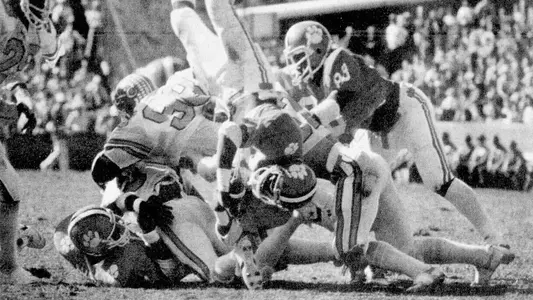
Time out on the field. Clemson ball at the 10 yard-line. Fourth down, 20 seconds to play. The Atlantic Coast Conference title on the line. Thousands of orange-clad Tiger fans are rollicking and rolling in Death Valley as the Tigers attempt to convert a mammoth fourth-quarter comeback. The Tar Heels lead, 24-19.
Tar Heel senior safety Steve Streater is in the middle of the defensive huddle, loud and animated. He's in his teammates' faces. He grabs a few face masks and punches some chests.
"These are our rings," Streater screams, looking every Tar Heel in the eye. "No one else is going to get them. Step up, strap it on. They are not going to get in the end zone. Do exactly what you are supposed to do and don't try to do anyone else's job."
The Tar Heels are 7-1 overall and are coming off a 41-7 loss the week before at Oklahoma. They are ranked No. 14 in the nation and are 3-0 in the ACC. They have Virginia and Duke left on the schedule and have already beaten Maryland, the second-place team in the league standings. A win at Clemson essentially would secure the league title for the Tar Heels at a time when Virginia and Duke posed no real threat (and Florida State was still a dozen years from entering the ACC).
"We got the dog beat out of us the week before at Oklahoma," says Dick Crum, the Tar Heel coach from 1978-87. "That was disappointing because we let that game get away from us in the second half. We pretty much embarrassed ourselves because that was not who we were. It took us a while to get the rust off at Clemson. But in the end, we made the plays we needed to make. We had some really good athletes on that team. There was nothing magical about it, those guys just played hard."
"There were only 11 people in that stadium who thought you guys would keep them out of the end zone," Greg Poole Sr. later told son his son, Greg Jr., a sophomore cornerback. "And those were the only ones who mattered."
Jordan takes the snap, rolls out to the left and away from Lawrence Taylor, who had just had a big third-down sack. Jordan is hurried by a six-man Tar Heel rush and throws wide to receiver Jerry Gaillard in the left corner of the end zone. The Tar Heels run the clock out and collect their fifth ACC title since the league's inception in 1953.
They have not won one since.
"Lord, what a team," Streater remembered years later. "I loved the fellas. That's what I called them, 'The fellas.' When we stepped on the field, everyone was on the same page. We'd knock your mouthpiece out. I called it 'cow-pasture football,' just a bunch of guys out having fun."
The most famous statistic from those 1980 ACC champion Tar Heels was the fact that both Amos Lawrence and Kelvin Bryant rushed for more than 1,000 yards. Lawrence, a senior, collected 1,118 yards on 4.9 yards per carry. Bryant, a sophomore, tallied 1,039 yards on 5.9 yards per carry.
But here are two fascinating but more obscure kernels about that team:
* Through their first seven games of the season, the first-team defense allowed exactly one touchdown.
* In that pivotal Clemson game, quarterback Rod Elkins threw the ball eight times. He completed four for 27 yards. Many modern-era quarterbacks like Sam Howell and Drake Maye had just cleared their throats with eight throws in the first quarter.
"We won with defense and played smash-mouth football on offense," Elkins says today. "That was the right formula for that team. That was our identity. We had great linemen, great running backs. There was no need to do anything fancy."
The 1980 team was Crum's third Carolina edition after taking over from Bill Dooley following the 1977 season. Seven offensive starters and seven on defense returned from a team that was riding a crest of a 17-15 win over Michigan in the 1979 Gator Bowl. The starting offense featured future NFL players in linemen Ron Wooten, Rick Donnalley and David Dreschler, tight end Shelton Robinson and tailback Lawrence. Bryant wasn't a bad backup tailback. The No. 1 defense included end Calvin Daniels, tackle Donnell Thompson, nose guard Paul Davis and, of course, "LT," all of whom would go on to multi-year professional careers. Streater would have been a successful punter in the NFL and perhaps a safety as well if not for his tragic automobile accident in the summer of 1981 that left him in a wheelchair for life.
They were top-heavy with seniors, with 23 on the roster.
"We'd just line up and beat people," said Walter Sturdivant, a senior fullback. "There was nothing fancy about us. We had great senior leadership, and we were focused on winning the ACC championship and playing for the national championship.
"To this day, I think that team should have played Georgia in the Sugar Bowl."
Carolina ripped through seven games and climbed to No. 6 in the Associated Press rankings. The offense was productive and efficient, though short on fireworks.
The defense was dominating.
Furman scored two field goals and a long fumble return for a touchdown.
Texas Tech had one field goal.
Maryland had one field goal.
Georgia Tech was whitewashed.
Wake Forest had a field goal and a late-game TD against the reserves.
N.C. State scored a late-game TD against the reserves.
East Carolina scored one field goal.
"Our defense shut people down," says Elkins. "We had so much talent over there. There was not a single weakness on our defense."
The defense was built around Taylor, the linebacker who had burst on the scene a year earlier with a scary combination of speed, strength and ferocity. He shed some blockers like straw men. He pancaked others. He pounced on quarterbacks in the blink of an eye. He'd pound your fanny and run his mouth at the same time.
"I saw something from 'LT' I'd never seen before," defensive coordinator Denny Marcin said. "We were playing at Texas Tech that year, defending the option. He goes down the line, checks the fullback, who didn't have the ball. So then he goes to the quarterback, who does have it. He hits the quarterback, causes a fumble and then recovers the fumble. We called it 'The Trifecta.'"
The Tar Heels were primed for a Nov. 1 visit to Oklahoma and hoped they were catching the Sooners in an off year. Barry Switzer's team had lost twice and was ranked No. 16. Carolina played OU close for a half, trailing only 14-7 at intermission and letting two scoring threats dissolve. Tight end Mike Chatham, normally sure-handed enough to have snared eight TDs as a junior, suffered a concussion that no one knew about and dropped a TD pass. Elkins threw an interception. The Sooners, with quarterback J.C. Watts running the Wishbone offense, exploded in the second half. They scored three touchdowns in the third quarter while the Tar Heel offense had the ball for six snaps total.
"One minute it was 14-7 and the next minute it was 34-7," Taylor said. "Everything went wrong that could go wrong."
Sturdivant remembers finishing a block and having his Sooner opponent help him up, all the while laughing.
"I said, 'Hey, what's so funny?'" Sturdivant says. "He said, 'Man, this is just not your day. We're not this good.'"
Oklahoma collected a 41-7 victory and sent the Tar Heels back to the ACC.
"The good news is, no one got hurt," Crum said. "Our only serious injury is a bruised ego."
The Tar Heels rebounded the following week in Clemson's Death Valley for a 12:30 regional TV appearance. The defense limited Clemson to two Obed Ariri field goals in the first half, and with Lawrence and Bryant each gaining more than 100 yards, Carolina took a commanding 24-6 lead into the fourth quarter. The Tigers found a spark in the fourth quarter, scoring two TDs to cut the margin to 24-19. They were forced to punt with just over three minutes to play, but a short, low punt took a nasty bounce and hit Tar Heel Rocky White. The "fumble" was recovered by the Tigers at the Tar Heel 38 with 3:18 to play.
Clemson drove to the 1 yard-line with less than two minutes to play. Twice the Tigers pounded the middle for no gain. Then they tried a play-action pass and Taylor was unblocked and nailed Jordan for a nine-yard loss.
"The guard forgot to pull, and I had a clean shot at the quarterback," Taylor said.
That set the last-minute fireworks.
"Steve Streater got in our faces and said, 'They are not going to score. We're the ACC champs,'" Taylor said. "That got our confidence back and everyone got fired up. Sometimes you need something like that."
The Tar Heels held firm in the red zone, and it was a fun return trip to Chapel Hill. They finished their business with a 26-3 win over Virginia and a 44-21 rout of Duke, then were ranked No. 13 when they bounced Texas 16-7 in the Bluebonnet Bowl in Houston. Georgia beat Notre Dame in the Sugar Bowl and won the national title.
"Think about this," Crum says. "Texas beat Oklahoma that year. Then Oklahoma beat us. Then we beat Texas in the bowl game."
Those early 1980s Carolina teams caught the eye of a young linebackers coach with the New York Giants. Bill Belichick wound up coaching Taylor, who was drafted by the Giants in 1981, and linebacker Darrell Nicholson, who followed in 1982. Taylor would be the cornerstone of those defenses coordinated by Belichick that would win two Super Bowls.
"That 1980 team gave up 120 points on defense, and nearly half of that was to Oklahoma," Belichick said upon taking the Carolina coaching job in December 2024. "We knew and scouted all those great players—L.T., Buddy Curry, Donnell Thompson, Paul Davis. They had a great team. We're very respectful of what this program has done before. I have a lot of pride in this program and will do everything I can to get it back to that level."
Chapel Hill writer Lee Pace (Carolina '79) has been writing about Tar Heel football under the "Extra Points" banner since 1990 and reporting from the sidelines on radio broadcasts since 2004. Write him at leepace7@gmail.com and follow him @LeePaceTweet.
Tar Heel senior safety Steve Streater is in the middle of the defensive huddle, loud and animated. He's in his teammates' faces. He grabs a few face masks and punches some chests.
"These are our rings," Streater screams, looking every Tar Heel in the eye. "No one else is going to get them. Step up, strap it on. They are not going to get in the end zone. Do exactly what you are supposed to do and don't try to do anyone else's job."
The Tar Heels are 7-1 overall and are coming off a 41-7 loss the week before at Oklahoma. They are ranked No. 14 in the nation and are 3-0 in the ACC. They have Virginia and Duke left on the schedule and have already beaten Maryland, the second-place team in the league standings. A win at Clemson essentially would secure the league title for the Tar Heels at a time when Virginia and Duke posed no real threat (and Florida State was still a dozen years from entering the ACC).
"We got the dog beat out of us the week before at Oklahoma," says Dick Crum, the Tar Heel coach from 1978-87. "That was disappointing because we let that game get away from us in the second half. We pretty much embarrassed ourselves because that was not who we were. It took us a while to get the rust off at Clemson. But in the end, we made the plays we needed to make. We had some really good athletes on that team. There was nothing magical about it, those guys just played hard."
"There were only 11 people in that stadium who thought you guys would keep them out of the end zone," Greg Poole Sr. later told son his son, Greg Jr., a sophomore cornerback. "And those were the only ones who mattered."
Jordan takes the snap, rolls out to the left and away from Lawrence Taylor, who had just had a big third-down sack. Jordan is hurried by a six-man Tar Heel rush and throws wide to receiver Jerry Gaillard in the left corner of the end zone. The Tar Heels run the clock out and collect their fifth ACC title since the league's inception in 1953.
They have not won one since.
"Lord, what a team," Streater remembered years later. "I loved the fellas. That's what I called them, 'The fellas.' When we stepped on the field, everyone was on the same page. We'd knock your mouthpiece out. I called it 'cow-pasture football,' just a bunch of guys out having fun."
***
The most famous statistic from those 1980 ACC champion Tar Heels was the fact that both Amos Lawrence and Kelvin Bryant rushed for more than 1,000 yards. Lawrence, a senior, collected 1,118 yards on 4.9 yards per carry. Bryant, a sophomore, tallied 1,039 yards on 5.9 yards per carry.
But here are two fascinating but more obscure kernels about that team:
* Through their first seven games of the season, the first-team defense allowed exactly one touchdown.
* In that pivotal Clemson game, quarterback Rod Elkins threw the ball eight times. He completed four for 27 yards. Many modern-era quarterbacks like Sam Howell and Drake Maye had just cleared their throats with eight throws in the first quarter.
"We won with defense and played smash-mouth football on offense," Elkins says today. "That was the right formula for that team. That was our identity. We had great linemen, great running backs. There was no need to do anything fancy."
The 1980 team was Crum's third Carolina edition after taking over from Bill Dooley following the 1977 season. Seven offensive starters and seven on defense returned from a team that was riding a crest of a 17-15 win over Michigan in the 1979 Gator Bowl. The starting offense featured future NFL players in linemen Ron Wooten, Rick Donnalley and David Dreschler, tight end Shelton Robinson and tailback Lawrence. Bryant wasn't a bad backup tailback. The No. 1 defense included end Calvin Daniels, tackle Donnell Thompson, nose guard Paul Davis and, of course, "LT," all of whom would go on to multi-year professional careers. Streater would have been a successful punter in the NFL and perhaps a safety as well if not for his tragic automobile accident in the summer of 1981 that left him in a wheelchair for life.
They were top-heavy with seniors, with 23 on the roster.
"We'd just line up and beat people," said Walter Sturdivant, a senior fullback. "There was nothing fancy about us. We had great senior leadership, and we were focused on winning the ACC championship and playing for the national championship.
"To this day, I think that team should have played Georgia in the Sugar Bowl."
Carolina ripped through seven games and climbed to No. 6 in the Associated Press rankings. The offense was productive and efficient, though short on fireworks.
The defense was dominating.
Furman scored two field goals and a long fumble return for a touchdown.
Texas Tech had one field goal.
Maryland had one field goal.
Georgia Tech was whitewashed.
Wake Forest had a field goal and a late-game TD against the reserves.
N.C. State scored a late-game TD against the reserves.
East Carolina scored one field goal.
"Our defense shut people down," says Elkins. "We had so much talent over there. There was not a single weakness on our defense."
The defense was built around Taylor, the linebacker who had burst on the scene a year earlier with a scary combination of speed, strength and ferocity. He shed some blockers like straw men. He pancaked others. He pounced on quarterbacks in the blink of an eye. He'd pound your fanny and run his mouth at the same time.
"I saw something from 'LT' I'd never seen before," defensive coordinator Denny Marcin said. "We were playing at Texas Tech that year, defending the option. He goes down the line, checks the fullback, who didn't have the ball. So then he goes to the quarterback, who does have it. He hits the quarterback, causes a fumble and then recovers the fumble. We called it 'The Trifecta.'"
The Tar Heels were primed for a Nov. 1 visit to Oklahoma and hoped they were catching the Sooners in an off year. Barry Switzer's team had lost twice and was ranked No. 16. Carolina played OU close for a half, trailing only 14-7 at intermission and letting two scoring threats dissolve. Tight end Mike Chatham, normally sure-handed enough to have snared eight TDs as a junior, suffered a concussion that no one knew about and dropped a TD pass. Elkins threw an interception. The Sooners, with quarterback J.C. Watts running the Wishbone offense, exploded in the second half. They scored three touchdowns in the third quarter while the Tar Heel offense had the ball for six snaps total.
"One minute it was 14-7 and the next minute it was 34-7," Taylor said. "Everything went wrong that could go wrong."
Sturdivant remembers finishing a block and having his Sooner opponent help him up, all the while laughing.
"I said, 'Hey, what's so funny?'" Sturdivant says. "He said, 'Man, this is just not your day. We're not this good.'"
Oklahoma collected a 41-7 victory and sent the Tar Heels back to the ACC.
"The good news is, no one got hurt," Crum said. "Our only serious injury is a bruised ego."
The Tar Heels rebounded the following week in Clemson's Death Valley for a 12:30 regional TV appearance. The defense limited Clemson to two Obed Ariri field goals in the first half, and with Lawrence and Bryant each gaining more than 100 yards, Carolina took a commanding 24-6 lead into the fourth quarter. The Tigers found a spark in the fourth quarter, scoring two TDs to cut the margin to 24-19. They were forced to punt with just over three minutes to play, but a short, low punt took a nasty bounce and hit Tar Heel Rocky White. The "fumble" was recovered by the Tigers at the Tar Heel 38 with 3:18 to play.
Clemson drove to the 1 yard-line with less than two minutes to play. Twice the Tigers pounded the middle for no gain. Then they tried a play-action pass and Taylor was unblocked and nailed Jordan for a nine-yard loss.
"The guard forgot to pull, and I had a clean shot at the quarterback," Taylor said.
That set the last-minute fireworks.
"Steve Streater got in our faces and said, 'They are not going to score. We're the ACC champs,'" Taylor said. "That got our confidence back and everyone got fired up. Sometimes you need something like that."
The Tar Heels held firm in the red zone, and it was a fun return trip to Chapel Hill. They finished their business with a 26-3 win over Virginia and a 44-21 rout of Duke, then were ranked No. 13 when they bounced Texas 16-7 in the Bluebonnet Bowl in Houston. Georgia beat Notre Dame in the Sugar Bowl and won the national title.
"Think about this," Crum says. "Texas beat Oklahoma that year. Then Oklahoma beat us. Then we beat Texas in the bowl game."
Those early 1980s Carolina teams caught the eye of a young linebackers coach with the New York Giants. Bill Belichick wound up coaching Taylor, who was drafted by the Giants in 1981, and linebacker Darrell Nicholson, who followed in 1982. Taylor would be the cornerstone of those defenses coordinated by Belichick that would win two Super Bowls.
"That 1980 team gave up 120 points on defense, and nearly half of that was to Oklahoma," Belichick said upon taking the Carolina coaching job in December 2024. "We knew and scouted all those great players—L.T., Buddy Curry, Donnell Thompson, Paul Davis. They had a great team. We're very respectful of what this program has done before. I have a lot of pride in this program and will do everything I can to get it back to that level."
Chapel Hill writer Lee Pace (Carolina '79) has been writing about Tar Heel football under the "Extra Points" banner since 1990 and reporting from the sidelines on radio broadcasts since 2004. Write him at leepace7@gmail.com and follow him @LeePaceTweet.

Wednesday, October 07
Wednesday, October 07
Wednesday, October 07
Wednesday, October 07