


University of North Carolina Athletics
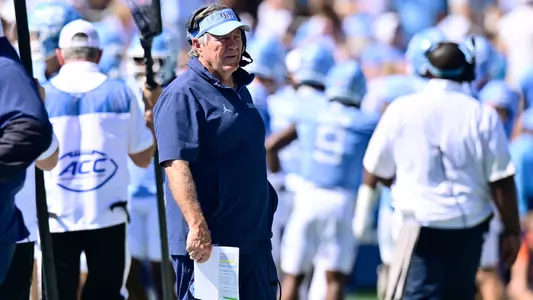
Photo by: JEROME IBRAHIM
Belichick Named Finalist For Pro Football Hall Of Fame’s Class Of 2026
December 3, 2025 | Football
CANTON, Ohio (Pro Football Hall of Fame) – Five individuals have reached the Finalist stage across three categories for possible election to the Pro Football Hall of Fame's Class of 2026.
Moving within one step of inclusion in the next class of enshrinees are Robert Kraft (Contributor), Bill Belichick (Coach), and Ken Anderson, Roger Craig and L.C. Greenwood (Seniors). The remaining bar to clear: approval from at least 80% of the members of the full Selection Committee at their annual meeting next year in advance of the class unveiling during Super Bowl LX week in San Francisco.
For the second year, the Finalists from these categories within the selection process are competing directly against each other under bylaws the Pro Football Hall of Fame's Board of Directors approved in 2024. The revision to the process helps ensure the exclusivity of inclusion in the game's most elite fraternity.
Each member of the Selection Committee may vote for only three of these five Finalists. With the bylaws revision, a maximum of three of this year's Finalists can be elected. If none of the five individuals receives 80% approval, then the individual who receives the most support would be elected to the Class of 2026.
Contributor Finalist (1): Robert Kraft
Kraft, the owner, chairman and CEO of the New England Patriots since 1994, has seen his teams win six Super Bowls and play in four others. Those 10 Super Bowl appearances are three more than any other owner in NFL history, an achievement magnified when considering the once dire straits of the club. In 1994, Kraft not only paid a record amount at the time ($172 million) to purchase a professional sports franchise to keep the Patriots from moving to St. Louis, but he also financed the construction of Gillette Stadium privately to give the franchise a permanent home. Every home game has been sold out since he bought the team, and the franchise now is valued at $9.25 billion. Kraft has served on 17 owners committees, including the broadcast/media committee since 1997, which he has chaired for the past 18 years.
The other eight Semifinalists in the Contributor category this year were K.S. "Bud" Adams, Roone Arledge, Ralph Hay, Frank "Bucko" Kilroy, Art Rooney Jr., Clark Shaughnessy, Seymour Siwoff and Buddy Young.
Coach Finalist (1): Bill Belichick
Belichick began his nearly five-decade career in the NFL as a special assistant with the Baltimore Colts in 1975. After winning two Super Bowl rings as an assistant coach with the New York Giants (1986, 1990), he took his first head coaching job with the Cleveland Browns (1991-95). In 2000, he succeeded Pete Carroll in New England and in his second season led the Patriots to the first of their six Super Bowl victories over an 18-season span. Belichick finished his head coaching career with an overall record of 333-178 – second only to Hall of Famer DON SHULA'S 347 career NFL victories – and won 31 of 44 games (.705) in the playoffs. Among his numerous accolades, Belichick is a member of the NFL 100 All-Time Team.
The eight other Semifinalists in the Coach category this year were Tom Coughlin, Mike Holmgren, Chuck Knox, Buddy Parker, Dan Reeves, Marty Schottenheimer, George Seifert and Mike Shanahan.
Seniors Finalists (3): Ken Anderson, Roger Craig, L.C. Greenwood
Anderson, a third-round draft choice (67th player overall) from tiny Augustana (Ill.) College in the 1971 NFL Draft, started four games at quarterback for the Cincinnati Bengals as a rookie before becoming their full-time starter in his second season. He played exclusively for the Bengals, 192 games overall through the 1986 season, and finished his career with four Pro Bowl nods, a League MVP award for the 1981 season and 32,838 passing yards with 197 passing touchdowns.
Craig might be best-known as the first player in the National Football League to total 1,000 yards rushing and receiving in the same season (1985), a feat matched by only two other players in the following 40 seasons (Hall of Famer MARSHALL FAULK and Christian McCaffrey). Craig won three Super Bowls with the San Francisco 49ers, where he spent eight seasons before a year with the Los Angeles Raiders and two with the Minnesota Vikings. For his career, he totaled 13,100 yards from scrimmage and scored 73 touchdowns. He was named the league's Offensive Player of the Year in 1988, when he also finished third in MVP voting.
Greenwood, a member of the famous "Steel Curtain" defensive units in the 1970s, played his entire 170-game career over 13 seasons with the Pittsburgh Steelers. Drafted in the 10th round (pick 238 overall) in the 1969 NFL Draft out of Arkansas-Pine Bluff, Greenwood won four Super Bowl rings, was named a first-team All-Pro defensive end twice and was selected to play in six Pro Bowls. He was credited with 78 sacks (an unofficial stat during his playing career) and 14 fumble recoveries.
Also advancing to the Semifinalist stage in the Seniors category were Henry Ellard, Joe Jacoby, Eddie Meador, Stanley Morgan, Steve Tasker and Otis Taylor. Players in this group last could have appeared in a professional game in the 2000 season.
Modern-Era Players
Reduction voting also has been occurring for Modern-Era Players – those whose career ended after the 2001 season – with this category currently in the Semifinalist stage.
The 26 players still under consideration for the Class of 2026 are: quarterbacks Drew Brees, Eli Manning and Philip Rivers; running backs Frank Gore and Fred Taylor; wide receivers Larry Fitzgerald, Torry Holt, Steve Smith Sr., Hines Ward and Reggie Wayne; tight end Jason Witten; offensive linemen Willie Anderson, Lomas Brown, Jahri Evans, Richmond Webb, Steve Wisniewski and Marshal Yanda; defensive backs Rodney Harrison, Earl Thomas and Darren Woodson; linebackers Luke Kuechly and Terrell Suggs (also DE); defensive linemen Robert Mathis (also LB), Vince Wilfork and Kevin Williams; and kicker Adam Vinatieri.
Selectors will reduce the number to 15 Finalists, with those names announced later this month through the Hall of Fame and on NFL Network.
When the Selection Committee meets to choose the Class of 2026, a minimum of three and a maximum of five Modern-Era Players will comprise the new class along with the Finalists (one, two or three) from the pool of Coach/Contributor/Seniors candidates.
While there is no set number for any class of enshrinees, the Hall of Fame's selection process bylaws stipulate that between four and eight new members shall be selected.
This year's voting will be completed with oversight from the firm Ernst & Young LLP, a Hall partner since 2019. EY's Agreed-Upon Procedures include validating the completeness of the ballots and tabulating the ballots in accordance with the bylaws established by the Hall of Fame's Board of Directors.
The Pro Football Hall of Fame's Class of 2026 will be announced Feb. 5 during the "NFL Honors" show at the Palace of Fine Arts in San Francisco and enshrined Aug. 8 in Canton.
Moving within one step of inclusion in the next class of enshrinees are Robert Kraft (Contributor), Bill Belichick (Coach), and Ken Anderson, Roger Craig and L.C. Greenwood (Seniors). The remaining bar to clear: approval from at least 80% of the members of the full Selection Committee at their annual meeting next year in advance of the class unveiling during Super Bowl LX week in San Francisco.
For the second year, the Finalists from these categories within the selection process are competing directly against each other under bylaws the Pro Football Hall of Fame's Board of Directors approved in 2024. The revision to the process helps ensure the exclusivity of inclusion in the game's most elite fraternity.
Each member of the Selection Committee may vote for only three of these five Finalists. With the bylaws revision, a maximum of three of this year's Finalists can be elected. If none of the five individuals receives 80% approval, then the individual who receives the most support would be elected to the Class of 2026.
Contributor Finalist (1): Robert Kraft
Kraft, the owner, chairman and CEO of the New England Patriots since 1994, has seen his teams win six Super Bowls and play in four others. Those 10 Super Bowl appearances are three more than any other owner in NFL history, an achievement magnified when considering the once dire straits of the club. In 1994, Kraft not only paid a record amount at the time ($172 million) to purchase a professional sports franchise to keep the Patriots from moving to St. Louis, but he also financed the construction of Gillette Stadium privately to give the franchise a permanent home. Every home game has been sold out since he bought the team, and the franchise now is valued at $9.25 billion. Kraft has served on 17 owners committees, including the broadcast/media committee since 1997, which he has chaired for the past 18 years.
The other eight Semifinalists in the Contributor category this year were K.S. "Bud" Adams, Roone Arledge, Ralph Hay, Frank "Bucko" Kilroy, Art Rooney Jr., Clark Shaughnessy, Seymour Siwoff and Buddy Young.
Coach Finalist (1): Bill Belichick
Belichick began his nearly five-decade career in the NFL as a special assistant with the Baltimore Colts in 1975. After winning two Super Bowl rings as an assistant coach with the New York Giants (1986, 1990), he took his first head coaching job with the Cleveland Browns (1991-95). In 2000, he succeeded Pete Carroll in New England and in his second season led the Patriots to the first of their six Super Bowl victories over an 18-season span. Belichick finished his head coaching career with an overall record of 333-178 – second only to Hall of Famer DON SHULA'S 347 career NFL victories – and won 31 of 44 games (.705) in the playoffs. Among his numerous accolades, Belichick is a member of the NFL 100 All-Time Team.
The eight other Semifinalists in the Coach category this year were Tom Coughlin, Mike Holmgren, Chuck Knox, Buddy Parker, Dan Reeves, Marty Schottenheimer, George Seifert and Mike Shanahan.
Seniors Finalists (3): Ken Anderson, Roger Craig, L.C. Greenwood
Anderson, a third-round draft choice (67th player overall) from tiny Augustana (Ill.) College in the 1971 NFL Draft, started four games at quarterback for the Cincinnati Bengals as a rookie before becoming their full-time starter in his second season. He played exclusively for the Bengals, 192 games overall through the 1986 season, and finished his career with four Pro Bowl nods, a League MVP award for the 1981 season and 32,838 passing yards with 197 passing touchdowns.
Craig might be best-known as the first player in the National Football League to total 1,000 yards rushing and receiving in the same season (1985), a feat matched by only two other players in the following 40 seasons (Hall of Famer MARSHALL FAULK and Christian McCaffrey). Craig won three Super Bowls with the San Francisco 49ers, where he spent eight seasons before a year with the Los Angeles Raiders and two with the Minnesota Vikings. For his career, he totaled 13,100 yards from scrimmage and scored 73 touchdowns. He was named the league's Offensive Player of the Year in 1988, when he also finished third in MVP voting.
Greenwood, a member of the famous "Steel Curtain" defensive units in the 1970s, played his entire 170-game career over 13 seasons with the Pittsburgh Steelers. Drafted in the 10th round (pick 238 overall) in the 1969 NFL Draft out of Arkansas-Pine Bluff, Greenwood won four Super Bowl rings, was named a first-team All-Pro defensive end twice and was selected to play in six Pro Bowls. He was credited with 78 sacks (an unofficial stat during his playing career) and 14 fumble recoveries.
Also advancing to the Semifinalist stage in the Seniors category were Henry Ellard, Joe Jacoby, Eddie Meador, Stanley Morgan, Steve Tasker and Otis Taylor. Players in this group last could have appeared in a professional game in the 2000 season.
Modern-Era Players
Reduction voting also has been occurring for Modern-Era Players – those whose career ended after the 2001 season – with this category currently in the Semifinalist stage.
The 26 players still under consideration for the Class of 2026 are: quarterbacks Drew Brees, Eli Manning and Philip Rivers; running backs Frank Gore and Fred Taylor; wide receivers Larry Fitzgerald, Torry Holt, Steve Smith Sr., Hines Ward and Reggie Wayne; tight end Jason Witten; offensive linemen Willie Anderson, Lomas Brown, Jahri Evans, Richmond Webb, Steve Wisniewski and Marshal Yanda; defensive backs Rodney Harrison, Earl Thomas and Darren Woodson; linebackers Luke Kuechly and Terrell Suggs (also DE); defensive linemen Robert Mathis (also LB), Vince Wilfork and Kevin Williams; and kicker Adam Vinatieri.
Selectors will reduce the number to 15 Finalists, with those names announced later this month through the Hall of Fame and on NFL Network.
When the Selection Committee meets to choose the Class of 2026, a minimum of three and a maximum of five Modern-Era Players will comprise the new class along with the Finalists (one, two or three) from the pool of Coach/Contributor/Seniors candidates.
While there is no set number for any class of enshrinees, the Hall of Fame's selection process bylaws stipulate that between four and eight new members shall be selected.
This year's voting will be completed with oversight from the firm Ernst & Young LLP, a Hall partner since 2019. EY's Agreed-Upon Procedures include validating the completeness of the ballots and tabulating the ballots in accordance with the bylaws established by the Hall of Fame's Board of Directors.
The Pro Football Hall of Fame's Class of 2026 will be announced Feb. 5 during the "NFL Honors" show at the Palace of Fine Arts in San Francisco and enshrined Aug. 8 in Canton.


Wednesday, October 14
Tuesday, October 13
Monday, October 12
Monday, October 12